
This post contains affiliate links. If you buy through our links, we may earn a commission at no extra cost to you.
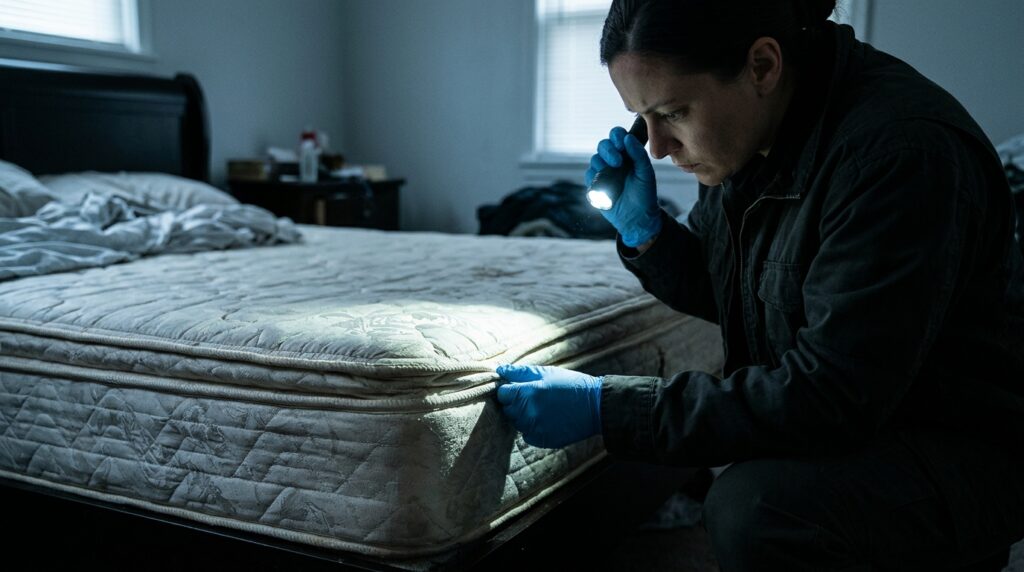
You woke up with itchy welts. Or you spotted a dark stain on your sheet that wasn’t there before. Or someone mentioned that the hotel you just stayed in had a bed bug report. Now you’re wondering: do I actually have bed bugs?
The signs of bed bugs are specific and identifiable — this isn’t a situation where you have to guess. Within 20 minutes of a focused inspection, you can confirm or rule out an active infestation. The key is knowing exactly what to look for and exactly where to look.
This guide covers the 7 signs of bed bugs that indicate an active infestation, how to distinguish bed bug bites from other insect bites, and the step-by-step inspection method that pest control professionals use.
Quick answer:
The most reliable signs of bed bugs are: (1) live bugs or shed skins in mattress seams and furniture joints, (2) dark reddish-brown fecal staining on mattress seams, sheets, or walls, and (3) blood spots on sheets from crushed bugs. Bites alone are not a reliable indicator — about 30% of people show no reaction to bed bug bites, and bite patterns from bed bugs are indistinguishable from other insect bites without additional evidence. Always confirm with a physical inspection before treating.
The 7 Signs of Bed Bugs to Look For
Sign 1: Live bed bugs
The most definitive sign. Adult bed bugs are flat, oval, reddish-brown, and about the size of an apple seed (4–5mm). They’re visible to the naked eye but expert at hiding — you won’t find them crawling across the bed in daylight. Look for them in the folds and seams of your mattress, in the joints of your bed frame, behind the headboard, and inside nightstand drawers. Use a flashlight and a credit card to probe seams. If you find even one live bug, you have an active infestation.
Sign 2: Fecal staining (dark spots)
Bed bug feces are dark reddish-brown to black, about the size of a pen tip dot, and appear in clusters. Unlike dirt or other stains, bed bug fecal stains bleed into fabric like a felt-tip marker — they have a slightly fuzzy edge rather than a sharp border. You’ll find them in mattress seams, along the piping of the mattress, on the box spring fabric, on baseboards near the bed, and sometimes on walls behind the headboard. A cluster of these dots in a mattress seam is a strong indicator of active or recent infestation.
Sign 3: Blood spots on sheets
Small reddish-brown spots on your sheets or pillowcase — typically smaller than a pencil eraser — are caused by rolling over and crushing a recently-fed bed bug during sleep. They look similar to fecal stains but are more uniformly red and appear on the sleep surface rather than concentrated in seams. Blood spots on sheets combined with fecal staining on the mattress seam is one of the most common sign combinations in confirmed bed bug infestations.
Sign 4: Shed exoskeletons (molted skins)
Bed bugs shed their exoskeleton five times as they progress through nymph stages to adulthood. These translucent, hollow shells — called cast skins or molts — accumulate in harborage sites and don’t break down quickly. They’re the same shape as a live bed bug but pale yellow and empty. Finding multiple shed skins in a mattress seam or bed frame joint indicates an established population that’s been present for weeks or months, not a recent introduction.
Sign 5: Eggs and egg shells
Bed bug eggs are white, about 1mm long, and shaped like a tiny grain of rice. They’re laid in clutches of 1–5 and glued to surfaces with a sticky secretion, making them hard to dislodge. You’ll find them in the same harborage sites as adults and nymphs: mattress seams, bed frame joints, behind headboards. Empty egg shells (slightly flattened and open at one end) confirm that eggs have already hatched — meaning the infestation is actively reproducing. Eggs are easiest to spot with magnification.
Sign 6: A sweet, musty odor
A significant bed bug infestation produces a distinctive smell — often described as sweet and musty, similar to overripe raspberries or coriander. This odor comes from the bugs’ scent glands and from accumulated fecal matter. It’s not present in early or light infestations — you need a substantial population for the smell to be noticeable. If you’ve entered a room and immediately noticed an unusual sweet-musty smell you can’t explain, add it to the evidence checklist alongside a physical inspection.
Sign 7: Bites on your skin
Bed bug bites appear as small, red, itchy welts — often in a line, curve, or cluster of 3 on exposed skin (arms, shoulders, neck, legs). They appear hours to days after being bitten. However, bites alone cannot confirm bed bugs for two reasons: (1) about 30% of people don’t react to bed bug bites at all, and (2) the bite pattern is indistinguishable from mosquito, flea, mite, or allergic reaction without additional evidence. Treat bites as a trigger for inspection, not confirmation. Only a physical inspection can confirm or rule out bed bugs.
Bed Bug Bites vs. Other Insect Bites
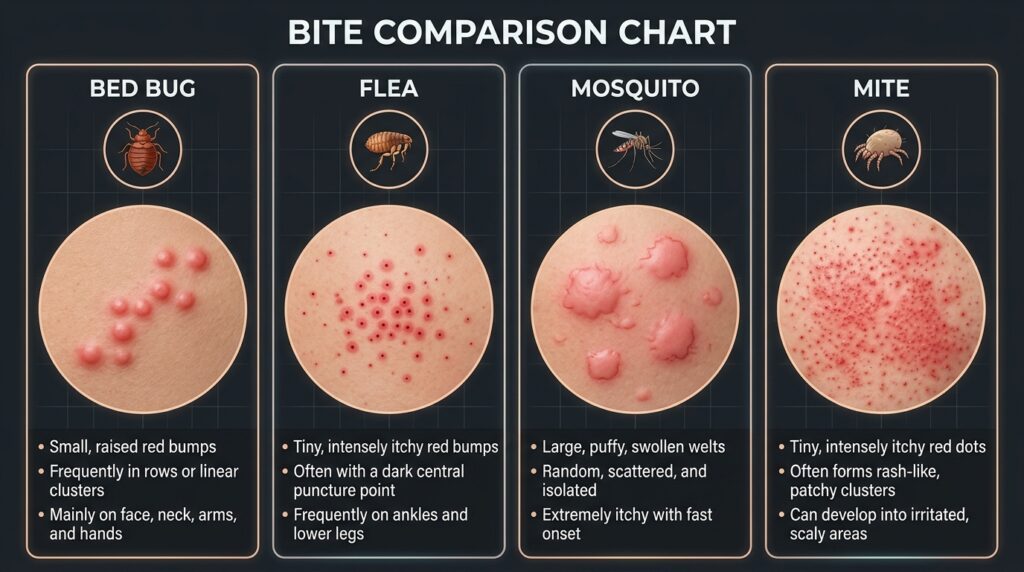
Since bites alone can’t confirm bed bugs, knowing how to compare them helps narrow down the cause:
Bed bug bites
Small red welts, flat or slightly raised, intensely itchy. Often in a line or zigzag of 3 (“breakfast, lunch, dinner” pattern). Appear on exposed skin during sleep — arms, neck, shoulders, lower legs. Usually noticed in the morning. Take 1–3 days to appear in some people; immediate in others.
Flea bites
Also small and intensely itchy, but almost always concentrated on ankles and lower legs — fleas jump from floor level. If your bites are only on your lower legs and you have pets, fleas are a more likely explanation than bed bugs. Flea bites often have a red halo around a central puncture point.
Mosquito bites
Larger, rounder welts that appear immediately after being bitten. Not concentrated on one body area or in patterns. If you’re getting bites during the day or when you’re awake, it’s not bed bugs — bed bugs feed almost exclusively between midnight and 5 AM.
Mite bites (bird or rodent mites)
Intensely itchy, widespread, random distribution across the body. Often appear after a bird nest or rodent nest is disturbed near the home. Unlike bed bug bites, mite bites are often in large numbers (dozens) distributed everywhere rather than in clusters of 3–5.
The rule:
If bites are concentrated on exposed skin during sleep, appear in clusters or rows of 3, and you can’t identify another insect source — inspect your mattress before assuming it’s something else.
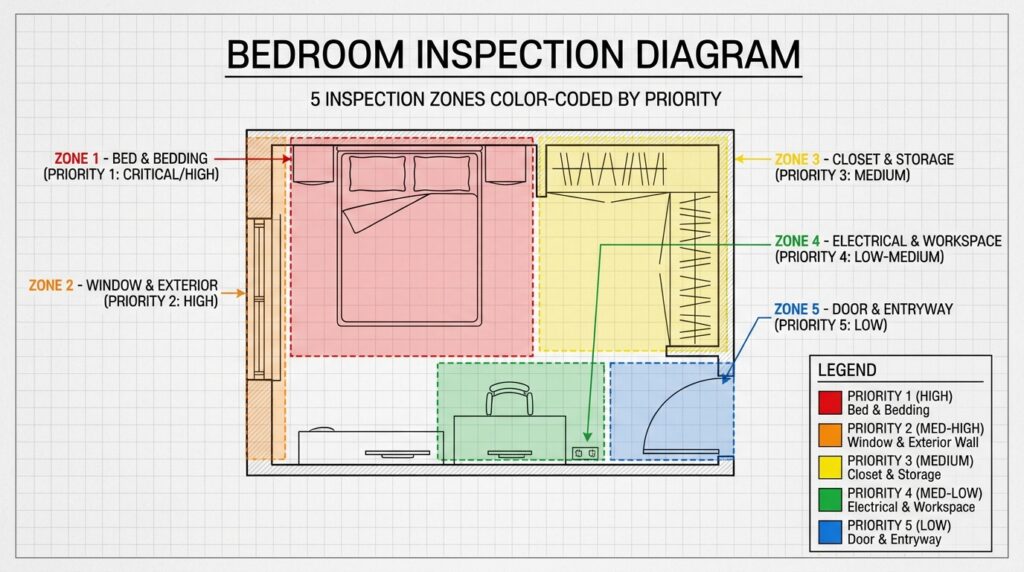
How to Inspect Your Bedroom for Bed Bugs
A professional-level inspection takes 20–30 minutes and requires only a flashlight and a flat card (credit card or playing card) to probe seams. Work in this order — most likely harborage sites first:
Zone 1: Mattress (5 minutes)
Strip all bedding down to the bare mattress. Run your flashlight along every seam, fold, and the area around the label. Use the card to press into deep seams and dislodge anything hiding in the fold. Check both sides of the mattress. Look for: live bugs, shed skins, dark fecal dots, eggs, or blood staining. Pay extra attention to corners where the seam meets the flat surface.
Zone 2: Box spring (5 minutes)
The box spring is often more heavily infested than the mattress. Remove the dust cover from the bottom (the thin fabric stapled to the underside of the box spring) and inspect the interior with your flashlight. Bed bugs frequently establish colonies inside the wooden frame of the box spring, in the recessed corners, and along any cardboard inserts. This is the inspection step most homeowners skip — don’t.
Zone 3: Bed frame and headboard (5 minutes)
Disassemble the bed frame as much as possible. Every joint, screw hole, crack, and hollow section is a potential harborage site. For headboards: inspect front, back, all joints, and — if it’s mounted to the wall — the gap between the headboard and the wall. Upholstered headboards are particularly challenging: probe along the seams and tufting with your card. Bed bugs congregate in upholstered headboard seams more than almost anywhere else in the room.
Zone 4: Nearby furniture (5 minutes)
Check any furniture within 6–8 feet of the sleeping area: nightstands (open drawers, check the joints and the back panel), dressers (especially the lowest drawer and where the back panel meets the frame), and any upholstered chairs or ottomans. Bed bugs don’t stay on the bed — they spread to any furniture close to where their host sleeps.
Zone 5: Baseboards and walls (5 minutes)
In heavier infestations, bed bugs move to the walls. Inspect baseboards along the wall behind the bed with your flashlight at a low angle — fecal staining along baseboards shows up clearly this way. Check behind any pictures or mirrors on the bedroom walls. Loose wallpaper or peeling paint near the bed are signs of a significant infestation that’s spread beyond the furniture.
Tools That Help With Inspection
Beyond a flashlight and card, two tools make inspection more reliable:
Bed bug interceptors
ClimbUp interceptors placed under each bed leg trap bugs attempting to climb up to or down from the bed. After 48–72 hours, any catches confirm active infestation and tell you which side of the bed has more activity. They’re also the most reliable ongoing monitoring tool during and after treatment.
Amazon: ClimbUp Bed Bug Interceptors
Bed bug detection spray
Some pest control professionals use a chemical spray that causes bed bugs to emerge from harborage — this is more useful for professional confirmation than DIY inspection. For home use, a good flashlight combined with a systematic zone-by-zone inspection is sufficient.
What to Do If You Find Signs of Bed Bugs
Don’t panic, and don’t immediately throw out your mattress — that rarely solves the problem and wastes money. The infestation is in the room, not just the mattress.
- Confirm: find at least one of the physical signs above (live bug, shed skin, fecal staining, eggs) before starting treatment
- Don’t move furniture or bedding to other rooms — this spreads the infestation
- Don’t sleep in a different room — bed bugs will follow their host
- Start treatment immediately: see our complete guide on how to get rid of bed bugs for the step-by-step protocol
The sooner you start treatment after confirming signs of bed bugs, the smaller the population you’re dealing with and the faster the resolution.

Frequently Asked Questions
Can you have bed bugs without seeing bites?
Yes — and this is common. About 30% of people show no visible reaction to bed bug bites. If you share a bed with someone and they have bites while you don’t, that doesn’t rule out bed bugs. Similarly, if you suspect an infestation but aren’t getting bites, it doesn’t mean you’re clear. Always confirm or rule out bed bugs with a physical inspection, not by absence of bites.
What do bed bug stains look like on a white mattress?
On white fabric, bed bug fecal stains appear as dark reddish-brown to black dots, roughly the size of a pen tip. They bleed into the fabric with slightly blurry edges — not sharp like ink. Fresh stains may still be slightly reddish; older stains turn darker brown to black. A cluster of these dots concentrated in a seam or along the piping is the classic presentation. Blood spots from crushed bugs are more uniformly red and appear on the flat sleeping surface rather than only in seams.
How soon do signs of bed bugs appear after infestation?
Physical signs (fecal staining, shed skins) can appear within 2–3 weeks of introduction. A single fertilized female introduced to a bedroom starts laying 5–7 eggs per day. Within 3–4 weeks, first-generation nymphs are present and beginning to feed. The infestation becomes visually detectable in mattress seams around weeks 3–6 depending on conditions. This is why early inspection after potential exposure (returning from travel, buying second-hand furniture) matters — catching it at 20 bugs is far easier than at 200.
Do bed bugs only stay in the bedroom?
No — but the bedroom is where they concentrate because that’s where their host sleeps. In light infestations, virtually all bugs are within 6–8 feet of the bed. In moderate infestations, they spread to other bedroom furniture. In severe, long-standing infestations, they move to living room furniture, couches, and even behind electrical outlets throughout the home. If you find signs in multiple rooms, the infestation has been present and untreated for months.
Can I use a bed bug detection dog?
Canine bed bug detection is a legitimate and accurate method — trained dogs can detect live bugs and viable eggs with accuracy above 95% in controlled conditions. It’s worth the cost ($200–$400 per inspection) when you have a strong suspicion but can’t visually confirm, when you’re inspecting a large property with many rooms, or when you want to confirm that treatment has been fully effective. For a single bedroom with visible signs, a DIY inspection is sufficient.
Confirm First, Then Act
The signs of bed bugs are specific enough that a careful inspection almost always gives a definitive answer — yes or no. Waking up with unexplained bites is a reason to inspect, not a reason to panic or immediately call an exterminator. Most people who do a thorough zone-by-zone inspection either find the evidence they need to start treatment confidently, or rule out bed bugs entirely and look for another explanation.
If your inspection confirms an active infestation, our guide on how to get rid of bed bugs walks through the complete treatment protocol — encasements, residual spray, diatomaceous earth, and the timeline to expect. For protecting your mattress going forward, our bed bug mattress cover roundup covers the best encasements at every price point.