
This post contains affiliate links. If you buy through our links, we may earn a commission at no extra cost to you.
Some spider repellents kill. Some just keep spiders from building webs. Some barely do anything. Here’s an honest breakdown of what works, what doesn’t, and when to use each.
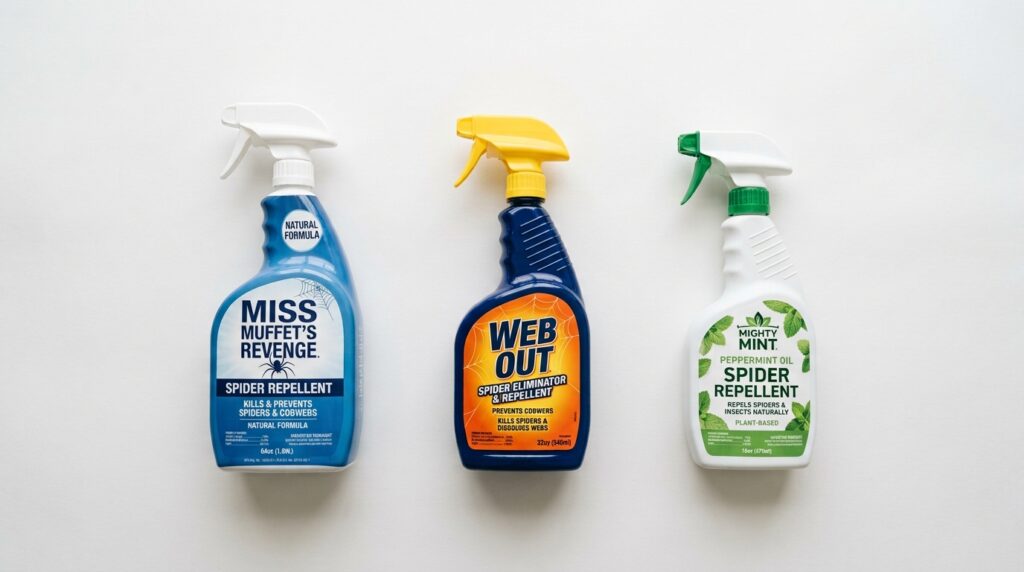
Spider repellents fall into two categories that most people don’t distinguish: products that kill spiders on contact (and leave a residual that kills or deters new arrivals), and products that repel spiders from building webs in treated areas without necessarily killing them. Understanding which you need changes what you buy.
For active infestations with visible spiders, you want a contact killer with residual. For maintenance — keeping spiders out of areas you’ve already treated — you want a web repellent or natural deterrent. Most households need both at different stages.
Quick answer: Miss Muffet’s Revenge is the best all-around spider spray for most homes — kills on contact, repels for up to 12 months. Web Out is the best web repellent for keeping cleared areas clean. Mighty Mint peppermint spray is the best natural option for kitchens and food prep areas.
⭐ Our Top Pick:
Miss Muffet’s Revenge Spider Killer — ready-to-use, long wand applicator for corners and tight spaces, kills on contact with up to 12-month residual claim. Best overall spider spray for indoor and outdoor use.
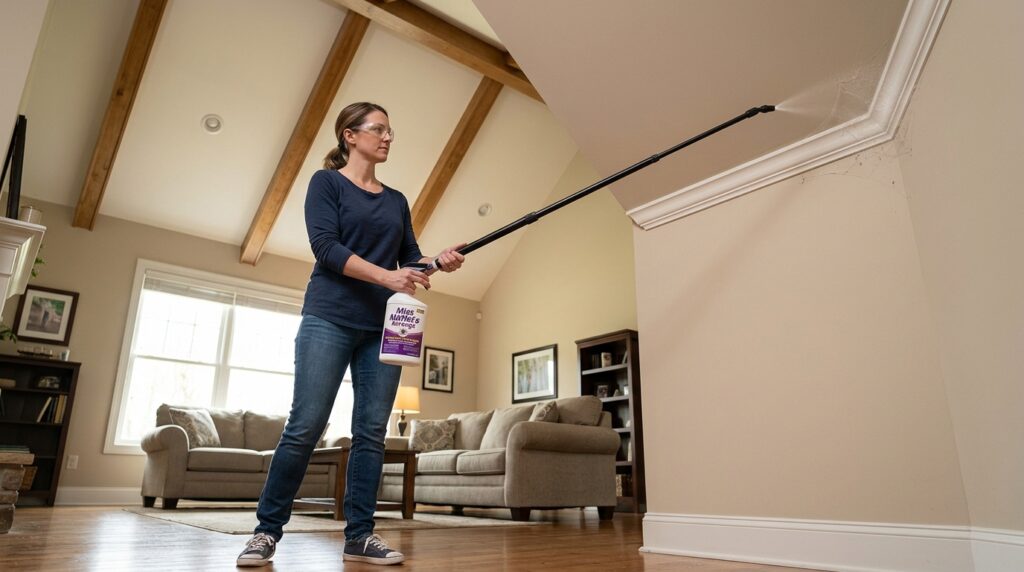
Contact Killers with Residual: Best for Active Infestations
These products kill spiders on contact and leave a residual film on treated surfaces that continues killing spiders that walk across them. Use these when you have an active spider population to reduce.
Miss Muffet’s Revenge Spider Killer — Best Overall
The most popular spider-specific spray on the market for good reason. Ready-to-use formula with a wand applicator that extends for reaching corners, ceiling joints, and under furniture without a ladder. Active ingredient: bifenthrin, a synthetic pyrethroid.
Best for: Indoor perimeter treatment, basements, garages, crawlspaces, and any area with active spider webs
Apply to: Baseboards, window frames, door frames, corners, and areas where webs have appeared
Residual claim: Up to 12 months indoors — one of the longest claims of any consumer spider product
Safety: Keep pets and children off treated surfaces until dry (about 30 minutes). Safe for use near food preparation areas once dry.
Ortho Home Defense Insect Killer — Best for Whole-Home Perimeter
Broad-spectrum insecticide that kills spiders, ants, roaches, and 130+ other insects. Continuous spray wand makes application along baseboards fast and consistent. 12-month residual claim indoors.
Best for: Homeowners dealing with multiple pest types simultaneously — one product handles spiders plus other common household insects
Limitation: Not spider-specific — if you only have a spider problem, Miss Muffet’s Revenge is more targeted and cost-effective
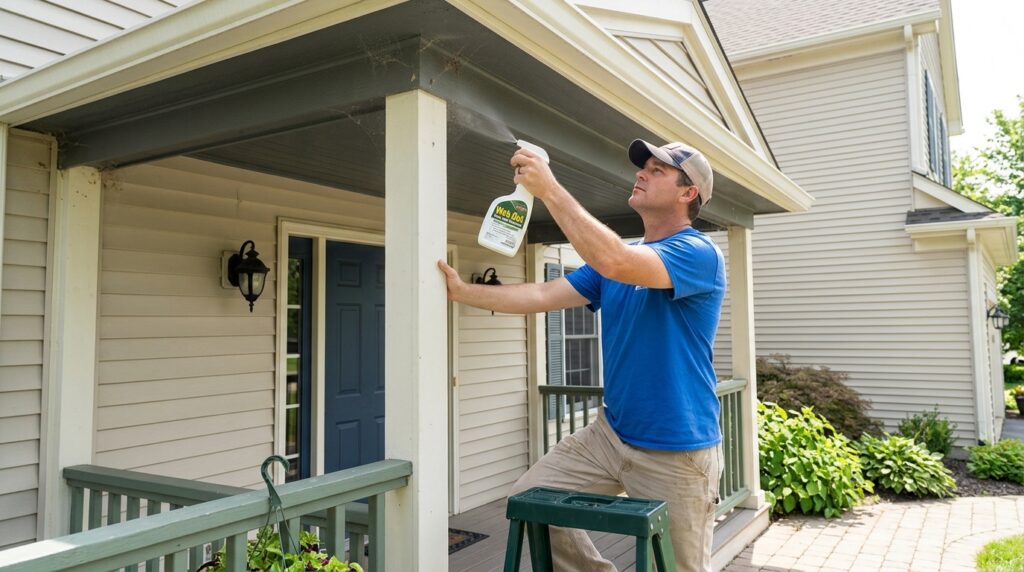
Web Repellents: Best for Maintenance After Treatment
Web repellents don’t necessarily kill spiders — they make surfaces inhospitable for web-building. Spiders rely on web attachment points; treated surfaces don’t hold web silk well, so spiders move on. Use these after clearing existing webs and applying a contact killer, to prevent reestablishment.
Web Out Spider Web Eliminator — Best Web Repellent
Specifically formulated to prevent spider webs from adhering to treated surfaces. Spray on walls, eaves, porch ceilings, corners, and any surface where spiders repeatedly rebuild. Safe for painted surfaces, vinyl siding, and most exterior materials.
Best for: Outdoor use on porch ceilings, garage walls, eaves, and window frames — anywhere spiders repeatedly rebuild webs
How to use: Remove existing webs first, then apply Web Out to the surface. Reapply every 3–4 months or when webs start appearing again
Limitation: Repels rather than kills — spiders move to untreated areas. Use alongside a contact killer for full population control
Natural Spider Repellents: Best for Kitchens and Food Areas
Natural repellents use plant-derived compounds that spiders detect through chemoreceptors on their legs. They’re less potent and shorter-lasting than synthetic options, but appropriate for food prep areas, homes with pets or small children, or anyone who prefers chemical-free solutions.
Mighty Mint Peppermint Oil Spider Repellent — Best Natural Option
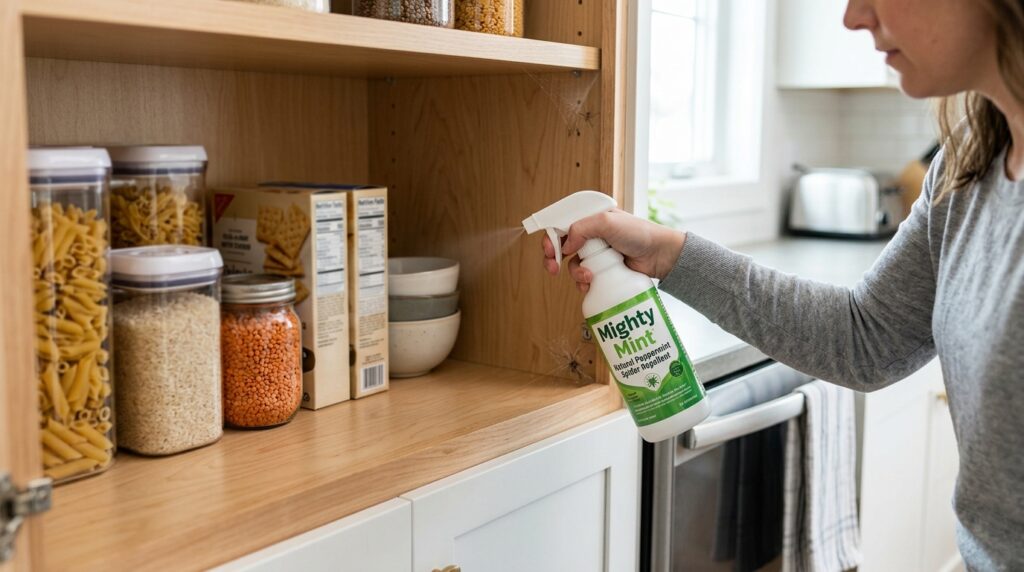
Peppermint oil has the strongest evidence base of any natural spider repellent. Lab studies show spiders actively avoid surfaces treated with peppermint oil. Mighty Mint uses a high concentration of peppermint oil in a water base — spray along baseboards, window sills, and entry points.
Best for: Kitchen cabinets, pantry areas, food prep surfaces, homes with pets or infants
Reapply: Every 2–4 weeks — peppermint oil evaporates faster than synthetic options, especially in ventilated areas
Bonus: Also deters ants, mice, and other pests that dislike strong mint scent
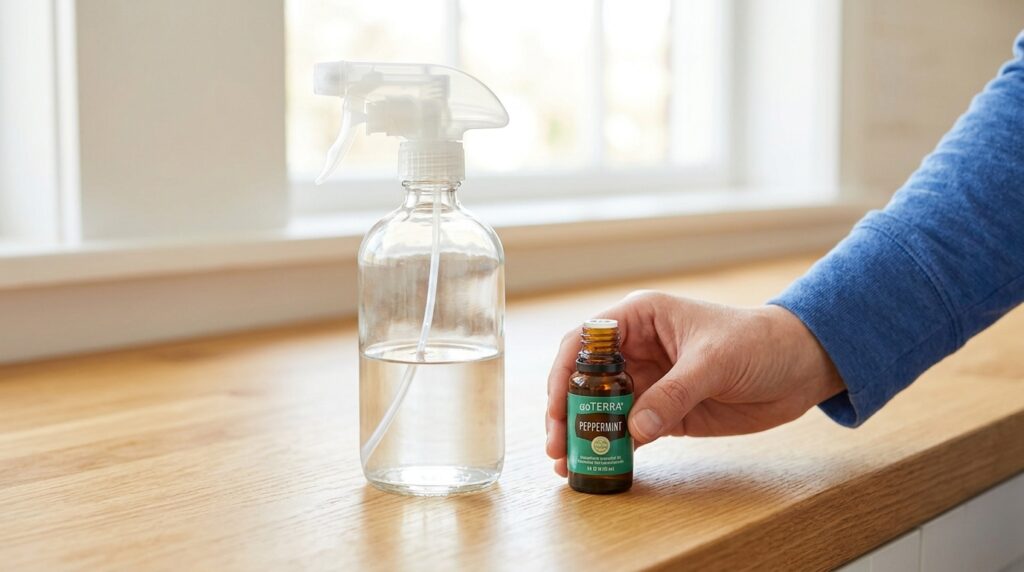
DIY Peppermint Oil Spray
Add 15–20 drops of pure peppermint essential oil to a 16 oz spray bottle of water. Shake before each use. Apply to baseboards, window sills, and corners. Less concentrated than commercial products but cost-effective for large areas.
What Doesn’t Work
Ultrasonic repellers: No peer-reviewed evidence of effectiveness against spiders. Spiders don’t rely primarily on hearing and are largely unaffected by ultrasonic frequencies.
Cedar chips and blocks: Mild deterrent at best. Cedar oil in concentrated form has repellent properties, but cedar wood chips or blocks don’t release enough oil vapor to meaningfully deter spiders.
Chestnuts (horse chestnuts): A persistent folk remedy with no scientific support. Chestnuts contain no compound known to repel spiders.
Which Product for Your Situation
Active spider problem indoors: Miss Muffet’s Revenge — kill the current population first
Multiple pest types (spiders + ants + roaches): Ortho Home Defense — one product covers all
Prevent webs on porch, eaves, garage: Web Out — after clearing existing webs
Kitchen, food areas, homes with young children: Mighty Mint peppermint spray
Budget-conscious natural option: DIY peppermint oil spray — 20 drops per 16 oz water
Avoid: Ultrasonic devices, cedar chips, chestnuts
Frequently Asked Questions
How long do spider repellents last?
Synthetic pyrethroid sprays (Miss Muffet’s Revenge, Ortho Home Defense) claim up to 12 months residual indoors — real-world results are typically 3–6 months depending on traffic and cleaning. Web Out lasts 3–4 months outdoors. Natural peppermint oil sprays last 2–4 weeks before evaporating and need more frequent reapplication.
Are spider repellent sprays safe for pets?
Pyrethroid sprays are toxic to cats when wet — cats groom themselves and can ingest residue. Keep cats off treated surfaces until completely dry (minimum 2 hours). Dogs are less sensitive to pyrethroids but should also stay off treated areas until dry. Natural peppermint sprays are generally safe around pets once dry, though cats dislike the scent.
Does vinegar repel spiders?
Acetic acid (vinegar) has some evidence of repelling spiders in high concentrations, but the smell dissipates within hours and the effect is inconsistent. It’s less effective than peppermint oil for natural spider repellency and requires much more frequent reapplication. If you prefer a natural option, peppermint oil is better supported by evidence.
Can I use spider spray in the kitchen?
Avoid applying pyrethroid sprays directly to food contact surfaces or open food areas. Apply to baseboards, the backs of cabinets, and under the sink — not to countertops or shelves where food sits. For food prep areas specifically, peppermint oil spray is the safer choice and can be applied more freely.
The Bottom Line
The most effective approach uses two products together: a contact killer with residual (Miss Muffet’s Revenge) to eliminate the current spider population, followed by a web repellent (Web Out) to prevent reestablishment. Add peppermint spray for kitchens and sensitive areas. Used consistently, this combination keeps spider populations low without constant retreatment.
Want to address the root cause? See our guide on how to get rid of spiders in your house — reducing the insects they feed on does more long-term than any repellent alone.