
This post contains affiliate links. If you buy through our links, we may earn a commission at no extra cost to you.
Not all roach killers work the same way. Here’s a straight comparison of gel baits, boric acid, sprays, IGRs, and traps — what each one does, what it doesn’t, and when to use it.
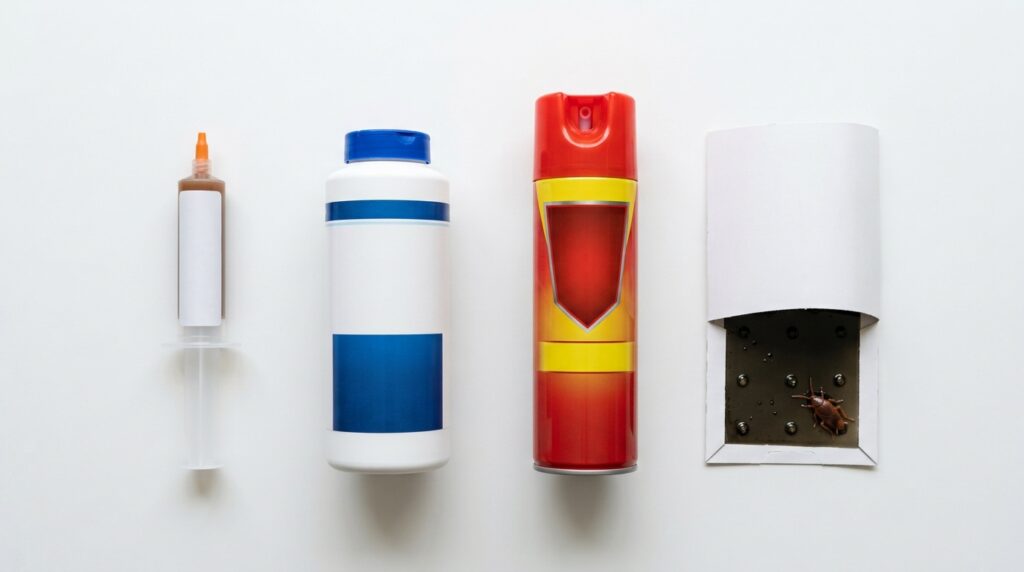
⭐ Editor’s Top Picks:
• Best overall: Advion Cockroach Gel Bait
• Best secondary layer: Harris Boric Acid Roach Powder
• Best IGR: Gentrol IGR Concentrate
• Best maintenance bait: Combat Max 12-Month Roach Killing Bait
Walk into any hardware store with a roach problem and you’ll find an entire aisle of products promising to kill cockroaches. Sprays, gels, bombs, traps, powders, baits. It’s overwhelming — and most of them don’t work the way you think they do.
Here’s the problem: cockroaches are not an above-the-surface pest. They live in harborage areas — inside cabinet walls, behind appliances, under dishwashers — that contact sprays can’t reach. Killing the roaches you see does nothing to the colony. That’s why most people spray, think the problem is solved, and see roaches again two weeks later.
This guide breaks down every major type of roach killer, explains the mechanism behind each one, and tells you exactly when to use it. No fluff.
Quick answer: Gel bait (Advion or Combat Max) is the most effective roach killer available to homeowners. It works through horizontal transfer — roaches eat it, return to the colony, die there, and other roaches consume them, spreading the kill through the entire population. Add boric acid in voids and an IGR to break the reproduction cycle. Use sprays only as a last resort, and never mix them with gel bait.
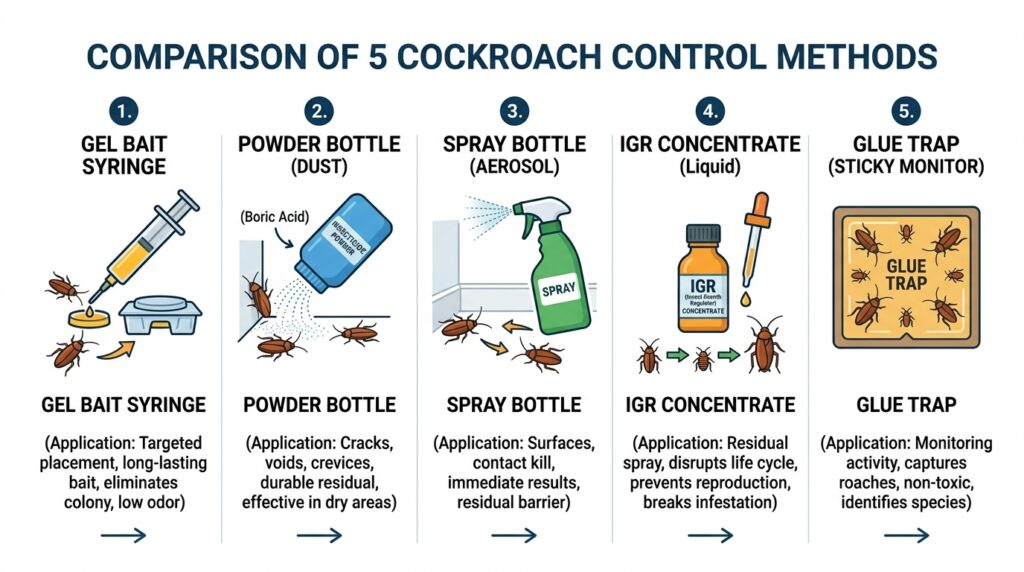
The 5 Types of Roach Killers: At a Glance
Before diving into each product type, here’s how they compare on the metrics that actually matter:
GEL BAIT
- How it works: Roaches eat it, die, infect colony through horizontal transfer
- Speed: Slow (3–14 days to see results)
- Colony reach: High — kills roaches you never see
- Best for: German cockroaches, active infestations
- Verdict: PRIMARY weapon — most effective DIY option
BORIC ACID
- How it works: Damages exoskeleton and gut on contact; roaches must walk through it
- Speed: Slow (3–10 days)
- Colony reach: Moderate — only kills roaches that walk through treated areas
- Best for: Void treatment, cabinet interiors, behind appliances
- Verdict: SECONDARY layer — excellent when gel bait can’t reach
IGR (INSECT GROWTH REGULATOR)
- How it works: Prevents nymphs from maturing into reproductive adults; disrupts egg viability
- Speed: Long-term effect (weeks to months)
- Colony reach: High — sterilizes the reproductive cycle
- Best for: Severe infestations, apartments, long-term prevention
- Verdict: CRITICAL add-on for large infestations — pair with gel bait
RESIDUAL SPRAY
- How it works: Contact kill + residual surface coating
- Speed: Fast contact kill
- Colony reach: Low — only kills exposed roaches
- Best for: Perimeter defense, sealing entry points
- Verdict: LIMITED effectiveness; repels roaches from gel bait if used in the same area
GLUE TRAPS
- How it works: Sticky surface captures roaches that cross it
- Speed: Immediate capture
- Colony reach: Very low — catches individuals only
- Best for: Monitoring activity levels, not elimination
- Verdict: MONITORING tool, not a treatment
1. Gel Bait — The Gold Standard
If you only buy one roach product, make it gel bait. Nothing else available to homeowners comes close to its effectiveness against an active infestation — especially German cockroaches.
How Gel Bait Works
Gel bait contains an attractant (food-grade ingredients that cockroaches seek out) mixed with a slow-acting insecticide — typically indoxacarb or fipronil. The slow kill is intentional.
A roach eats the bait and returns to harborage before dying. The corpse — and its droppings, which also contain active bait — is then consumed by other roaches. This “horizontal transfer” is how gel bait kills the egg-laying females deep inside the wall that you never see. Sprays kill the individuals in front of you. Gel bait kills the colony.
Best Gel Baits
Advion Cockroach Gel Bait — Best Overall
Advion uses indoxacarb, which targets insect-specific sodium channels and has minimal mammalian toxicity. It’s the same product professional exterminators use. The attractant formulation is exceptionally effective — cockroaches consistently prefer it over food sources in test environments.
- Best for: German cockroaches, heavy infestations, any situation where you need the strongest bait available
- Comes as: Syringe applicator (makes placement easy in tight spaces)
- Coverage: One 30g syringe treats a moderate infestation; buy 4 for a heavy kitchen infestation
- Rotation note: If you’ve used Advion for 2+ cycles without full resolution, switch to a different active ingredient — roaches can develop bait aversion
Combat Max 12-Month Roach Killing Bait — Best Maintenance Option
Combat Max uses fipronil and comes in pre-loaded bait stations — no syringe application required. It’s less potent than Advion for a severe infestation, but the stations are clean, easy to place, and last up to 12 months without replacement.
- Best for: Moderate infestations, maintenance after Advion treatment, apartments where you want a set-it-and-forget-it option
- Limitation: Bait stations are less flexible in placement than gel syringes — can’t place inside hinges or narrow voids
How to Apply Gel Bait Correctly
Most people apply too much bait in the wrong places. Here’s the correct approach:
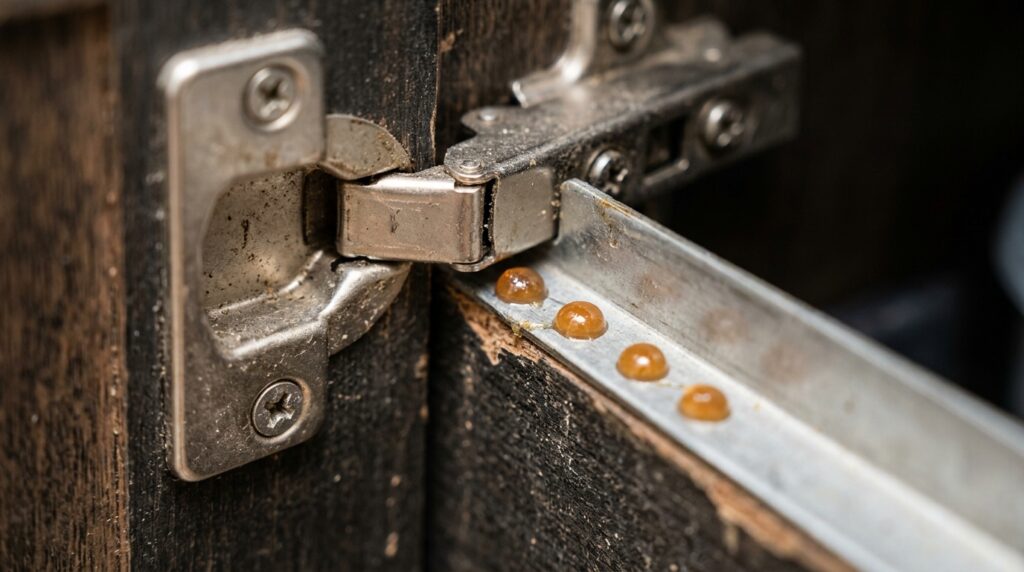
- Apply pea-sized dots (¼ inch) — NOT large globs. Roaches prefer small, fresh bait points over big dried-out ones
- Place every 6 inches along active travel routes and harborage areas
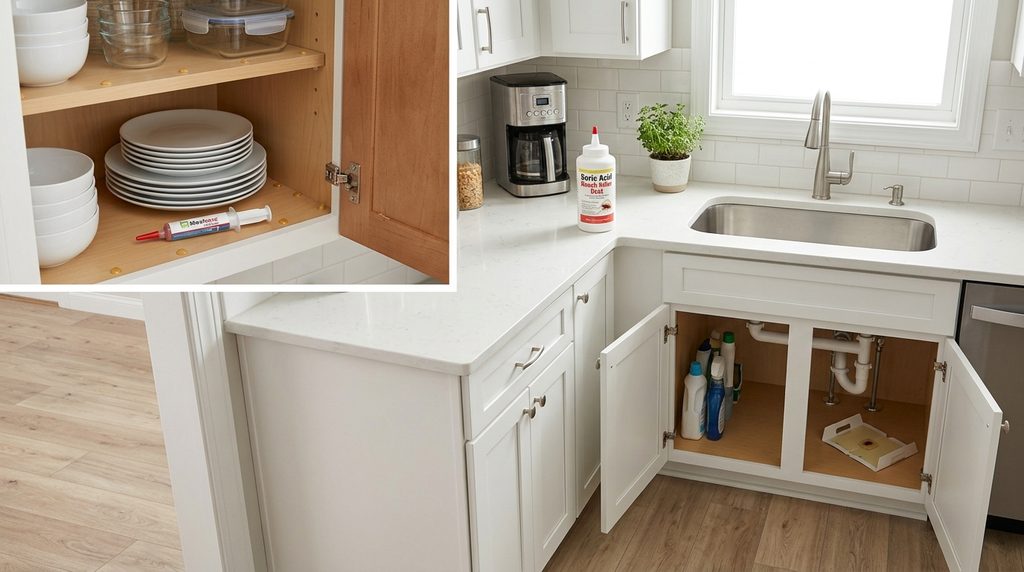
- Target: inside cabinet hinges, along the back wall of lower cabinets, under and behind the refrigerator and stove, around plumbing penetrations
- NEVER spray insecticide near gel bait — residual sprays repel roaches away from bait and kill the entire treatment strategy
- Replace bait every 3 months or when it dries out
2. Boric Acid — The Essential Secondary Layer
Boric acid has been used as a roach killer for over 50 years. It’s not glamorous, but it’s highly effective when applied correctly — and it reaches places gel bait can’t.
How Boric Acid Works
When a cockroach walks through boric acid powder, the particles cling to its legs and body. The roach grooms itself, ingesting the powder. Boric acid then damages the gut lining and disrupts nerve function. It’s a slow kill — 3 to 10 days — but it’s persistent. Properly applied boric acid in a dry location stays active for months.
The key word is “walk through.” Boric acid only kills roaches that physically cross the treated area. It doesn’t attract them — it doesn’t function like bait. This is why it works as a secondary layer in voids and enclosed spaces where roaches already travel, not as a standalone treatment in open areas.
Best Product
Harris Boric Acid Roach Powder
Harris is the standard for homeowner boric acid. It comes with a puffer applicator that lets you blow a thin layer into voids, which is exactly the application you need. The lure added version (Harris with lure) adds an attractant to draw roaches through the treated area — worth the slight price premium for heavy infestations.
Critical Application Rule: Thin Is Everything
This is where most people fail with boric acid. A heavy pile of powder repels roaches — they can see it and walk around it. The correct application is almost invisible: a very light dusting that coats the surface. If you can see a distinct pile, you’ve applied too much.
Where to apply:
- Inside the void space behind kitchen cabinets (remove kick plate to access)
- Behind the refrigerator motor — a thin line along the floor under the motor
- Inside electrical outlet and junction boxes (turn off breaker first)
- Under the dishwasher behind the motor housing
- Inside the void between the countertop and the wall (if accessible)
Where NOT to apply:
- Under sinks or anywhere with moisture — boric acid clumps and loses effectiveness when wet
- In open areas on countertops or floors — kids and pets can contact it
- Anywhere near the gel bait — unnecessary, and keeps the treatment areas conceptually clean
3. IGR (Insect Growth Regulator) — The Reproductive Shutdown
IGRs are the least-known roach control tool and arguably the most underutilized by homeowners. If you’re dealing with a heavy German cockroach infestation — or you live in an apartment with persistent re-infestation from neighboring units — an IGR changes the math entirely.
How IGRs Work
IGRs don’t kill adult cockroaches. Instead, they disrupt the juvenile hormone system that cockroach nymphs need to develop into reproductive adults. Nymphs exposed to IGR either die during molting, develop into sterile adults, or hatch from eggs that never develop properly.
The practical effect: within 60–90 days of IGR application, the reproductive capacity of the colony collapses. New nymphs can’t mature. The colony stops replacing itself. Combined with gel bait killing the existing adults, the infestation has no path to recovery.
Best Product
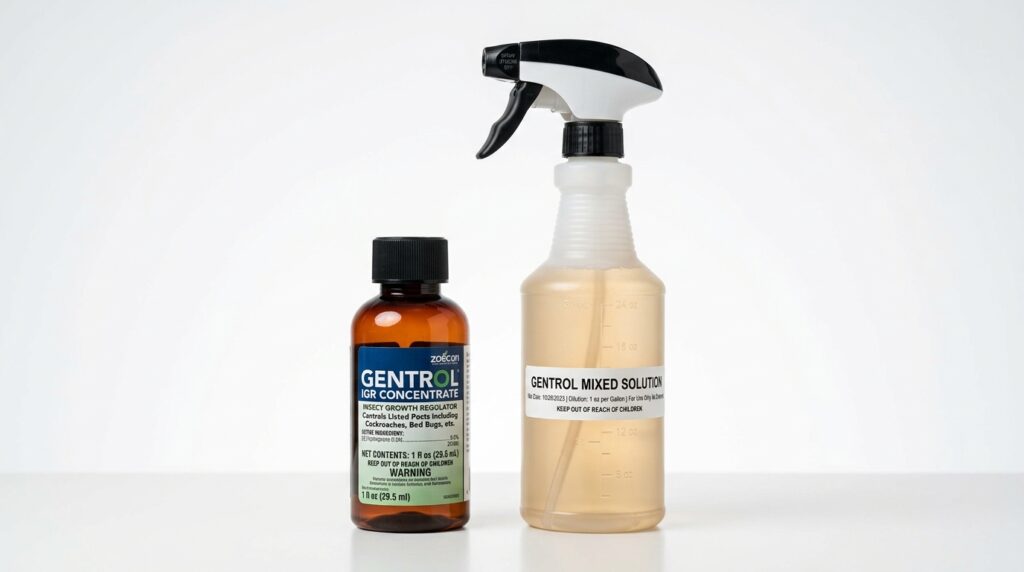
Gentrol uses (S)-hydroprene, the same active ingredient used by professional pest control companies. The concentrate is mixed with water and applied as a spray to harborage areas — inside cabinets, under appliances, around plumbing. It’s odorless, has very low mammalian toxicity, and remains active for 90+ days after application.
One 4oz bottle makes roughly 2–3 gallons of mixed solution — enough to treat an entire apartment. Apply every 90 days as part of a long-term management strategy.
When to add an IGR to your treatment:
- Heavy infestation (seeing roaches during daylight, large catch counts on sticky traps)
- Apartment situation where you’re fighting constant re-infestation from neighbors
- After initial gel bait treatment — as a second layer to prevent population rebound from surviving egg cases
4. Residual Sprays — When to Use Them (and When Not To)
Residual sprays are the most common roach product people reach for — and the most commonly misused. They have a role in a roach control program, but it’s a narrow one.
How Residual Sprays Work
Residual sprays leave a chemical coating on surfaces that kills insects that walk across them. Products like Ortho Home Defense use bifenthrin, a pyrethroid insecticide that affects insect nerve function on contact.
The problem with pyrethroids for cockroach control is that cockroaches can detect them. German cockroaches show repellency to pyrethroid-treated surfaces — they avoid them. This means spraying the kitchen interior drives roaches deeper into harborage rather than killing them. And if you spray near gel bait, the repellency effect makes roaches avoid the bait entirely. The two treatments cancel each other out.
When Sprays ARE Useful
Residual sprays work well for one specific purpose: perimeter defense against American cockroaches entering from outside.
- Apply along the exterior foundation, around door frames, and at window wells to create a barrier against large outdoor roaches entering
- Spray inside the garage along floor edges — American roaches often enter through the garage
- Treat floor drains as a barrier against sewer roaches coming up through the plumbing
Best option for this use: Ortho Home Defense Indoor & Outdoor Insect Killer
The Rule: Separate Sprays and Bait
Never apply residual spray in the same area as gel bait. If you’re running a gel bait treatment (which you should be), keep sprays to the perimeter — exterior foundation, door frames, basement floor edges. The kitchen interior is bait territory only.
5. Glue Traps — Your Monitoring System
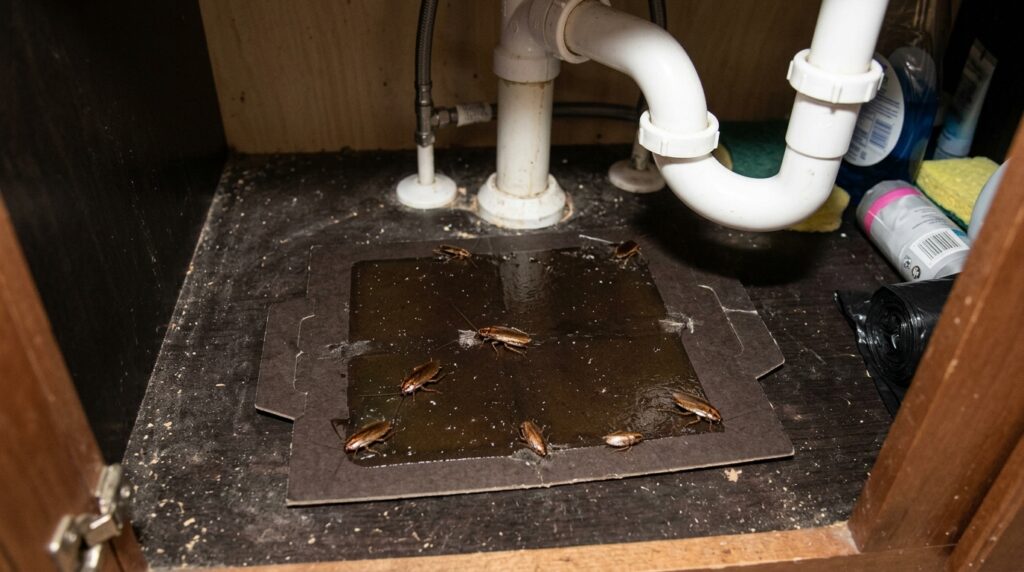
Glue traps (sticky monitors) are not a treatment — they will not eliminate a cockroach infestation on their own. But they’re invaluable as a monitoring tool, and most homeowners skip them entirely.
What Glue Traps Are Actually For
The number of roaches caught in a 24–48 hour period tells you more about your infestation than any visual sighting. One roach seen at night could be a lone forager. Twenty roaches caught overnight on a trap under the sink tells you exactly where the colony is centered.
Use glue traps to:
- Locate the primary harborage area (the trap with the most catches = where to concentrate gel bait)
- Monitor treatment progress (declining catch counts = gel bait is working)
- Detect activity after treatment ends (any catches weeks later = surviving colony or re-infestation)
Placement: Under the sink, behind the stove, under the refrigerator, and inside lower cabinets. Place 4–6 monitors and check after 24–48 hours.
What Doesn’t Work (And Why People Keep Buying It)
The pest control aisle includes several product categories that are, at best, a waste of money for serious infestations. At worst, they make the problem harder to treat.
Roach Bombs and Foggers
Foggers release a pesticide mist that settles on open surfaces — counters, floors, open shelving. Roaches live in enclosed harborage areas that foggers can’t penetrate. The mist doesn’t reach inside cabinet walls, behind the refrigerator motor, or under appliances. Worse: the sudden pesticide exposure drives roaches deeper into walls and can scatter a colony, spreading the infestation to new areas. Save the $12.
Ultrasonic Pest Repellers
No peer-reviewed evidence supports the effectiveness of ultrasonic devices against cockroaches. Multiple university extension studies have found them ineffective. Cockroaches are not meaningfully deterred by ultrasonic frequencies in real-world conditions.
Essential Oil Sprays
Peppermint oil and similar products can deter roaches from treated surfaces temporarily. They don’t kill roaches, don’t affect harborage areas, and wear off quickly. Not a treatment.
The Right Combination: How to Stack These Products
For most homeowners dealing with an active cockroach infestation, the optimal approach uses three products in parallel:
Phase 1: Active Infestation (Weeks 1–4)
- Gel bait (Advion) — primary weapon, placed at all harborage points
- Boric acid (Harris) — secondary layer in voids and enclosed spaces gel bait can’t reach
- Glue traps — monitor results and locate heaviest activity
Phase 2: Large Infestation or Apartment (Weeks 1–12)
- Everything in Phase 1, plus:
- IGR (Gentrol) — spray applied to harborage areas; breaks the reproductive cycle over 60–90 days
Phase 3: Perimeter Defense (Ongoing)
- Residual spray (Ortho Home Defense) — applied to exterior foundation and entry points only
- Combat Max bait stations — long-term maintenance bait to catch stragglers and prevent reinfestation
The key is sequencing: gel bait goes in first. Spray stays on the perimeter. IGR runs in parallel if the infestation is severe. Glue traps tell you if it’s working.
Frequently Asked Questions
How long does gel bait take to work?
Gel bait typically shows results in 3–7 days. You may see MORE roach activity in the first few days as bait draws them out of harborage — this is normal and means the bait is being consumed. Significant reduction in sightings usually happens by days 10–14. Complete elimination of a moderate infestation takes 3–6 weeks. Keep bait fresh and replace every 3 months.
Can I use gel bait and spray at the same time?
No — this is the most common mistake in DIY roach control. Pyrethroid sprays repel cockroaches from surfaces, including the surface where you placed gel bait. The repellency effect reduces bait consumption and can make the entire treatment fail. If you’ve recently sprayed, wait 2–3 weeks for the residual to break down before placing gel bait. Going forward, keep sprays to the exterior perimeter only.
Is Advion safe to use around kids and pets?
Advion’s active ingredient (indoxacarb) has low mammalian toxicity — it targets insect-specific sodium channels. When applied correctly in tiny dots inside cabinet hinges, appliance voids, and enclosed spaces, direct contact by children or pets is unlikely. As a general rule, apply bait in inaccessible areas (inside cabinet frameworks, behind appliances) rather than on open surfaces. Keep boric acid out of areas children and pets can reach.
What’s the difference between German and American cockroach treatment?
German cockroaches (small, tan, indoors) require intensive gel bait and IGR treatment — they breed fast and live entirely inside. American cockroaches (large, reddish-brown) primarily come from outside and respond better to perimeter spray barriers and sealing entry points. If you see large roaches occasionally near drains or doors, seal gaps and use perimeter spray. If you see small roaches in the kitchen regularly, lead with gel bait.
Final Thoughts
The roach control market is full of products that capitalize on urgency without delivering results. Foggers, ultrasonic devices, and sprays applied to kitchen interiors are the biggest offenders — they feel like action but don’t solve the problem.
The products that actually work operate on a different principle: reach the colony, not just the roaches you can see. Gel bait does this through horizontal transfer. Boric acid does this by treating the voids where roaches spend most of their lives. IGRs do this by collapsing the reproductive cycle over time.
Start with Advion gel bait placed correctly at harborage points. Add boric acid in voids. If the infestation is large, add Gentrol IGR. Monitor with sticky traps. That’s the system that works.
For more on applying these products in specific situations, see our guides on how to get rid of cockroaches in your home and how to get rid of German cockroaches in an apartment.