
This post contains affiliate links. If you buy through our links, we may earn a commission at no extra cost to you.
Most spiders in US homes are completely harmless — but two species aren’t. Here’s how to identify the 8 most common house spiders, tell the dangerous ones from the harmless ones, and know when (if ever) to be concerned.
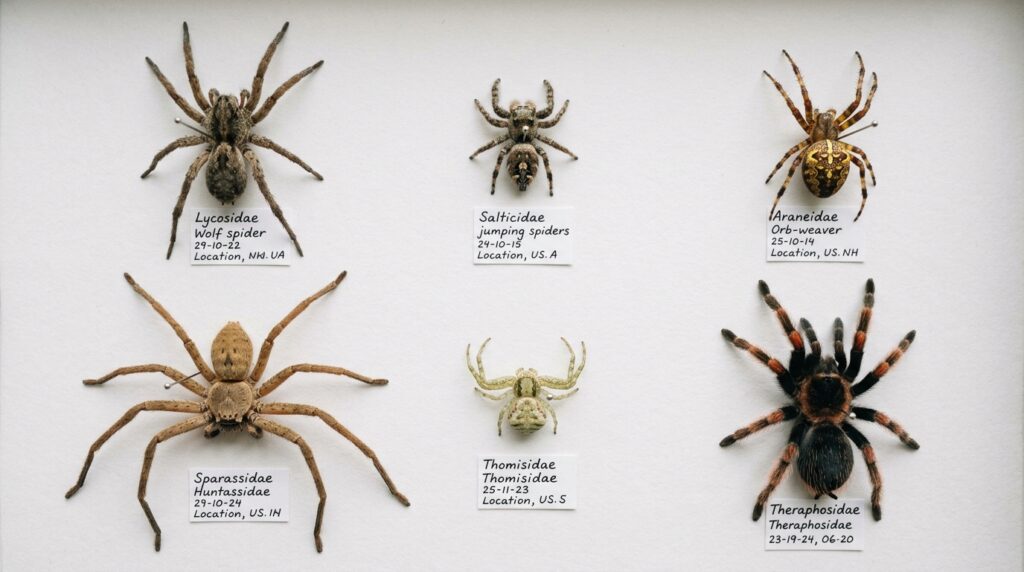
You found a spider. Maybe it was in the corner of the bathroom, crossing the basement floor, or dangling from the ceiling in your bedroom. The question most people ask first isn’t “how do I kill it” — it’s “what is it, and should I be worried?”
The honest answer: the vast majority of spiders you’ll find inside a US home are completely harmless. Out of the roughly 3,000 spider species native to North America, fewer than a dozen are considered medically significant. Two of those — the brown recluse and the black widow — get most of the attention, and for good reason. But they’re also the most frequently misidentified spiders in the country.
Quick answer:
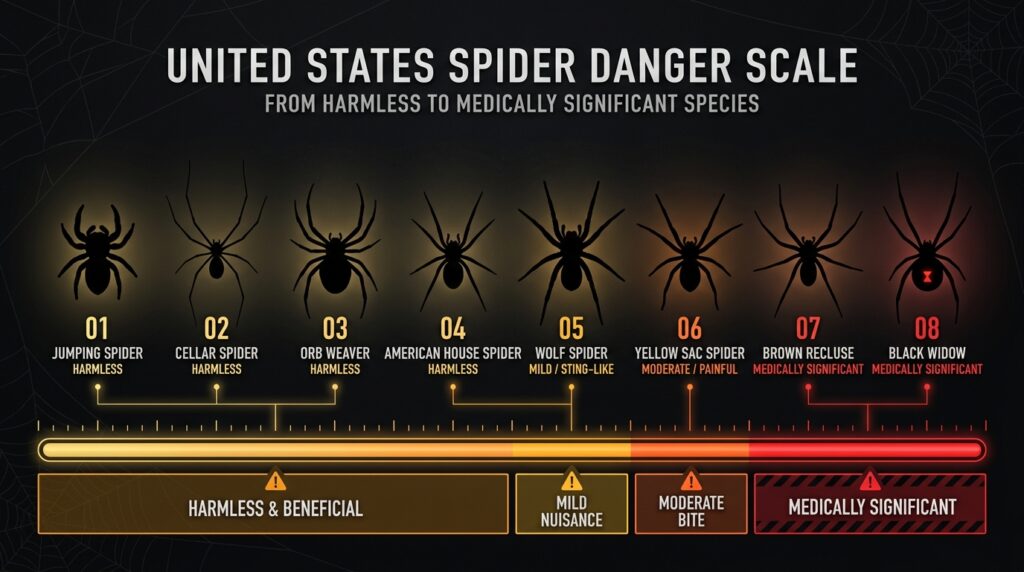
The 8 most common house spiders in the US are: common house spider, cellar spider, jumping spider, wolf spider, orb weaver, yellow sac spider, brown recluse, and black widow. The first five are completely harmless. Yellow sac spiders can cause mild irritation. Brown recluse and black widow are the two species worth serious attention — and both are identifiable once you know what to look for.
This guide covers each species with the identification markers that actually matter, where they’re found in the home, and what to do if you’re dealing with them.
1. Common House Spider (Parasteatoda tepidariorum)
What it looks like:
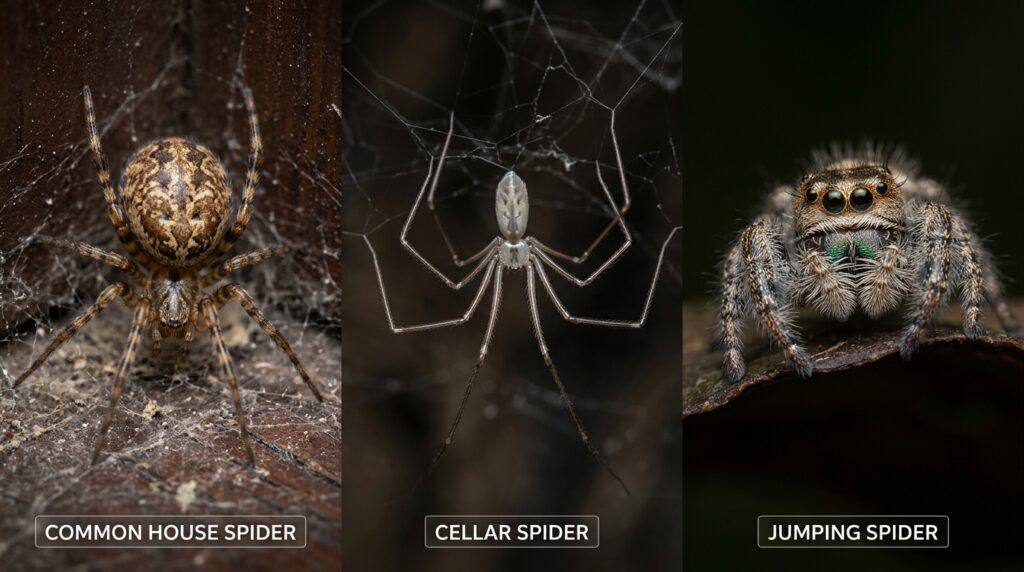
Small to medium — body about 3/16 inch (5mm), legs bring total to about 3/4 inch. Yellowish-brown to tan, often with dirty white or grayish markings on the abdomen. The abdomen is rounded, almost spherical. Legs are long relative to the body and often banded. Colors are variable and inconsistent — there’s no single marking to look for. The most reliable ID feature is the body shape: round abdomen on a small frame.
Where you’ll find it:
Ceiling corners, upper wall junctions, window frames, garage rafters, basement corners. Builds a tangled, irregular web — not a symmetrical orb. Webs often accumulate debris and old insect husks. Female tends to stay in or near her web. Common year-round, more active in fall.
Dangerous?
No. Venom is not medically significant. Even if it could bite a person (rare — they’re not aggressive), the effect would be minimal redness at most.
What to do:
Vacuum the web and spider with a hose attachment. No chemical treatment needed for isolated individuals. For persistent infestations, see our guide on getting rid of spiders.
2. Cellar Spider / Daddy Longlegs (Pholcus phalangioides)
What it looks like:
Unmistakable — extremely long, thin legs (often 2 inches leg-span or more) on a tiny pale body (about 1/4 inch). The body is often translucent tan or light gray. Holds its body close to the web and vibrates rapidly when disturbed — a defense behavior that makes it blur visually. Often confused with the harvestman (also called daddy longlegs), which is not a spider at all — it has no separate head/thorax and no venom glands.
Where you’ll find it:
Basements, crawl spaces, ceiling corners, behind furniture, in garages and sheds. Prefers undisturbed, low-traffic areas. Common in every US state year-round.
Dangerous?
No. The common myth that cellar spiders are “the most venomous spider but can’t bite humans” is false. Their venom is weak and their fangs are small, but they are physically capable of biting humans. They simply never do. No recorded medically significant bites.
What to do:
Vacuum the web. No further action needed unless you want to reduce their population — they eat other insects and are harmless. Some people tolerate them as passive pest control.
3. Jumping Spider (Salticidae family)
What it looks like:
Small, compact, and fuzzy — body 1/4 to 3/4 inch depending on species. The defining feature: large front-facing eyes that give them an almost cartoonish, face-forward appearance. They look at you directly. Usually dark (black, brown, gray) with iridescent or colorful markings depending on species — some have red, orange, or metallic green. Moves in short, quick bursts and jumps rather than running. The most visually distinctive spider in most US homes.
Where you’ll find it:
Windowsills (they hunt by sight and seek light), door frames, sunny exterior walls, garden areas. Often seen in daytime unlike most other house spiders. Active hunters — they don’t build webs to catch prey.
Dangerous?
No. Technically capable of biting if handled, but bites are rare and produce minimal reaction — equivalent to a minor bee sting at worst. Jumping spiders are generally considered the most “people-friendly” spider species — they appear curious and do not flee immediately.
What to do:
Catch and release outside if you want to remove them. Not worth chemical treatment.
4. Wolf Spider (Lycosidae family)
What it looks like:
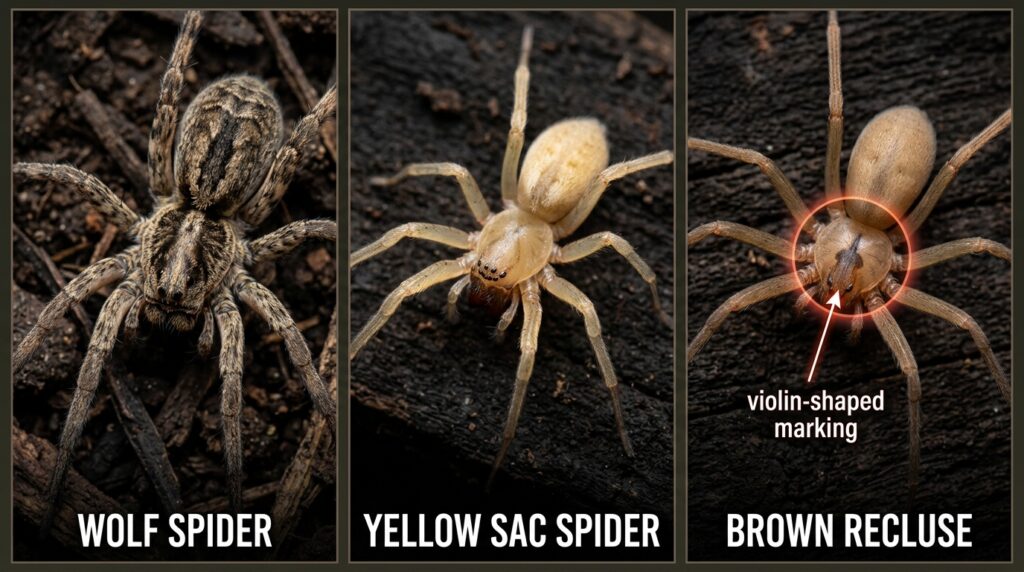
Large and alarming — among the biggest spiders you’ll find inside a US home. Body 3/4 to 1.5 inches, with legs bringing total span to 2–3 inches or more in large females. Brown to dark gray, often with stripes or chevron patterns on the abdomen. Stout, hairy legs. Eight eyes arranged in three rows: four small eyes on the bottom row, two large eyes in the middle, two medium eyes on top. The eye arrangement is diagnostic — no other common house spider shares this pattern.
Where you’ll find it:
Basements, garages, ground level. Active hunters — they chase prey rather than web-building. Moves fast on the ground. Often seen crossing floors at night. Females carry egg sacs attached to their spinnerets and, after hatching, carry spiderlings on their backs — an eerie but harmless sight.
Dangerous?
No, despite their intimidating appearance. Wolf spiders can bite if handled roughly, but bites are rare and the reaction is mild — local pain, redness, and minor swelling that resolves within days. There are no documented cases of significant tissue damage or systemic effects from wolf spider bites in the US.
What to do:
Catch with a glass and cardboard and release outside. If wolf spiders are frequently entering the home, seal foundation gaps and door sweeps — they follow insects inside. Miss Muffet’s Revenge Spider Killer (B00H4FQKCI) applied along baseboards kills wolf spiders that cross the treated area.
Amazon: Miss Muffet’s Revenge Spider Killer (B00H4FQKCI)
5. Orb Weaver (Araneidae family)
What it looks like:
Best known for the classic circular wheel-shaped web. The spider itself varies by species — most are medium to large (1/2 to 1 inch body) with a notably round, often colorful abdomen. Common species include the garden spider (Argiope aurantia — black and yellow, large), the marbled orb weaver (orange with white markings), and the barn spider. Generally found with their web, often with the spider centered in it or hiding in a retreat at the edge.
Where you’ll find it:
Primarily outdoor — between shrubs, in garden areas, under eaves, around exterior lights. Occasionally indoors near windows or in garages. Most active in late summer and fall when webs are largest.
Dangerous?
No. Orb weavers are non-aggressive and bites essentially don’t happen. They retreat from disturbance. Even if bitten, the reaction would be mild.
What to do:
Generally leave them — orb weavers outdoors are excellent pest control, capturing large numbers of flying insects. If they’re building webs in inconvenient locations (over doorways, near exterior lights you use frequently), knock the web down and they’ll relocate.
6. Yellow Sac Spider (Cheiracanthium species)
What it looks like:
Small — body about 1/4 inch, pale yellow to light green. No distinctive markings on the abdomen. The front pair of legs is noticeably longer than the others. Builds small silk retreats (sacs) in corners and behind furniture rather than open webs. One of the more nondescript spiders — easy to overlook or misidentify as a generic small house spider.
Where you’ll find it:
Upper wall-ceiling junctions, behind picture frames, in folded curtains, inside cabinet corners. Nocturnal hunter — active at night. One of the most common indoor spiders in the US but rarely noticed due to its small size and pale color.
Dangerous?
Mildly. Yellow sac spider bites do occur — they’re the most common spider bite in the US. The bite causes local pain and a red bump, sometimes a small blister, that resolves in a few days. Yellow sac spiders were historically suspected in some tissue-damaging bites (necrosis), but current research suggests this was misattribution — true necrotic bites in non-endemic brown recluse areas are now considered extremely unlikely to be from yellow sac spiders. Still, worth removing rather than tolerating.
What to do:
Vacuum sacs and spiders from corners. Apply pyrethroid spray in corners where sacs are found. Sticky traps placed along walls catch them effectively. Catchmaster Spider & Insect Glue Traps (B07Q4W5BYY).
Amazon: Catchmaster Spider & Insect Glue Traps (B07Q4W5BYY)
7. Brown Recluse (Loxosceles reclusa) — Know This One
What it looks like:
Medium — body 1/4 to 1/2 inch, legs bring total to about 1 inch. Light to medium brown (not dark, not gray). The single most useful feature: a violin-shaped or fiddle-shaped darker marking on the top of the cephalothorax (the front section). The neck of the violin points toward the abdomen. However — this mark fades in younger spiders and can be unclear, so always confirm with the eye count.
Eye count (definitive): Brown recluse has six eyes in three pairs arranged in a semicircle. All other common US house spiders have eight eyes. This is the most reliable diagnostic feature — if the spider has eight eyes, it’s not a brown recluse. Requires magnification (a magnifying glass or macro phone photo) to count reliably.
Abdomen: uniformly colored, no pattern or markings. Legs are long, thin, and have no banding or spines — smooth. The combination of violin marking + six eyes + unmarked abdomen + smooth legs = brown recluse. Any spider missing any of these features is almost certainly not a recluse.
Geographic range:
The brown recluse’s true range is the south-central US: Missouri, Kansas, Nebraska, Iowa (southern), Illinois (southern), Indiana (southern), Ohio (extreme southern), Kentucky, Tennessee, Arkansas, Oklahoma, Texas, Louisiana, Mississippi, Alabama, and Georgia (northern). The brown recluse is extremely rare or absent in the Pacific states, New England, and upper Midwest — most spiders identified as recluse outside this range are misidentifications of other species.
Dangerous?
Yes — the only medically significant spider in this list besides the black widow. A bite can cause local tissue death (necrosis) in some cases, progressing over days to weeks. Severity varies widely — many bites cause minimal reaction; a minority cause significant tissue damage requiring medical treatment. Seek medical attention for any confirmed or suspected recluse bite.
Where you’ll find it:
Undisturbed, dark spaces: inside stored boxes and clothing, in attics and crawl spaces, under furniture that hasn’t been moved in months, in woodpiles. Reclusive by behavior — does not seek contact with humans. Bites almost always result from accidental contact (reaching into a box, putting on a shoe left on the floor).
What to do:
Confirmed recluse presence warrants aggressive action: heavy glue trap deployment throughout the home, sealing all cracks and gaps aggressively, inspecting and shaking out clothing and shoes before use, and considering professional treatment for established infestations. See our full spider control guide for the complete approach.
8. Black Widow (Latrodectus species)
What it looks like:
Unmistakable when seen from the correct angle. Shiny black, smooth, round abdomen about 1/2 inch — the largest common venomous spider in the US. The defining feature: a red hourglass marking on the underside of the abdomen. This mark is on the bottom — you won’t see it unless the spider is upside down or in a web (which is where they usually are). Some females have red spots or partial markings instead of a complete hourglass. Males are smaller, paler, often with markings on the top of the abdomen — and not medically significant.
Geographic range:
Found throughout the US, more common in the South and West. All four US species (southern, western, northern, red widow) have significant venom. The southern and western black widows are the most commonly encountered.
Dangerous?
Yes. Black widow venom is a potent neurotoxin (latrotoxin) that causes systemic symptoms: severe muscle cramping and pain, especially in the abdomen and back, sweating, nausea, and hypertension. Bites are rarely fatal in healthy adults but can be serious in children, the elderly, and immunocompromised individuals. Seek emergency medical care for any confirmed or suspected black widow bite.
Where you’ll find it:
Primarily outdoors in the US: under decks, in woodpiles, in utility boxes, under outdoor furniture, in garages and sheds. Indoor encounters are less common. Builds irregular tangled webs close to the ground. Active at night. Not aggressive — bites occur from accidental contact.
What to do:
Wear gloves when working in woodpiles, under decks, or in garage corners. Spray outdoor harborage areas with a pyrethroid. Ortho Home Defense (B0756R6GQK) applied under decks, around woodpiles, and in garage corners kills black widows on contact and provides residual protection. Check outdoor play equipment and furniture before children use it.
Amazon: Ortho Home Defense (B0756R6GQK)
Quick Reference: 8 Common House Spiders at a Glance
Common house spider — small, round abdomen, tan/brown, irregular web — harmless
Cellar spider — extremely long thin legs, tiny pale body, vibrates when disturbed — harmless
Jumping spider — compact, fuzzy, large front eyes, doesn’t build web — harmless
Wolf spider — large, hairy, brown/gray striped, ground hunter — harmless (can bite, mild)
Orb weaver — round abdomen, classic wheel web, variable colors — harmless
Yellow sac spider — small, pale yellow-green, silk sac retreats — mild bite possible
Brown recluse — violin marking, 6 eyes, smooth legs — medically significant (south-central US)
Black widow — shiny black, red hourglass on underside — medically significant (US-wide)
A Note on Misidentification
Brown recluse and black widow bites are frequently diagnosed by patients, not by physicians, based on a skin lesion with no spider ever captured or identified. Studies have found that the vast majority of suspected recluse bites occur outside the brown recluse’s geographic range — where the spider simply isn’t present. Skin lesions attributed to spider bites are more often caused by MRSA infections, other bacterial infections, or other medical conditions. If you have a wound you think might be a spider bite, see a physician — and try to capture the spider for identification if possible.
Frequently Asked Questions
How do I tell a brown recluse from a wolf spider?
Size is the first separator — wolf spiders are significantly larger (2–3 inch leg span vs 1 inch for recluse). Eye arrangement is definitive: wolf spiders have 8 eyes in three rows; brown recluse have 6 eyes in three pairs. Wolf spiders have banded, hairy legs; recluse legs are smooth and uniform. Wolf spiders do not have a violin marking. If you see a large, fast-moving spider crossing your floor in the south-central US, it’s almost certainly a wolf spider.
What is the most common spider found in houses?
By occurrence, the common house spider (Parasteatoda tepidariorum) is found in more homes than any other species. The cellar spider is a close second, particularly in basements and garages. Both are completely harmless and present year-round throughout the US.
Are daddy longlegs spiders?
Confusingly, “daddy longlegs” refers to two completely different animals depending on where you’re from. Cellar spiders (Pholcus phalangioides) are true spiders with two body sections, silk glands, and venom. Harvestmen (order Opiliones) are arachnids but not spiders — they have one fused body section, no venom glands, and produce no silk. Both are sometimes called daddy longlegs. Both are completely harmless.
Should I kill spiders I find in my house?
It’s your house and your call, but the ecological argument for tolerating harmless species is real — common house spiders and cellar spiders consume large numbers of flies, gnats, and moths. Wolf spiders and jumping spiders actively hunt insects. If the species is harmless and not causing a nuisance, letting it be has some practical upside. For the two medically significant species, removal is clearly the right call.
What spider makes the tangled, messy web in ceiling corners?
Almost certainly the common house spider (Parasteatoda tepidariorum). The tangled, irregular cobweb in ceiling corners with debris caught in it is the signature of this species. Clean, symmetrical wheel-shaped webs belong to orb weavers (more often found outdoors). Flat, sheet-like webs in grass or low vegetation are funnel weavers — also harmless.
Identification Is the First Step
Knowing what you’re dealing with changes what you do next. A wolf spider crossing your floor doesn’t need treatment — it needs a glass and a piece of cardboard. A confirmed brown recluse in a south-central US home does warrant action. Most encounters fall into the first category.
If you’ve identified what you have and need to get rid of it, our complete guide on how to get rid of spiders covers every step from web removal to perimeter treatment. And if your problem is specifically in the basement or garage, our basement spider guide covers those environments in detail.