
This post contains affiliate links. If you buy through our links, we may earn a commission at no extra cost to you.
Finding a spider in your house doesn’t have to mean calling an exterminator. Here’s the complete guide to getting rid of spiders — including what actually works, what doesn’t, and the one thing that brings more spiders than anything else.
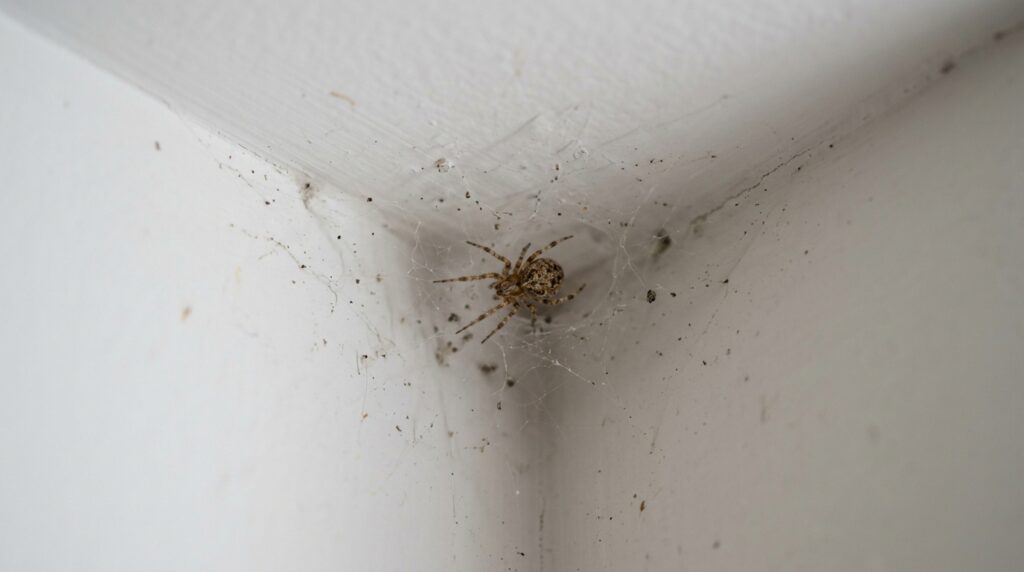
Most spiders that end up inside your home are harmless — they’re not there to bite you, they’re there because they followed the insects you already have. A spider in the corner of your ceiling is, in a literal sense, doing you a favor by eating gnats, flies, and moths.
That said, “harmless” and “welcome” are different things. Whether your concern is genuinely dangerous species (brown recluse, black widow) or you just don’t want spiders sharing your living space, there’s a reliable way to reduce and eliminate them. This guide covers both.
Quick answer:
The most effective spider control strategy has two parts: (1) reduce their food supply by controlling other insects inside and outside the house, and (2) eliminate their harborage — the clutter, dark corners, and entry points they use. Spider sprays and traps are supplemental tools, not the foundation. For most homes, consistent application of this two-part approach eliminates the spider population within 2–4 weeks without any pest professional.
Know What You’re Dealing With First
Before treating for spiders, it helps to know which species you’re seeing. The vast majority of house spiders in the US are completely harmless. The two species that matter medically:
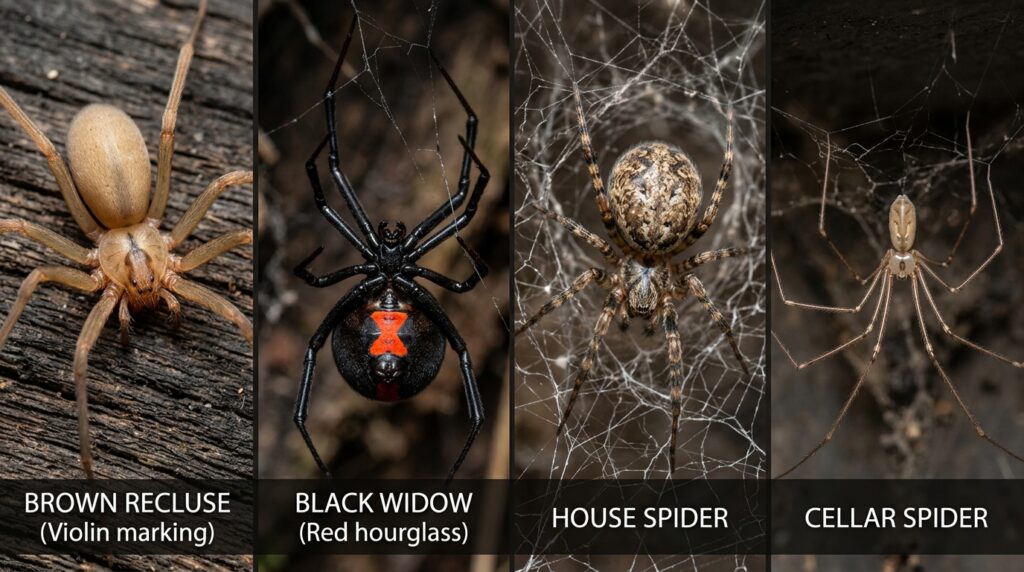
Brown recluse (Loxosceles reclusa)
Found primarily in the south-central US (Missouri, Kansas, Oklahoma, Texas, and adjacent states). Light to dark brown with a distinctive violin-shaped marking on the top of the cephalothorax (the front body section). Six eyes arranged in three pairs (most spiders have eight eyes). About the size of a quarter including legs. Reclusive — they hide in undisturbed dark areas like storage boxes, inside shoes left out, in closets and attics. Bites are rare and usually result from accidental contact (putting on a shoe with one inside, reaching into a box). A brown recluse bite can cause tissue necrosis in some cases — if you suspect a brown recluse bite, seek medical attention.
Black widow (Latrodectus species)
Found throughout the US, more common in warmer climates. Shiny black with a red hourglass marking on the underside of the abdomen. About the size of a quarter. Prefer dark, undisturbed outdoor areas — under decks, in woodpiles, in garages. Bites are rare but can cause systemic symptoms (muscle pain, cramping, nausea). Seek medical attention for any suspected black widow bite.
Everything else — harmless house spiders
The vast majority of spiders in US homes are common house spiders (Parasteatoda tepidariorum), cellar spiders (Pholcus phalangioides, the long-legged “daddy longlegs”), wolf spiders (large, fast, ground-hunting), or jumping spiders (small, compact, curious). None are medically significant. Wolf spiders look alarming due to their size but are harmless. Jumping spiders are arguably the most visually interesting spider in the US and eat a significant number of pests.
If you’re not sure what you’re seeing, our guide on common house spider identification covers the key species with photos.
Why Do You Have Spiders Inside?
Spiders enter homes for two reasons: food and shelter. Understanding this makes treatment obvious.
Food:
Spiders eat insects. If you have spiders, you have insects — often more than you realize. A house with a thriving spider population almost always has an underlying insect problem that the spiders are feeding on. Common insect attractors: indoor plants (fungus gnats), food left out (fruit flies), exterior lighting that draws moths and flies, and gaps that let in gnats and midges. Solve the insect problem and spiders lose their food source and typically leave or stop appearing.
Shelter:
Spiders prefer dark, undisturbed spaces: cluttered storage areas, boxes that haven’t been moved in months, the space behind furniture pushed against walls, attics and basements. A house with significant clutter and undisturbed corners will have more spiders than a clean, organized home even with the same insect pressure.
Entry points:
Spiders enter through the same gaps that other pests use: cracks around doors and windows, gaps around pipes and cables, unscreened vents. Unlike insects, spiders are relatively large and can’t squeeze through tiny gaps — but any opening an insect can use, a spider can often follow through.
How to Get Rid of Spiders — Step by Step
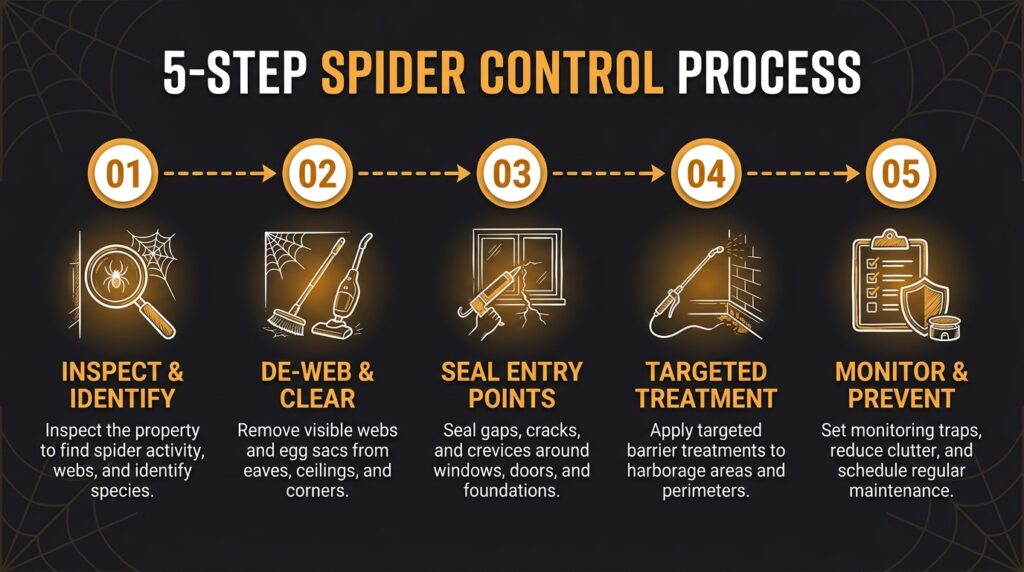
Step 1: Remove webs immediately and consistently
Removing webs serves two purposes: it eliminates the spider’s home and food trap, and it signals to remaining spiders that this location is not viable for web-building. A spider whose web is repeatedly removed moves on.
Use a vacuum with a hose attachment — not a broom — to remove webs. A broom spreads egg sacs (each sac can contain 100–400 eggs) around the room. A vacuum removes the web, spider, and any egg sacs completely. Vacuum along ceiling-wall junctions, in corners, behind furniture, in basement and garage corners, and around windows. Do this weekly during spider season (late summer and fall, when spiders are most active).
Step 2: Eliminate clutter and harborage
Reduce the places spiders can hide undisturbed:
- Storage boxes: Use sealed plastic bins instead of cardboard boxes. Cardboard boxes are perfect spider habitat — dark, enclosed, undisturbed. Plastic bins with lids eliminate this.
- Firewood: Don’t store firewood inside or against the house. This is prime black widow and wolf spider habitat. Bring wood in only as needed.
- Clothing and shoes left on the floor: A common brown recluse entry point. Store shoes in closed containers or check them before putting them on if you’re in brown recluse territory.
- Unused items in garages and attics: Regular clearing and organization reduces harborage significantly. Items that haven’t been touched in months are spider real estate.
Step 3: Treat with a residual perimeter spray
Once you’ve reduced harborage and removed webs, a residual pyrethroid spray along the baseboards, in corners, and around entry points kills spiders that cross the treated surface. Spiders are more difficult to kill with sprays than insects because their bodies are elevated off surfaces by their legs — they need to make direct contact with the spray to receive a lethal dose.
The most effective approach: spray directly into corners and along baseboard edges (not just a light mist on the floor). Focus on the wall-floor junction, behind large furniture, inside closets, and around door frames. Miss Muffet’s Revenge Spider Killer (B00H4FQKCI) is a ready-to-use spider-specific spray with a long-range wand applicator designed to reach into corners and under furniture — one of the most consistently well-reviewed consumer spider products.
Amazon: Miss Muffet’s Revenge Spider Killer (B00H4FQKCI)
Step 4: Apply outdoor perimeter treatment
Treating the exterior foundation, door frames, and window frames with a residual pyrethroid spray creates a barrier spiders cross before entering. This is more effective at reducing indoor spider populations than indoor treatment alone, because it stops them at the entry point.
Ortho Home Defense Insect Killer (B0756R6GQK) — applies as a continuous band around the foundation, along door and window frames, and under eaves. Effective for 12 months on non-porous surfaces. This is the same product recommended for general perimeter pest control and works well against spiders.
Amazon: Ortho Home Defense Insect Killer (B0756R6GQK)
Step 5: Use sticky traps for monitoring and capture
Spider glue traps placed along walls and in corners catch spiders that are moving through the space. They don’t attract spiders (unlike insect traps that use light or pheromones) — they intercept them along their travel routes, which are typically along walls. Place traps in corners, under furniture, inside closets, in the garage, and in the basement. Check weekly and replace when full or dusty.
Catchmaster Spider & Insect Glue Traps (B07Q4W5BYY) — flat traps that fold into a triangular tunnel shape. The enclosed shape is more effective than flat boards because spiders prefer to travel through enclosed spaces along walls.
Amazon: Catchmaster Spider & Insect Glue Traps (B07Q4W5BYY)
Natural Spider Repellents — What the Research Says
Several natural repellents are widely cited for spider control. The evidence is mixed, and none approaches the effectiveness of residual chemical treatments — but some have measurable effect:
Peppermint oil
The most widely cited natural spider repellent. A 2010 study found that peppermint oil had a repellent effect on spiders in laboratory conditions. The practical limitation: the effect requires high concentration and dissipates quickly as the oil evaporates. Spraying diluted peppermint oil along baseboards may offer some short-term deterrence but needs frequent reapplication (every few days). Mighty Mint Spider Repellent (B0813Q29NW) is a peppermint-oil-based ready-to-use spray — more convenient than DIY. Reasonable option for those avoiding synthetic pesticides, with realistic expectations about duration.
Amazon: Mighty Mint Spider Repellent (B0813Q29NW)
Diatomaceous earth (DE)
Food-grade DE applied in thin layers in corners, along baseboards, and in undisturbed areas kills spiders by abrading their exoskeleton and causing dehydration. Effective but slow — spiders die within 24–48 hours of contact. Needs to stay dry to work; loses effectiveness in humid environments. Harris Diatomaceous Earth (B00BKIZ7OE) is the most widely available food-grade option.
Amazon: Harris Diatomaceous Earth (B00BKIZ7OE)
Cedar
Cedar has some repellent properties against many insects and limited evidence suggests it repels some spider species. Cedar blocks or sachets in closets and storage areas are low-effort, long-lasting, and safe — reasonable to include as a passive measure without primary reliance.
What doesn’t work
Ultrasonic pest repellers: No evidence of effectiveness against spiders. Chestnuts (horse chestnuts): A persistent folk remedy with no scientific support. Essential oils other than peppermint: Limited evidence, highly variable.
Dealing With Spiders Outside the House
Outdoor spiders — particularly those building webs near exterior lights, under eaves, and around the foundation — are the source of most indoor spider problems. Treating them outside reduces indoor pressure:
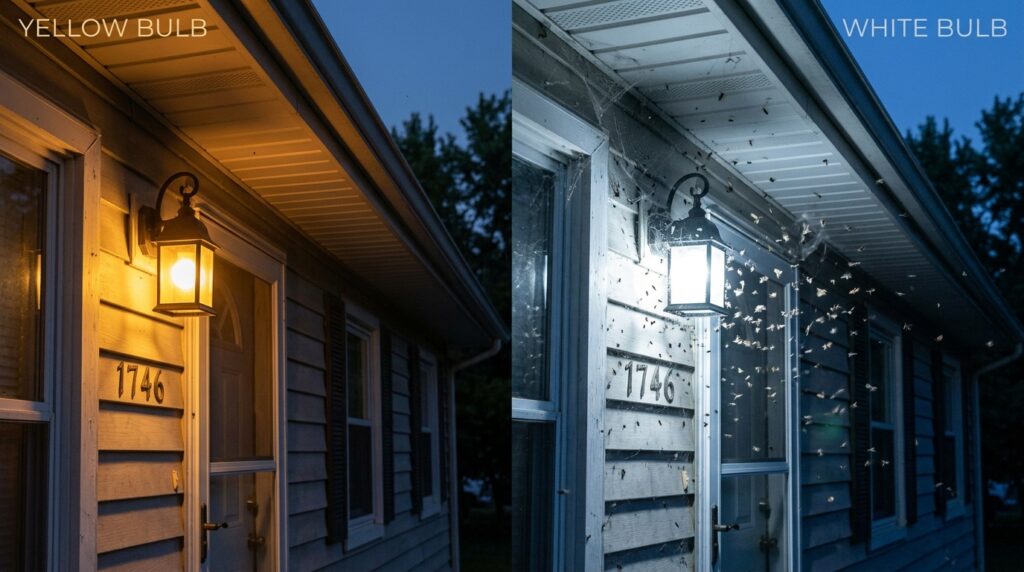
- Exterior lighting: Switch from white/incandescent bulbs to yellow or sodium vapor bulbs on exterior fixtures. White light attracts more insects (which attracts more spiders). Yellow light attracts significantly fewer.
- Remove debris from foundation: Woodpiles, leaf piles, rocks, and landscaping material directly against the foundation are prime spider habitat. Move them away from the house.
- Trim vegetation near the house: Shrubs and ground cover touching the exterior walls create a direct bridge for spiders to enter. Keep a clear 12-inch gap between vegetation and the foundation.
- Web removal outside: Use a long-handled brush to knock down webs under eaves, on exterior lights, in window corners. Do this monthly during spider season.
If You Have Brown Recluse Spiders
Brown recluse infestations require a more intensive approach than general house spider control. A home with brown recluse needs:
- Glue traps deployed heavily throughout — under furniture, in closets, in the attic and basement, in any undisturbed storage area. This is both treatment and monitoring. Count catches weekly to assess population size and track progress.
- Careful inspection of all clothing, shoes, and stored items before handling — shake out before use.
- Sealing all cracks and gaps aggressively — brown recluse enter through tiny gaps that other large spiders couldn’t use.
- Professional treatment if the population is established — a confirmed brown recluse infestation with regular sightings warrants a pest professional who can apply dust insecticides (like CimeXa) into wall voids and undisturbed spaces that DIY sprays can’t reach.
Brown recluse infestations are primarily a problem in the south-central US and are uncommon outside that range. If you’re seeing spiders you believe are brown recluse and you’re outside their known range (Pacific coast, New England, upper Midwest), confirm the identification before treating aggressively — misidentification is extremely common.
Safety Note
Pyrethroid sprays (Miss Muffet’s Revenge, Ortho Home Defense) are safe for adults and dogs when used as directed and allowed to dry. They are toxic to cats — keep cats out of treated areas until fully dry (1–2 hours). Highly toxic to fish and aquatic invertebrates — do not apply near water features, storm drains, or aquariums. Allow full ventilation after indoor application before re-entering the space.
Diatomaceous earth causes lung irritation if inhaled in quantity — wear a dust mask when applying in enclosed spaces.
Frequently Asked Questions
What smell do spiders hate?
Spiders show the most consistent aversion to peppermint oil in research settings — it contains compounds that interfere with their chemoreception. Tea tree oil, eucalyptus, and citrus oils have some repellent effect at high concentrations but the evidence is thinner. All essential oil repellents have a significant limitation: they evaporate quickly and require frequent reapplication to maintain any effect. None match the duration of residual pyrethroid treatments.
Do spiders come inside more in the fall?
Yes. Late summer and early fall is peak spider season in most of the US. Male spiders become more mobile in late summer as they search for mates — this is when you’re most likely to see large wolf spiders or house spiders crossing open floors. The impression that spiders “come in for the cold” is partly true (some do enter buildings as temperatures drop) but the bigger driver is mate-seeking behavior in adult males. Expect more spiders August through October and plan treatment around this seasonal peak.
Are spiders good to have in the house?
From a purely ecological standpoint, yes — house spiders eat flies, gnats, moths, and other insects you also don’t want. A spider in the corner of the garage is reducing your insect population. The practical reality is that most people find them unwelcome regardless, and a few species (brown recluse, black widow) do present real medical risk. The decision to tolerate or eliminate them is personal — there’s no wrong answer from a pest control standpoint.
Can spiders come up through drains?
Occasionally, yes — particularly cellar spiders and small house spiders. Spiders can navigate the U-bend in drain pipes in some cases. This is not a common entry route, but it does happen. If you’re seeing spiders consistently near drains, check for standing water in nearby areas that might attract insects, which attract spiders. Drain covers or screens reduce this entry vector.
How long does it take to get rid of spiders?
With consistent application of the five-step approach above (web removal, clutter reduction, indoor spray, outdoor perimeter, traps), most households see a significant reduction within 2–3 weeks. Complete elimination is not realistic — some spiders will always find their way in. The goal is reducing the population to the point where encounters are rare. Maintaining the outdoor perimeter treatment and doing seasonal web removal sustains that reduced population long-term.
The Strategy That Actually Works
Spider control is less about finding the right spray and more about making your home a poor habitat. Remove the webs, eliminate the clutter, treat the perimeter, and — most importantly — reduce the insects that spiders are following inside. Do these consistently and the spider population drops without needing to identify or kill every individual.
If you’re seeing spiders you think might be dangerous, our guide on identifying dangerous spiders in the US will help you determine whether you’re dealing with brown recluse or black widow versus the common harmless species. And if your spider problem is concentrated in the basement, our basement spider guide covers that specific environment in more detail.