
This post contains affiliate links. If you buy through our links, we may earn a commission at no extra cost to you.
Not all spider killers are created equal. Some spray types barely affect spiders due to their leg posture. Others work on contact but leave nothing residual. Here are the 6 best options, what each is actually good for, and the one product most people buy wrong.
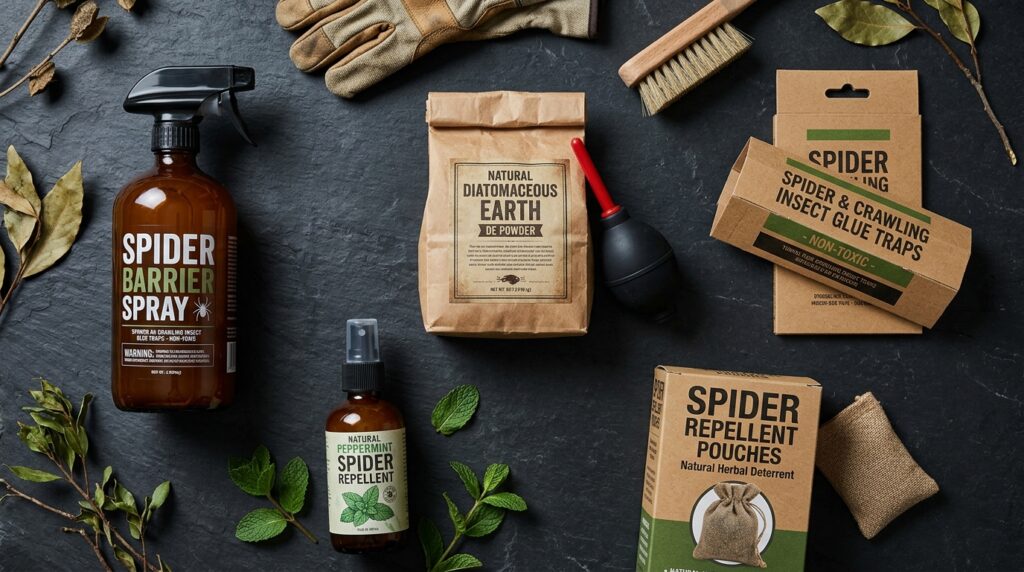
Spider control products have a problem most people don’t know about: standard insect sprays are significantly less effective on spiders than on other bugs. The reason is physics. When a spider walks across a treated surface, its elevated legs and body posture reduce contact with the chemical — it’s walking on stilts over the treated area. To kill a spider with a spray, you need either a direct hit or a formulation specifically designed to remain lethal through leg contact.
That’s the first thing to understand before buying anything. The second: “spider killer” and “spider repellent” are different categories with different mechanisms, and mixing them up leads to wasted money and continued spider problems.
Quick answer:
Miss Muffet’s Revenge Spider Killer is the best all-around choice for most homes — it applies directly into corners and along baseboards, kills on contact, and the residual formula remains effective for up to 12 months. For a natural option, Mighty Mint Spider Repellent works well as a deterrent when applied frequently. For monitoring and passive capture, Catchmaster glue traps are the most reliable tool.
Here are the 6 best spider control products, what each one is actually designed for, and who should use each.
1. Miss Muffet’s Revenge Spider Killer — Best Overall
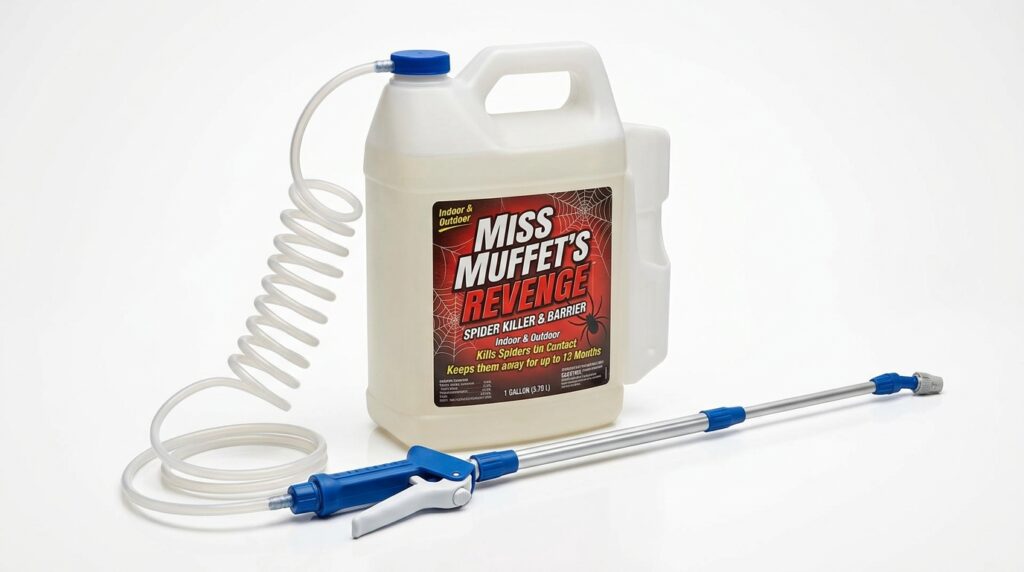
Amazon: Wet & Forget Miss Muffet’s Revenge Spider Killer Spray, 64 Oz
What it is:
A ready-to-use pyrethroid-based spider spray in a 64-oz bottle with a long-range extended wand applicator — the wand is the key feature. Most spider spray bottles require you to get close to the surface; Miss Muffet’s Revenge lets you apply directly into ceiling corners, under furniture, and along baseboards from several feet away without crouching or reaching. Designed specifically for spiders, not repositioned as a general insecticide.
Active ingredient:
Bifenthrin 0.05% — a pyrethroid that kills spiders on contact and remains active on surfaces for up to 12 months indoors. Bifenthrin is specifically effective against spiders because it’s lipophilic and absorbs through leg contact even at reduced application rates. This is the ingredient difference that makes it more effective than general household insect sprays for spider control.
Best for:
Indoor perimeter treatment along baseboards, in corners, inside closets, and in crawl spaces. Also works on garage walls and in basement corners. The 12-month residual claim is for indoor, non-washed surfaces — treat once in early fall before spider season peaks and again in spring.
What it’s not for:
Outdoor wide-area treatment — the bottle size and wand applicator are designed for targeted indoor use, not large exterior surfaces. For outdoor perimeter treatment, Ortho Home Defense is a better fit.
Limitations:
Toxic to cats — keep cats out of treated areas until fully dry (minimum 1–2 hours). Toxic to fish and aquatic invertebrates — don’t apply near fish tanks or water features. Smell dissipates quickly after drying. Will not repel spiders from untreated areas — coverage matters.
Verdict:
The most purpose-built spider spray available in the consumer market. The wand applicator alone sets it apart from competing products. Best for homeowners who want a reliable chemical option with lasting residual effect and targeted application. 4.4/5 stars, 7,000+ reviews.
2. Ortho Home Defense Insect Killer — Best for Outdoor Perimeter
Amazon: Ortho Home Defense Insect Killer for Indoor & Perimeter2, Wand, 1.33 gal.
What it is:
A gallon-sized continuous spray insecticide with a battery-powered Comfort Wand applicator. Designed for creating an outdoor perimeter barrier around the foundation, door frames, window frames, and under eaves. Marketed for general indoor/outdoor insect control, but is highly effective for spiders when used on the exterior perimeter — stopping them before they enter.
Active ingredient:
Bifenthrin 0.05% (same as Miss Muffet’s Revenge) — 12-month residual on non-porous outdoor surfaces. The gallon volume and Comfort Wand make it suited for treating the large surface areas that exterior perimeter treatment requires.
Best for:
Homeowners who want to treat the outside of their home to reduce spider (and general insect) entry. A single gallon treats approximately 2,000 linear feet of perimeter — enough for most homes applied 1–2 feet wide around the foundation. Also effective for garage doors, under decks, and around utility entry points.
Why it’s different from Miss Muffet’s Revenge:
Same active ingredient, very different delivery. Ortho Home Defense is designed for coverage — treating large exterior surfaces efficiently. Miss Muffet’s Revenge is designed for precision — reaching corners and tight spaces indoors. For complete spider control, both have a role: Ortho for outside, Miss Muffet’s for inside.
Verdict:
The most cost-effective exterior perimeter product. If you only buy one product and your spider problem is primarily indoor entry, start here — treating outside reduces indoor population more than indoor treatment alone. Apply in spring and again in late summer before peak spider season.
3. Catchmaster Spider & Insect Glue Traps — Best for Monitoring and Capture
Amazon: Catchmaster Spider & Insect Traps Indoor, Sticky Glue Boards 12 Pack
What it is:
Flat adhesive traps that fold into a triangular tunnel shape. Placed along walls and in corners, they intercept spiders moving through the space. The tunnel shape is specifically more effective for spiders than flat glue boards — spiders preferentially travel along walls and through enclosed spaces, so the tunnel geometry intercepts more spiders than an open flat trap.
Best for:
Three distinct uses: (1) Monitoring — counting catches per week tells you whether treatment is working and where spider activity is highest; (2) Supplemental capture — traps catch spiders in areas between spray applications; (3) Brown recluse management — glue traps are the primary tool recommended for confirmed recluse infestations, deployed heavily throughout the home.
Placement strategy:
Along baseboards and walls (spiders travel edges), inside closets, in the garage, in the basement, under large furniture. Replace when full or after 2–3 months. During peak season, check weekly — a sudden increase in catches signals a new entry point or breeding site.
Limitations:
Glue traps don’t attract spiders — they only intercept them. They’re a capture and monitoring tool, not a standalone eradication method. They won’t reduce a spider population on their own but are highly valuable as part of a complete strategy.
Verdict:
An underused tool in DIY spider control. Most homeowners skip straight to spray and miss the value of knowing whether treatment is working. Deploy traps alongside any spray treatment to track progress. Essential for brown recluse management.
4. Mighty Mint Spider Repellent — Best Natural Option
What it is:
A peppermint oil-based spider repellent spray in a ready-to-use bottle. Peppermint oil is the best-supported natural spider repellent — a 2010 study confirmed repellent activity in laboratory conditions. Mighty Mint is a concentrated formulation designed to be applied along baseboards, in corners, and around entry points.
How it works:
Peppermint oil contains compounds that interfere with spider chemoreception — essentially disrupting their ability to navigate familiar routes. Spiders avoid freshly treated areas. The key limitation: peppermint oil is volatile and evaporates, losing effectiveness within 2–7 days depending on temperature, ventilation, and surface type. Requires more frequent reapplication than synthetic pyrethroids.
Best for:
Households with cats (pyrethroid sprays are toxic to cats), pet-heavy households, anyone who prefers to avoid synthetic pesticides, and as a supplemental deterrent in areas where chemical spray isn’t practical (food prep surfaces, children’s play areas). Also useful as a maintenance spray between chemical treatments.
What it’s not:
A replacement for residual pyrethroid treatment in homes with significant spider pressure. The short duration and lack of kill action (it repels, doesn’t kill) mean it works best as one layer of a multi-approach strategy, or as the primary tool in low-pressure situations.
Verdict:
The best natural option with actual supporting evidence. Realistic expectations are key — it works, but works differently (repels vs. kills) and requires more frequent application. Worth the shelf space for any household with cats or chemical sensitivity.
5. Harris Diatomaceous Earth — Best for Persistent Infestations
Amazon: HARRIS Diatomaceous Earth Food Grade, 4lb with Powder Duster Included in The Bag
What it is:
Food-grade diatomaceous earth (DE) — a powder made from fossilized algae (diatoms). Applied in a thin layer in corners, along baseboards, inside wall voids (through outlet gaps), and in attic/crawl space areas. Kills spiders by mechanically abrading their waxy exoskeleton, causing dehydration and death within 24–48 hours of contact.
Why it’s different from sprays:
DE doesn’t evaporate or lose effectiveness over time as long as it stays dry. A layer applied in a dry attic corner or behind a baseboard remains active indefinitely. It’s the right tool for places where liquid spray isn’t practical — inside wall voids, in dry crawl spaces, in attic areas. Also completely safe for mammals (food-grade DE is inert to them) when not inhaled as dust.
Best for:
Dry, undisturbed areas — attics, dry crawl spaces, behind appliances, along dry basement walls. Also useful in areas where liquid spray might damage surfaces. Works for brown recluse in hard-to-reach harborage areas.
Limitations:
Completely ineffective when wet — humidity above 60% or any moisture contact renders it ineffective. Not suitable for active living spaces where it will be disturbed or vacuumed regularly. Application requires a dust mask (irritating to lungs when inhaled, though not toxic). Slower kill time than contact sprays — 24–48 hours minimum.
Verdict:
The right tool for dry, persistent harborage areas that liquid sprays can’t reach. Not a substitute for contact sprays in active areas — a complement. Include it in attics and dry basement corners where brown recluse harborage is a concern. Harris is the most consistently available food-grade option at good value.
6. WEB OUT Spider Repellent — Best for Web Prevention
Amazon: Nisus Web Out Cobweb Eliminator, Ready-to-Use Biodegradable Spray, 1 Quart
What it is:
A spray specifically formulated to prevent spiders from building webs in treated areas. Applied to exterior surfaces — under eaves, on exterior lights, around garage door frames, on porch ceilings. The formula interferes with the spider’s ability to anchor web strands to treated surfaces, causing them to abandon the location.
Best for:
Exterior web prevention in specific high-annoyance areas: porch ceilings where orb weavers build webs repeatedly overnight, exterior light fixtures that attract insects and spiders, garage door surrounds, and any outdoor surface where web removal is a recurring task. Not designed for killing spiders or for interior use — it’s a deterrent for specific exterior spots.
How it differs from other repellents:
Mighty Mint repels spiders from treated surfaces generally. WEB OUT specifically prevents web-building by disrupting web anchorage — spiders may still pass through treated areas, they just won’t establish webs there. A more targeted solution for the “I keep knocking down the same web every week” problem.
Verdict:
A niche but useful product for exterior web management. Not a primary spider control product — it doesn’t reduce spider populations. If you have recurring exterior web problems in specific locations (porch ceiling, garage entrance), WEB OUT saves time and frustration. Apply after web removal and reapply monthly during spider season.
Which Product Is Right for Your Situation?
General indoor spider problem (most common scenario):
Miss Muffet’s Revenge (indoor targeted treatment) + Catchmaster traps (monitoring + capture) + Ortho Home Defense on exterior perimeter. This three-product combination covers every vector: indoor kill, indoor monitoring, and exterior prevention.
Household with cats or chemical sensitivity:
Mighty Mint (repellent spray, safe for cats) + Harris DE in dry undisturbed areas + Catchmaster traps. Avoids pyrethroids entirely while maintaining reasonable control. Requires more frequent Mighty Mint reapplication.
Confirmed or suspected brown recluse (south-central US):
Heavy Catchmaster trap deployment throughout the home (primary tool) + Miss Muffet’s Revenge in all accessible corners and cracks + Harris DE in attic/crawl space. If population is established and traps are catching 5+ recluse per week, add professional treatment.
Outdoor web nuisance (porch, eaves, garage):
Ortho Home Defense on exterior foundation + WEB OUT on specific web-prone surfaces. Knocks down webs first, then applies both products.
Budget-only option:
Catchmaster traps + Ortho Home Defense exterior treatment. This covers monitoring and the most effective single-product intervention (exterior perimeter). Add Miss Muffet’s Revenge if indoor pressure remains high after 4 weeks.
Safety Note
All pyrethroid-based products (Miss Muffet’s Revenge, Ortho Home Defense) are toxic to cats. Allow 1–2 hours drying time before cats re-enter treated areas. Highly toxic to fish and aquatic invertebrates — never apply near fish tanks, ponds, or storm drains.
Diatomaceous earth should be applied with a dust mask in enclosed spaces — the fine particles irritate the lungs when inhaled in quantity, though food-grade DE is non-toxic.
All products listed are safe for dogs when used as directed and allowed to dry. Keep children out of treated indoor areas until dry.
Frequently Asked Questions
What kills spiders instantly?
A direct spray with any pyrethroid spray (Miss Muffet’s Revenge, Ortho Home Defense) kills spiders on direct contact within seconds. Rubbing alcohol in a spray bottle also kills spiders instantly on contact. For residual effect that kills spiders after they walk through treated areas, pyrethroid applications along baseboards and in corners work within minutes of contact. Nothing kills spiders “from a distance” without direct application.
Does vinegar kill spiders?
Acetic acid (vinegar) is lethal to spiders in direct contact at sufficient concentration. White vinegar diluted 1:1 with water will kill a spider if sprayed directly on it. However, vinegar leaves no residual effect — once it evaporates, it has zero prevention or deterrence value. It’s a kill-on-contact option for single spiders when you don’t have a proper spray, not a treatment for spider infestations.
Are spider bombs (foggers) effective?
Spider foggers are largely ineffective for spiders. Total release foggers disperse insecticide as a fog that settles on horizontal surfaces — floors, countertops, furniture tops. Spiders don’t rest on these surfaces; they’re in corners, ceiling junctions, inside cracks, and under furniture where fog doesn’t penetrate. Studies on spider foggers consistently show poor results. Targeted sprays in corners and cracks are dramatically more effective per dollar spent.
How long does spider spray last?
Residual duration depends heavily on the surface and environment. Bifenthrin-based sprays (Miss Muffet’s Revenge, Ortho Home Defense) claim 12 months on non-porous indoor surfaces in dry conditions. In practice, expect 3–6 months before reapplication is worthwhile. Outdoor surfaces exposed to rain, UV, and temperature cycling lose effectiveness faster — Ortho Home Defense lists 12 months on non-porous outdoor surfaces, but a reapplication after heavy rain or winter is practical. Natural options like Mighty Mint need reapplication every 2–7 days.
Do ultrasonic pest repellers work for spiders?
No. Despite widespread marketing claims, ultrasonic pest repellers have no demonstrated effectiveness against spiders. Multiple studies have tested these devices and found no reduction in spider activity or populations. The FTC has taken action against several manufacturers for unsubstantiated claims. Save the outlet and the money.
The Bottom Line
Spider control doesn’t require a large product arsenal. For most US homes, two products cover the problem effectively: an indoor targeted spray (Miss Muffet’s Revenge) and an outdoor perimeter treatment (Ortho Home Defense). Add glue traps if you want to monitor progress or if you’re dealing with brown recluse. Add a natural option if cats or chemical sensitivity are factors.
What doesn’t work: foggers, ultrasonic repellers, and general-purpose household bug sprays used as the primary spider control tool. What does work: bifenthrin-based products applied correctly, in the right locations, before spider season peaks.
For the step-by-step method that makes these products most effective, see our complete guide on how to get rid of spiders. And if you’re not sure which spider you’re dealing with, our identification guide covers all 8 common US house spider species.