
This post contains affiliate links. If you buy through our links, we may earn a commission at no extra cost to you.
If spiders are taking over your basement or garage, there’s a structural reason — and a structural fix. This guide covers why these spaces attract more spiders than anywhere else in the house, and the step-by-step method to reclaim them.
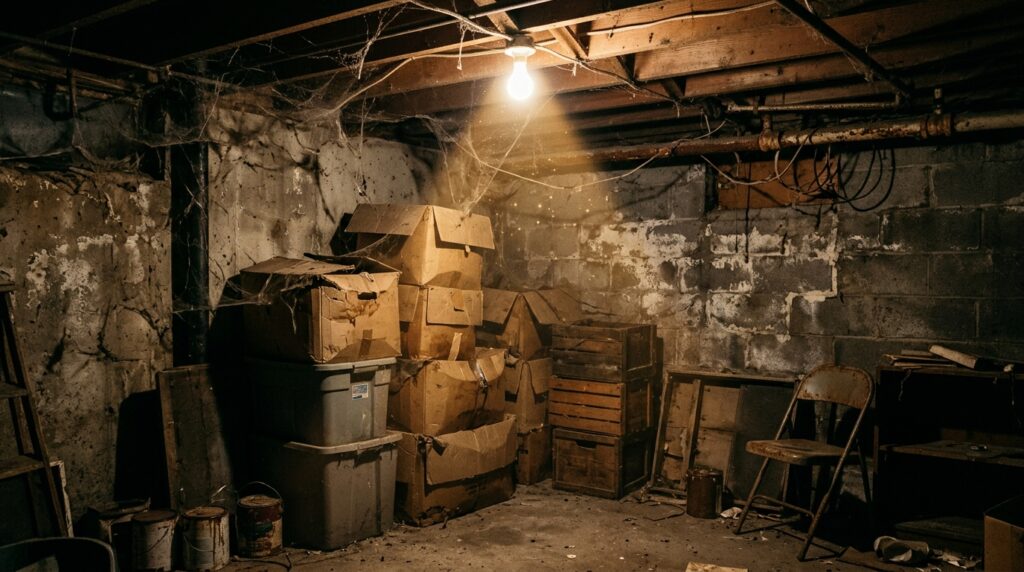
If you have a spider problem anywhere in your home, there’s a strong chance it started in the basement or garage. These two spaces are the primary spider hub in most houses — they offer everything spiders look for: low foot traffic, undisturbed corners, insects attracted to light and moisture, and abundant harborage in storage boxes and equipment.
The frustrating reality: if you want to know how to get rid of spiders in basement and garage spaces for good, you can’t treat just the visible ones. The basement is where they live, breed, and redistribute from. Fix the basement, and indoor spider counts drop throughout the home.
Quick answer:
The most effective basement and garage spider control combines three actions: (1) heavy glue trap deployment along walls and behind stored items to catch and monitor existing spiders, (2) Miss Muffet’s Revenge or similar bifenthrin spray applied directly into corners, along wall-floor junctions, and into any cracks, and (3) reducing the clutter and moisture that makes these spaces ideal habitat. For garages specifically, sealing the door gap and treating the threshold eliminates the primary entry vector. Most basements see significant improvement within 2–3 weeks of consistent treatment.
Why Basements and Garages Have More Spiders Than Anywhere Else
Understanding the attraction is the first step toward eliminating it. Four factors make these spaces disproportionately hospitable:
1. Low foot traffic and undisturbed spaces
Spiders don’t want to be disturbed. A corner of your basement that you walk past once a week is infinitely more appealing to a spider than a kitchen counter cleaned daily. Boxes stored for months, wall areas behind appliances, the gap between the water heater and the wall — these are prime real estate. The less a space is disturbed, the faster spider populations establish.
2. Insects attracted to moisture and light
Basements accumulate moisture-loving insects: springtails, fungus gnats, silverfish, and drain flies congregate wherever humidity is elevated. Garage lights attract moths, crane flies, and beetles every evening. Spiders follow their food supply. A basement with moisture issues will have a permanent insect (and therefore spider) population regardless of how many times you spray.
3. Exterior entry points at ground level
Foundation gaps, utility pipe penetrations, basement window frames, garage door gaps — all sit at or below ground level where spiders naturally forage. A gap under a garage door as narrow as 1/4 inch allows wolf spiders, house spiders, and cellar spiders to enter freely. The basement is the transition zone between outdoor spider habitat and your home’s interior.
4. Year-round livable temperature
Unlike unheated sheds or true crawl spaces, most basements and attached garages maintain temperatures that support spider activity year-round. There’s no die-off season. Populations that establish in fall survive through winter and expand in spring.
Which Spiders You’re Actually Seeing
Basement and garage spider populations are predictable. The vast majority of what you’re encountering falls into four species:
Cellar spiders (Pholcus phalangioides)
The long-legged, small-bodied spider with a habit of vibrating rapidly when disturbed. These are the most common basement spider by volume. They prefer high corners and ceiling-wall junctions in low-traffic spaces. Completely harmless. They actually consume other insects and smaller spiders, including house spiders — some pest control operators consider them beneficial. Their population in a basement directly reflects the basement’s insect population.
Common house spiders (Parasteatoda tepidariorum)
Small, round-bodied, brown to tan. Build the tangled irregular webs in corners that collect dust and debris. Extremely common in basements and garages. Harmless. Usually the spider behind the “cobwebs” people find in basement corners.
Wolf spiders (Lycosidae)
Large, fast-moving, alarming to encounter. Wolf spiders are ground hunters — you’ll find them crossing the basement floor rather than in webs. They enter from outside at ground level (foundation gaps, garage door gaps, basement windows). The most commonly reported “scary spider” in basement and garage encounters. Completely harmless despite their size, but their presence indicates open entry points at ground level.
Yellow sac spiders (Cheiracanthium)
Small, pale, found in corners and behind stored items. The species most likely to actually bite in a basement/garage context — people brush against them while reaching into storage or moving boxes. Bites are mildly painful with local redness that resolves within days. Worth treating specifically rather than tolerating.
If you’re in the south-central US:
Add brown recluse to this list. Basements, storage areas, and garages are primary brown recluse habitat — undisturbed boxes, dark corners, rarely touched items. If you find a brown recluse in these spaces, escalate treatment to heavy glue trap deployment throughout and consider professional treatment. See our spider identification guide to confirm species before treating aggressively.
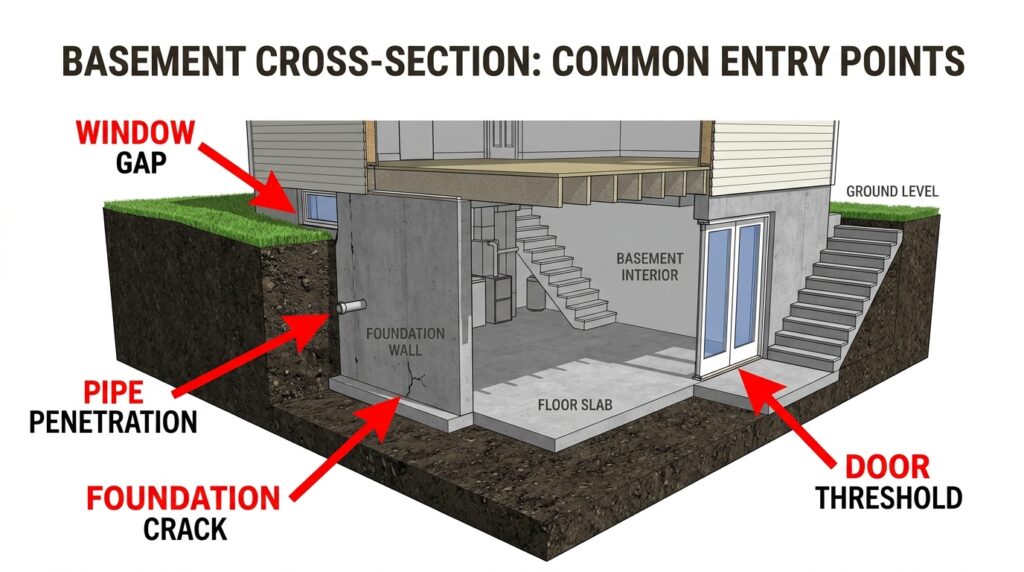
How to Get Rid of Spiders in Basement: Step-by-Step
Step 1: Deploy glue traps before anything else
Before spraying anything, place glue traps throughout the basement. This serves two purposes: it captures existing spiders immediately, and it tells you where activity is highest. Place Catchmaster tunnel-style traps (B07Q4W5BYY) in every corner, along every wall, behind stored boxes, near the water heater and sump pump, and in any utility areas. Count catches after the first week — concentrations of catches indicate active harborage locations.
Amazon: Catchmaster tunnel-style traps (B07Q4W5BYY)
In a basement with significant spider activity, you may catch 5–20 spiders in the first week from traps alone. This is normal and a sign the strategy is working.
Step 2: Remove webs and vacuum thoroughly
Before applying any spray, remove all existing webs with a vacuum hose attachment. Work systematically: ceiling corners first, then wall-ceiling junctions, then wall corners, then behind and under stored items. Use the vacuum — not a broom — to remove egg sacs along with webs. A single egg sac can contain 100–400 eggs; brushing it with a broom spreads rather than removes them.
Move stored boxes away from walls temporarily during this step. The wall-floor junction behind stored items is a primary spider highway that most homeowners never treat.
Step 3: Apply bifenthrin spray in all corners and along the wall-floor junction
Miss Muffet’s Revenge Spider Killer (B00H4FQKCI) is the right tool here — the extended wand applicator reaches into corners and behind appliances without requiring close contact. Apply along the full perimeter of the basement at the wall-floor junction, into every corner (floor level and ceiling level), along the base of any stored items you can’t move, and into any visible cracks or gaps.
Amazon: Miss Muffet’s Revenge Spider Killer (B00H4FQKCI)
In a dry basement, the bifenthrin residual remains effective for several months. Reapply in early fall before spider season peaks and again in spring. Allow the space to ventilate before use — the solvent carrier dissipates within 30–60 minutes.
Step 4: Apply diatomaceous earth in undisturbed dry areas
For areas of the basement that are consistently dry and undisturbed — behind water heaters, along rim joists, inside wall voids accessible through gaps — Harris Diatomaceous Earth (B00BKIZ7OE) applied in a thin layer provides a persistent kill mechanism that doesn’t degrade. Unlike liquid spray, DE doesn’t evaporate and remains active indefinitely in dry conditions.
Amazon: Harris Diatomaceous Earth (B00BKIZ7OE)
Apply with a duster or squeeze bottle for controlled application. Wear a dust mask. A thin layer is sufficient — thick piles are avoided by spiders. Target the same areas liquid spray can’t reach or won’t maintain residual due to surface conditions.
Step 5: Address moisture if present
If your basement has a humidity problem — visible condensation, musty smell, water staining — spider control is a temporary fix until moisture is addressed. A dehumidifier running during humid months (Midea 50-pint dehumidifier, or any Energy Star unit for the space size) reduces the insect population that supports spiders. Target relative humidity below 50%. A hygrometer confirms whether you’ve reached that threshold.
Fix active water intrusion (cracks, window well drainage) separately — a dehumidifier cannot compensate for active water entry. The moisture elimination alone will reduce the insect population that sustains the spider population.

Garage-Specific Spider Control: What’s Different
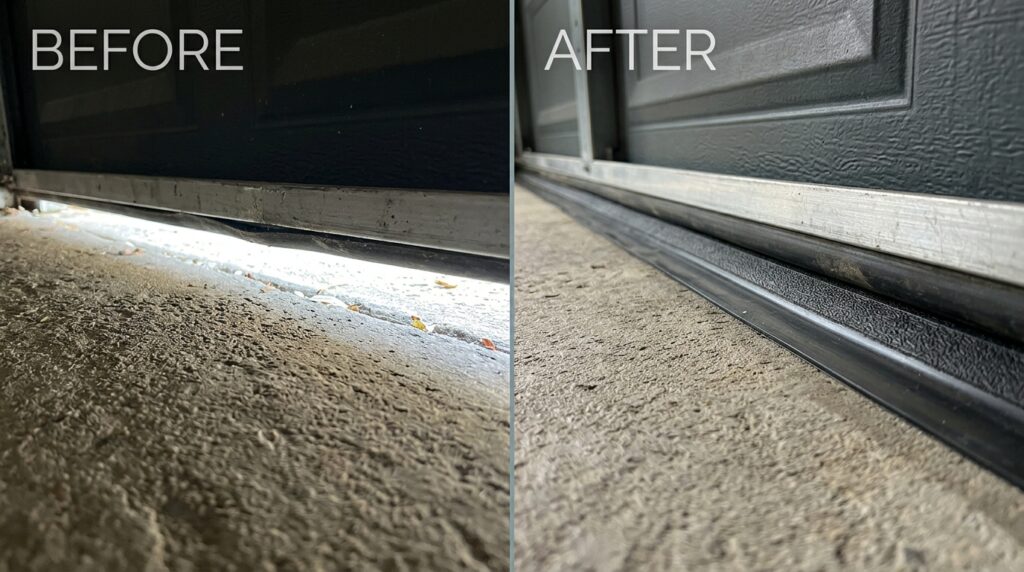
Garages present a different challenge than basements. The primary difference: the garage door gap. A standard sectional garage door leaves a gap at the threshold that serves as the main entry point for wolf spiders, ground beetles, crickets, and the spiders that follow them. Sealing this gap has outsized impact on garage spider populations.
Seal the garage door threshold
A garage door threshold seal (Garadry 1″ Garage Door Threshold Seal, B07WJRZF8C) creates a solid contact between the door bottom and the floor when the door is closed. Installation is DIY — adhesive-backed rubber strip applied to the floor at the door line, door presses against it when closed. Eliminates the primary entry point for ground-level pests. This single fix often reduces garage spider counts more than any spray treatment.
Amazon: Garadry 1″ Garage Door Threshold Seal, B07WJRZF8C
Switch the garage light
Standard white/cool LED and fluorescent garage lights attract large numbers of flying insects, which attract spiders directly to the garage entrance. Switching to amber or yellow LED bulbs (2700K or lower color temperature) significantly reduces insect attraction without reducing light output for working in the garage. The impact on spider populations near exterior lights is measurable within a few weeks.
Treat the exterior perimeter around the garage
Ortho Home Defense (B0756R6GQK) applied as a 12-inch band around the exterior of the garage — along the foundation, across the door threshold exterior, around any window or utility openings — stops spiders before they find entry points. Apply in early spring and again in late summer. This exterior treatment is more efficient than indoor treatment alone because it reduces the pressure at the source.
Amazon: Ortho Home Defense (B0756R6GQK)
Storage organization matters more in garages
Garages often have the worst storage organization in the house — items piled, cardboard boxes stacked, seasonal equipment stored for months. This is perfect spider habitat. Replacing cardboard boxes with sealed plastic bins, organizing items on shelving that allows floor-level access for cleaning and treatment, and eliminating ground-level debris piles removes harborage that can’t be compensated for with chemicals.
Maintenance Schedule to Keep Them Out
Monthly (during spider season, August–November):
- Check and replace glue traps — log catch counts to track whether population is stable, rising, or declining
- Knock down any new webs with vacuum hose
- Inspect threshold seal and window screens for gaps
Seasonally (spring and early fall):
- Reapply Miss Muffet’s Revenge along baseboards and in corners
- Apply Ortho Home Defense on exterior foundation perimeter
- Check DE applications in dry areas and touch up any disturbed spots
Annually:
- Full basement/garage cleanout — move all stored items and treat behind them
- Inspect and seal any new foundation cracks (hydraulic cement for active cracks, paintable caulk for dry cracks)
- Evaluate moisture levels — replace dehumidifier filter if applicable
Safety Note
Bifenthrin sprays (Miss Muffet’s Revenge, Ortho Home Defense) are toxic to cats. Allow 1–2 hours of ventilation and drying time before cats access treated spaces. Highly toxic to fish — do not apply near any water features or floor drains that connect to waterways.
Diatomaceous earth causes respiratory irritation when inhaled in quantity. Always wear a dust mask when applying in enclosed basement spaces. Food-grade DE is non-toxic to mammals when not airborne.
All products are safe for dogs when used as directed and allowed to dry fully before the dog re-enters the space.

Frequently Asked Questions
Why do I suddenly have so many spiders in my basement?
Late summer and fall — typically August through October — is peak spider season in the US. Male spiders become mobile as they search for mates, and cooler outdoor temperatures push spiders toward the warmth of basement and garage spaces. A sudden spike in spider sightings in September or October is normal seasonal behavior, not an infestation starting from scratch. The population was there all summer — it just became more visible. Proactive treatment in late August before peak season is more effective than reactive treatment after they’ve established.
Do cellar spiders actually eat other spiders?
Yes — cellar spiders (the long-legged daddy longlegs type) actively prey on other spiders, including black widows in some documented cases. They invade the webs of other spiders and overpower them. Some pest management professionals consider cellar spiders net beneficial in basements because they reduce populations of other spider species. If you’re tolerant of them and your primary concern is other species (especially in brown recluse territory), there’s a reasonable case for leaving cellar spider populations alone.
How do I keep spiders out of my basement permanently?
“Permanently” is unrealistic — spiders will always attempt to enter any suitable habitat. “Consistently low population” is achievable through the maintenance schedule above. The four factors that matter most long-term: sealed entry points (foundation gaps, door thresholds, window frames), controlled moisture (below 50% relative humidity), reduced clutter (no undisturbed cardboard boxes), and seasonal perimeter treatment. Homes that address all four factors typically see spider populations drop to near zero and stay there between treatments.
Is it normal to have dozens of spiders in the basement?
Depends on the context. A basement with significant harborage, moisture, and insect population can support dozens of cellar spiders and house spiders without any of them being a health or structural concern. “Dozens” of cellar spiders in corners is common in untreated basements and completely harmless. “Dozens” of wolf spiders crossing the floor, or any confirmed brown recluse, is a different situation that warrants active treatment. Let species identification guide your response, not raw count.
Can spiders come up through basement floor drains?
Occasionally, yes. Basement floor drains connect to the drainage system, and small spiders (especially cellar spiders) can navigate the U-bend trap in some drain configurations. This is a minor entry vector — far less significant than foundation gaps and door thresholds. A drain cover or screen cap eliminates it. If you’re seeing spiders consistently emerging near a floor drain, check for standing water nearby that might be breeding insects the spiders are following.
The Basement Is the Key
If you’re fighting spiders throughout your home and not winning, the basement or garage is almost certainly the origin point. A thorough one-time treatment of these spaces — glue traps, complete web removal, bifenthrin spray in every corner, DE in dry undisturbed areas, sealed entry points — breaks the cycle. Maintain it seasonally and the rest of the house stays manageable.
For help identifying what species you’re dealing with before treating, see our common house spider identification guide. For the products discussed here in a full comparison, our spider killers roundup covers the full lineup. The bottom line on how to get rid of spiders in basement and garage spaces: treat the source, seal the entry points, and maintain seasonally. And for the complete whole-home spider control approach, our main spider guide ties all of this together.