
This post contains affiliate links. If you buy through our links, we may earn a commission at no extra cost to you.
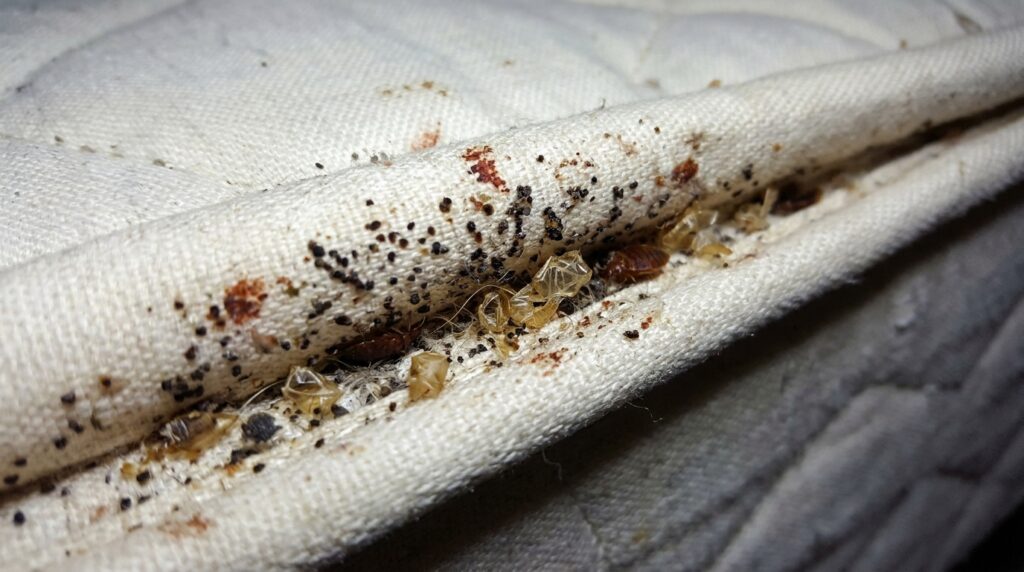
You woke up with itchy red welts. You stripped the bed and found tiny rust-colored stains on the seam of your mattress. Now you’re wondering if your home — and your sleep — are truly compromised.
Here’s the reality: bed bugs are one of the most psychologically distressing pest problems a homeowner can face, but they’re not impossible to eliminate without professional help. Knowing how to get rid of bed bugs yourself saves the average household $500–$1,500 in exterminator fees. The process is methodical, not magical — it requires inspecting every harborage site, applying the right products in the right sequence, and maintaining treatment long enough to break the egg cycle.
This guide covers everything: how to confirm you actually have bed bugs, how to inspect your room systematically, which products work and which don’t, and what to do if DIY treatment isn’t enough.
Quick answer:
The most effective DIY bed bug treatment combines three layers: (1) encasements on the mattress and box spring to trap any bugs inside and eliminate harborage, (2) a residual spray (Harris Bed Bug Killer or Ortho Home Defense Bed Bug) applied to all seams, furniture joints, baseboards, and cracks, and (3) diatomaceous earth in areas where spray can’t reach or maintain residual. Heat treatment of bedding and clothing (60°C / 140°F dryer cycle) kills all life stages including eggs. Expect 2–4 treatment cycles over 4–6 weeks before the infestation is fully resolved.
What Bed Bugs Actually Look Like
Correct identification before treatment is critical — you don’t want to spend weeks treating the wrong pest. Bed bugs at different life stages look quite different:
Adults
Adult bed bugs are flat, oval, reddish-brown, and about the size of an apple seed (4–5mm). They’re visible to the naked eye. Unfed adults are flat and mahogany-colored; after feeding they swell and turn darker red. You’ll find them in harborage sites, not in the open — in mattress seams, behind headboards, in furniture joints, along baseboards.
Nymphs (juveniles)
Nymphs are smaller versions of adults — same shape, but translucent to pale yellow when unfed. After feeding they turn bright red from the blood meal. Five nymph stages exist between hatching and adulthood, ranging from 1.5mm to 4.5mm. Unfed nymphs are easy to miss; fed nymphs are visible as tiny red specks.
Eggs
Bed bug eggs are white, about 1mm long, and shaped like a tiny grain of rice. They’re laid in clusters of 1–5, glued to surfaces with a sticky secretion. You’ll find them in the same harborage sites as adults. Eggs are the hardest life stage to kill — they’re resistant to many sprays and require direct contact with heat or diatomaceous earth to eliminate.
Signs without seeing bugs
You may detect an infestation before seeing a live bug:
- Rust-colored or dark reddish-brown stains on mattress seams, sheets, or walls — digested blood from crushed bugs or fecal matter
- Tiny dark spots (fecal stains) on mattress, headboard, or baseboards — look like fine-tip pen dots
- Shed exoskeletons (translucent, hollow shell of the bug) — these accumulate in harborage sites
- Musty, sweet odor in heavily infested rooms — described as similar to coriander or overripe raspberries
- Itchy, clustered welts on skin — often in rows or zigzag patterns on exposed skin during sleep
How to Inspect Your Bedroom for Bed Bugs
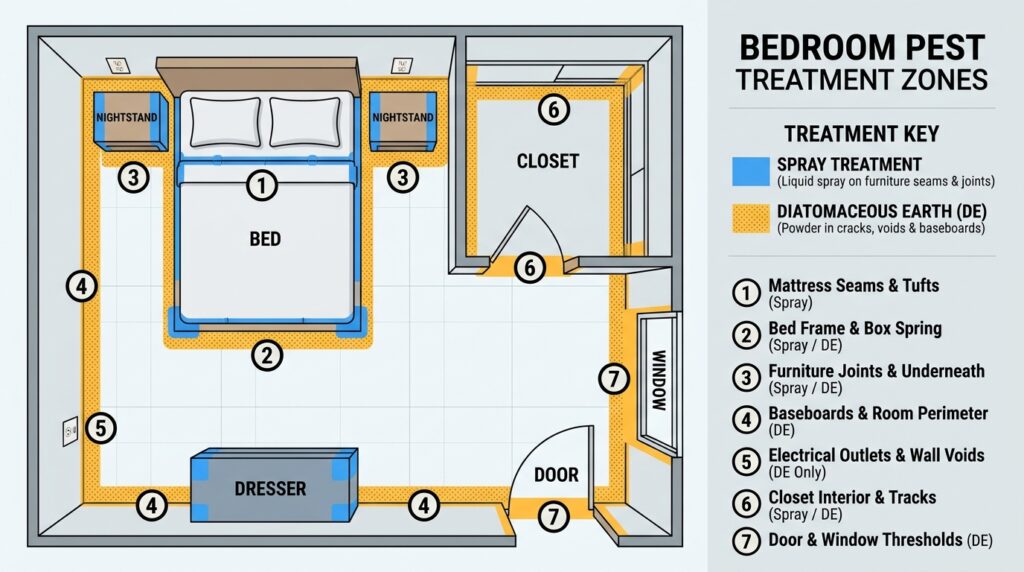
A thorough inspection before treatment tells you where the harborage sites are — and treatment without knowing harborage sites is largely wasted product. This inspection takes 20–30 minutes and requires only a flashlight and a credit card or playing card for probing seams.
Zone 1: The mattress and box spring
Strip all bedding and examine every seam, fold, and label on both the mattress and box spring. Use the card to probe deep into seams — this dislodges bugs hiding in folds. Look for live bugs, shed skins, eggs, and fecal staining. Pay particular attention to corners and where the seam meets the flat surface. The box spring is often more heavily infested than the mattress — remove the fabric dust cover on the bottom and inspect the interior frame.
Zone 2: The bed frame and headboard
Disassemble the bed frame as much as possible. Inspect every joint, screw hole, crack, and hollow section. Headboards — especially upholstered ones — are primary harborage sites. Check behind any wall-mounted headboard; bed bugs frequently live in the gap between the headboard and the wall. For wooden headboards, examine the joints and any decorative crevices.
Zone 3: Nearby furniture
Bed bugs don’t stay on the bed — they spread to any furniture within 6–8 feet of the sleeping area. Inspect nightstands (open drawers, check joints and backs), dressers (especially the bottom drawer and the back panel), and upholstered chairs. Any furniture touching or near the wall should have its back inspected.
Zone 4: Baseboards and walls
Check baseboards along the walls of the bedroom, particularly behind the bed. Loose wallpaper, electrical outlets, and picture frames on bedroom walls are secondary harborage sites in heavy infestations. Use the flashlight at an angle to spot fecal staining along the baseboard line.
How to Get Rid of Bed Bugs: Step-by-Step Treatment
Effective treatment to get rid of bed bugs works in layers — each step targets a different life stage or harborage location. Skip steps and the infestation persists through the gaps.
Step 1: Contain and reduce the population immediately
Before applying any product, reduce the active population through mechanical means:
- Vacuum the entire mattress, box spring, and bed frame using a brush attachment. Empty the vacuum outside immediately — seal the bag or empty canister contents into a plastic bag and dispose.
- Run all bedding, clothing, and soft items from the bedroom through the dryer on high heat (60°C / 140°F) for 30 minutes minimum. This kills all life stages including eggs.
- Bag items that can’t be treated immediately in sealed plastic bags — this prevents spread to other rooms.
Step 2: Encase the mattress and box spring
Mattress encasements serve two functions: they trap any bugs inside (where they’ll eventually die without feeding) and they eliminate the mattress and box spring as future harborage sites — the smooth encasement surface offers no seams or folds to hide in.
SureGuard Mattress Encasement is the benchmark product — designed specifically for bed bug protection with a micro-zipper that bugs can’t escape through. You need one for the mattress and one for the box spring.
Link Amazon: SureGuard Mattress Encasement
Leave the encasements on for a minimum of 12–18 months — bed bugs can survive over a year without feeding.
Step 3: Apply residual spray to all harborage sites
Harris Bed Bug Killer is the most effective OTC residual spray — the active ingredient (deltamethrin or imidacloprid depending on formulation) remains active on surfaces for weeks, killing bugs that walk through treated areas after application.
Apply to every harborage site you identified in the inspection:
- All mattress seams (on the encasement exterior after sealing)
- Bed frame joints, screw holes, hollow sections
- Headboard — front, back, and all joints
- Nightstand and dresser joints, drawer tracks, backs of furniture
- Baseboards along the full perimeter of the bedroom
- Any cracks in walls, around electrical outlets (turn off circuit first)
Link Amazon: Harris Bed Bug Killer
Ortho Home Defense Bed Bug Killer is the alternative — same mechanism, slightly different formulation. Either works.
Link Amazon: Ortho Home Defense Bed Bug Killer
Step 4: Apply diatomaceous earth in dry, undisturbed areas
Diatomaceous earth (DE) is a physical killer — the microscopic sharp edges of fossilized diatoms damage the bug’s exoskeleton, causing dehydration and death within 48 hours. Unlike sprays, DE doesn’t degrade and remains active indefinitely in dry conditions. It also kills eggs by desiccation.
Apply a thin layer in areas where spray can’t maintain residual or where bugs travel:
- Along baseboards behind furniture
- Inside the hollow sections of the bed frame
- In any wall voids accessible through cracks
- Under the dresser and nightstand
Link Amazon: Harris Diatomaceous Earth
Use food-grade DE. Wear a dust mask during application. A thin layer is sufficient — thick piles are avoided by bugs.
Step 5: Install interceptors on bed legs
Bed bug interceptors (ClimbUp or similar) placed under each bed leg serve two purposes: they trap bugs attempting to climb up to the bed, and they monitor whether the population is still active after treatment. Check interceptors weekly — continued catches after 2 weeks of treatment indicate active harborage you haven’t addressed.
Link Amazon: ClimbUp Bed Bug Interceptors
Move the bed away from the wall and ensure no bedding touches the floor — the interceptors only work if the bed legs are the only contact point between the bed and the floor.
Best Products for Bed Bug Treatment
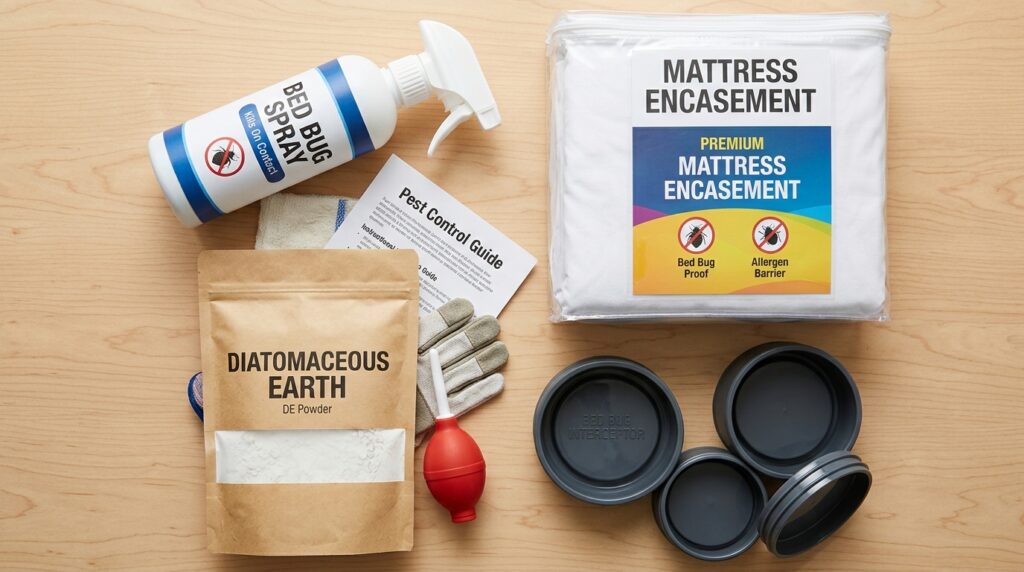
The product category matters more than the brand. Here’s what each type does and when to use it:
Residual sprays — the primary weapon
Residual sprays kill on contact and leave a treated surface that continues killing for weeks. They’re the backbone of DIY bed bug treatment. Look for active ingredients: deltamethrin, imidacloprid, or bifenthrin. Harris and Ortho are the two most reliable OTC options. Avoid aerosol “bed bug bombs” or foggers — they don’t penetrate harborage sites and cause bugs to scatter and spread.
Mattress encasements — eliminate harborage
Not a treatment in the traditional sense, but encasements are non-negotiable. Without them, the mattress remains a harborage site that no spray can fully reach. SureGuard is the only brand specifically engineered for bed bug containment — the zipper design and fabric weave are tested to prevent escape and entry.
Diatomaceous earth — long-term residual
DE is the complement to spray, not the replacement. In dry areas it outlasts any spray residual. It’s the right tool for inside furniture voids, along baseboards, and in areas where you want persistent kill activity without reapplication. Food-grade only.
Interceptors — monitoring and containment
Interceptors tell you if treatment is working. If catches drop to zero after week 2, the infestation is resolving. Continued catches point to missed harborage. They also physically prevent bugs from reaching the sleeping area while treatment progresses.
What does NOT work
Foggers and bug bombs — widely sold for bed bugs, widely ineffective. Bugs retreat deeper into harborage when the aerosol hits the room. Essential oil sprays (lavender, peppermint, tea tree) — repellent in lab conditions, ineffective in real infestations. Ultrasonic repellents — no peer-reviewed evidence of efficacy against bed bugs.
How Long Does It Take to Get Rid of Bed Bugs?
Realistic timeline for DIY treatment:
- Week 1: Initial treatment — spray, encase, install interceptors. Immediate population reduction from vacuuming and heat treatment of bedding. You’ll likely still see bugs or catch them in interceptors.
- Week 2: Second spray application. Eggs laid before treatment begin hatching — the nymphs walk through treated surfaces and die. Interceptor catches should be declining.
- Week 3–4: Third application if catches continue. Interceptor catches should be at or near zero by week 4 if treatment is working.
- Week 6–8: If catches have been zero for 2+ consecutive weeks, the infestation is likely resolved. Continue monitoring monthly for 3–4 months.
What extends the timeline: missing harborage sites, having adjacent units infested (apartments), carrying infested items from one room to another during treatment, not treating on schedule.
When to Call a Professional
DIY treatment is effective for most bed bug infestations, but some situations make professional treatment the better call:
- You’ve completed 3+ treatment cycles over 6 weeks with no reduction in catches — this indicates missed harborage you can’t locate or treat
- The infestation has spread to multiple rooms — treating one room while bugs migrate to others creates an endless cycle
- You live in an apartment building — neighboring units may be continuously reinfesting yours; the building management must coordinate treatment
- You have a heavily upholstered bedroom (thick carpet, multiple upholstered pieces) — spray penetration is limited and professional heat treatment becomes more viable
Professional heat treatment (bringing the entire room to 49°C / 120°F for several hours) kills all life stages in a single treatment. Cost: $500–$1,500 per room. Worth it when DIY treatment has failed twice.
How to Prevent Bed Bugs From Coming Back
Bed bugs don’t come from outside like ants or mosquitoes — they hitchhike. Prevention is about managing the vectors:
Travel protocol
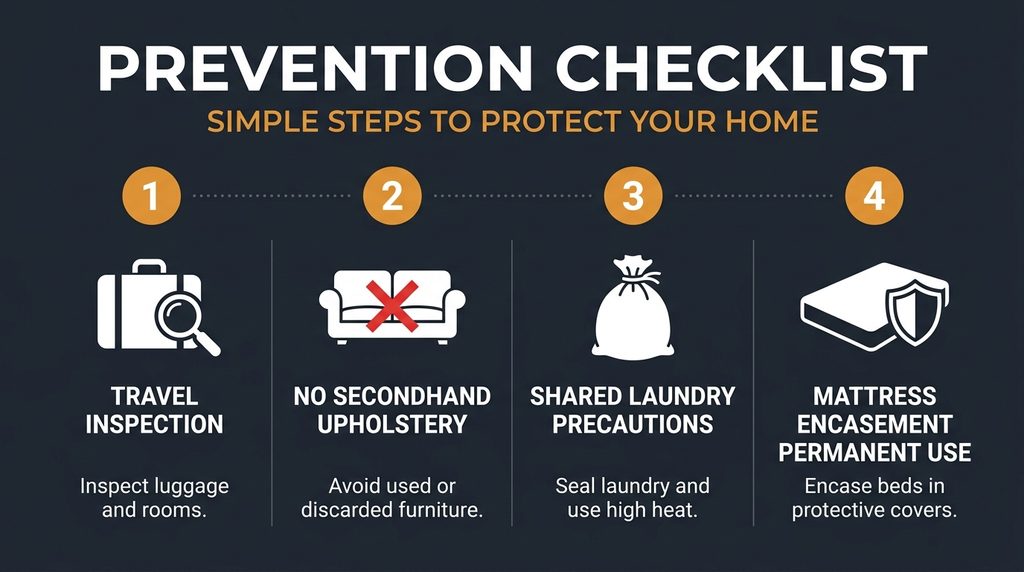
Hotels are the primary source of residential bed bug infestations. When traveling: inspect the hotel mattress seams and headboard before unpacking, keep luggage on the luggage rack away from the bed and walls, and run all clothing through a hot dryer cycle when you get home — before putting items away.
Second-hand furniture
Never bring upholstered furniture (mattresses, sofas, chairs, headboards) from the curb or unknown sources into your home without inspection. Even “clean-looking” items can harbor bugs in joints and seams. Inspect with a flashlight before bringing inside.
Visitors and shared spaces
Bed bugs spread via luggage, clothing, and bags left in infested spaces. In apartment buildings, shared laundry rooms are a transmission vector — use sealed bags to transport laundry and don’t leave clothing unattended.
Maintain encasements
Keep your mattress and box spring encasements in place permanently — not just during active treatment. They eliminate the primary harborage site, making any future infestation easier to detect and treat.
Frequently Asked Questions
Can I get rid of bed bugs myself without an exterminator?
Yes — most moderate infestations respond to DIY treatment. The keys are thoroughness (treating every harborage site, not just the obvious ones), patience (multiple treatment cycles over 4–6 weeks), and using the right products (residual spray + encasements + DE). The cases where DIY consistently fails are multi-room infestations, apartment situations where adjacent units are infested, and when the homeowner misses a major harborage site. If you’ve treated correctly for 6+ weeks without improvement, call a professional.
Do bed bugs only live in beds?
No — the name is misleading. Bed bugs live anywhere within 6–8 feet of where a human sleeps regularly. That includes nightstands, dressers, upholstered chairs, behind headboards, in baseboards, behind electrical outlets, and inside the walls in heavy infestations. The bed is the primary harborage site because it’s closest to the food source, but treating only the bed while ignoring surrounding furniture is a common reason DIY treatment fails.
How do I know if bed bugs are gone?
The most reliable indicator is interceptor catches. When interceptors under all four bed legs show zero catches for two consecutive weeks, and you haven’t seen any live bugs or fresh fecal staining, the infestation is likely resolved. Continue monthly monitoring for 3–4 months. Note that absence of bites alone isn’t confirmation — about 30% of people don’t react to bed bug bites.
Can bed bugs live in carpet?
Bed bugs can hide in carpet temporarily, but it’s not a preferred harborage site — the fibers don’t offer the tight, enclosed spaces they prefer. You’ll more likely find them in the carpet-baseboard junction than deep in the carpet pile. Vacuuming carpet thoroughly and applying DE along the baseboard is sufficient carpet treatment in most cases. Heavy infestations with bugs throughout the carpet indicate a severe, long-standing problem.
What temperature kills bed bugs?
All life stages of bed bugs (including eggs) die at 49°C (120°F) when exposed for 90+ minutes, or instantly at 60°C (140°F). A standard dryer on high heat reaches 60°C — 30 minutes in the dryer kills everything. Freezing also works: 0°F (-18°C) for 4+ days kills all life stages, but most home freezers only reach 0°F in the center with items packed loosely. Heat is more reliable for household use.
Take Back Your Bedroom
The key to how to get rid of bed bugs is understanding that you’re not just killing the bugs you can see — you’re eliminating harborage, breaking the reproductive cycle, and creating conditions where new bugs can’t establish. Encasements + residual spray + DE applied consistently over 4–6 weeks resolves the majority of home infestations.
The worst thing you can do is treat once, see improvement, and stop. Eggs survive the first treatment and hatch 7–10 days later — the second and third cycles are what close the infestation.
Once you’ve resolved the infestation, see our guide on the signs of bed bugs to know what to watch for, and our bed bug mattress cover roundup for the best encasements at every price point.