
This post contains affiliate links. If you buy through our links, we may earn a commission at no extra cost to you.
Apartment cockroach infestations are harder to solve than house infestations — because your neighbors are part of the problem. Here’s the tenant-specific approach that actually works.
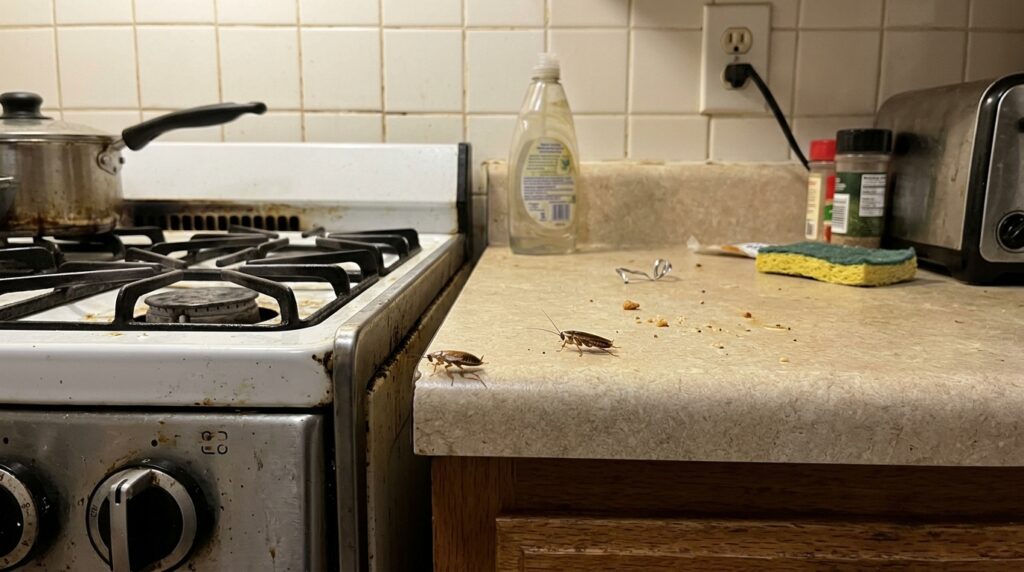
Apartment cockroach infestations are a different problem from house infestations — and they require a different strategy.
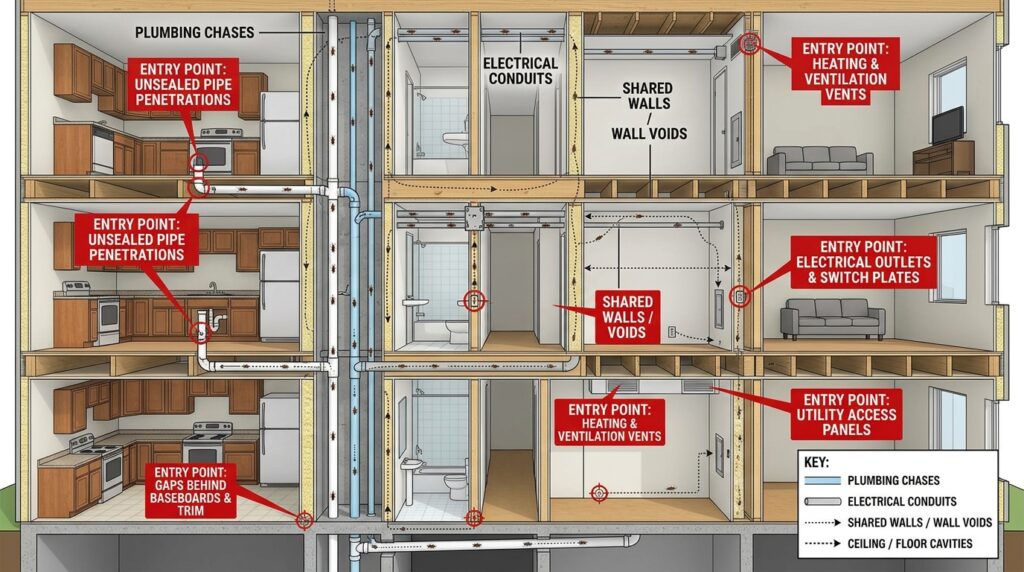
In a house, you treat the infestation and seal the entry points. Done. In an apartment, you can treat your unit perfectly and still have cockroaches return within weeks, because they’re coming through shared walls, plumbing chases, and electrical conduits from a neighboring unit you have no control over.
This guide is specifically written for apartment and condo renters dealing with German cockroaches — the small tan species that establishes colonies indoors. If you’re finding large reddish-brown cockroaches near your drain or basement, those are American cockroaches entering from outside, and the treatment approach is different (see our guide on German vs. American cockroaches).
Quick answer:
For apartments: the treatment protocol is gel bait (Advion) + boric acid (Harris) + IGR (Gentrol) applied inside your unit, combined with aggressive sealing of all shared-wall penetrations and a formal written request to building management to address the building-wide problem. Without building management involvement and sealing, individual unit treatment is a holding action — effective but temporary.
Why Apartments Are a Harder Problem
Three structural factors make apartment cockroach infestations harder to resolve than house infestations:
1. Continuous re-introduction from neighboring units
German cockroaches move freely between units through shared wall voids, plumbing chases (the vertical space around pipes that runs through multiple floors), electrical conduit, and under doors. If a neighboring unit has an established infestation, it will continuously seed your unit after every treatment. You are managing a flow problem, not just a population problem.
2. You don’t control the entire structure
In a house, you can inspect and seal every entry point, treat every harborage area, and address every moisture source. In an apartment, the shared walls, the basement, the hallways, and your neighbors’ units are outside your control. Building-wide treatment is the landlord’s responsibility — not yours — but getting it to happen requires documentation and often escalation.
3. Building history
Apartment buildings accumulate cockroach pressure over decades. Wall voids can harbor populations for years. A unit treated six months ago by a previous tenant may still have viable egg cases in the walls that hatch when you move in and create the warmth and food cues they need.
Step-by-Step Treatment Protocol for Your Unit
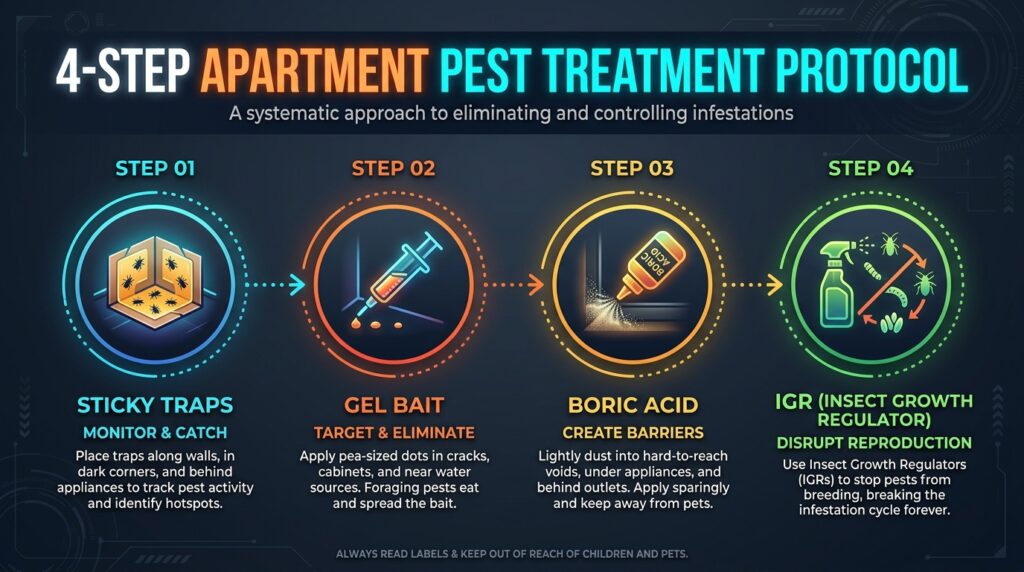
Even with a building-wide problem, treating your unit aggressively gives you the fastest path to a cockroach-free living space while the broader issue is resolved. The three-product protocol below is the same used by pest management professionals — applied correctly, it eliminates the within-unit population in 4–8 weeks.
Step 1: Identify the harborage (before you buy anything)
Place sticky traps inside the kitchen and bathroom for 24–48 hours: one inside the cabinet under the sink, one behind or under the refrigerator, one inside a kitchen cabinet near the stove. The trap that fills fastest is closest to the primary harborage. This targeting step saves you product and tells you exactly where to concentrate treatment.
Step 2: Apply gel bait in all harborage zones
Advion Cockroach Gel Bait (B00AA8I29G) is the highest-performing consumer-available cockroach bait. Apply pea-sized dots (about 0.5g each) every 6 inches in the following locations:
- Inside every kitchen cabinet door hinge — roaches congregate here and the bait is hidden from children and pets
- Along the back wall inside base cabinets, especially near the stove and sink
- Behind the refrigerator, on the floor against the wall
- Under the stove, inside the bottom drawer, and along the back of the broiler drawer
- Under the sink, inside the cabinet on the back wall and under the pipe
- Inside bathroom cabinet hinges and under the sink vanity
Critical rule: do not spray any insecticide in these areas for at least 2 weeks before or after applying bait. Pyrethroid spray residue repels cockroaches from bait and breaks the cascade kill mechanism that makes bait effective against entire colonies.
Amazon: Advion Cockroach Gel Bait (B00AA8I29G)
Step 3: Apply boric acid in voids and under appliances
Harris Boric Acid Roach Powder (B000BWF3GM) reaches areas gel bait can’t — inside wall voids, under motor housings, and in the enclosed spaces cockroaches travel through but don’t stop to feed.
- Under the refrigerator motor — use the applicator tip to puff a thin layer under the motor housing and along the floor perimeter under the fridge
- Inside wall voids around plumbing penetrations — press the applicator tip into the gap and deliver a small amount into the void
- Along the top of the base cabinet interior, at the back where the wall meets the cabinet floor
The application must be a thin, barely visible layer — cockroaches detect and avoid visible piles. If you can clearly see the powder, wipe it up and reapply more lightly.
Amazon: Harris Boric Acid Roach Powder (B000BWF3GM)
Step 4: Apply IGR to interrupt the breeding cycle
Gentrol IGR (B00AA8HUEY) contains hydroprene — a synthetic juvenile hormone analogue that prevents cockroach nymphs from maturing into breeding adults. Applied alongside bait and boric acid, it ensures that nymphs surviving the first treatment cycle can’t reproduce, collapsing the next generation of the population.
In an apartment context, IGR is especially valuable because cockroaches continuously re-entering from neighboring units will include nymphs. An IGR treatment converts many of those nymphs to sterile adultoids, reducing the reproductive success of the incoming population even when you can’t stop the entry entirely.
Use Gentrol Point Source discs (place one under the sink and one under the refrigerator) for no-mix convenience, or mix the concentrate per label and spray harborage areas.
Amazon: Gentrol IGR (B00AA8HUEY)
Sealing: The Step Most Tenants Skip (And Why It’s Critical)
Treatment kills the population you have. Sealing stops the next wave from entering. In an apartment, sealing is more important than in a house because the cockroach pressure from neighboring units is ongoing — not a one-time event.
Where to seal:
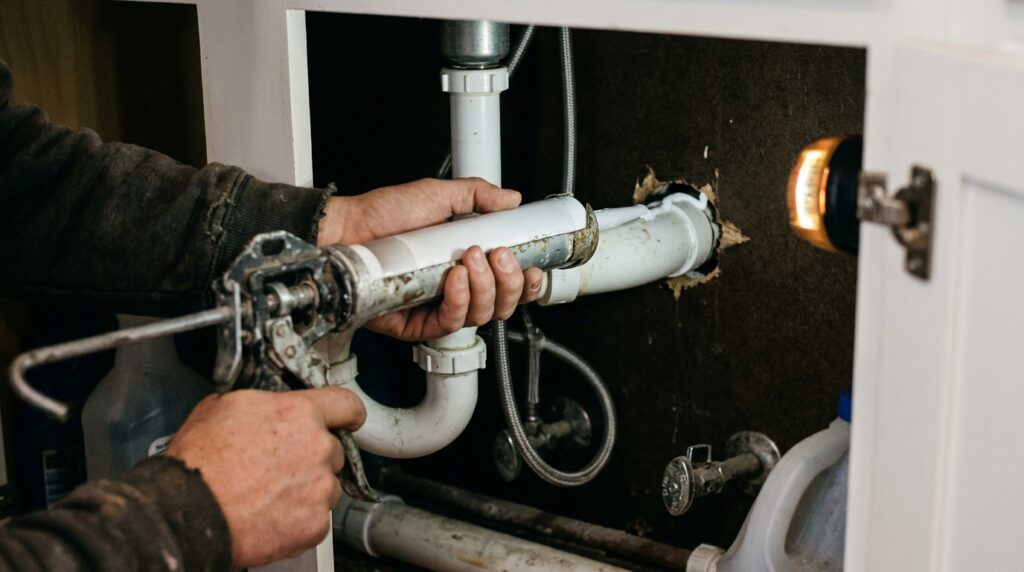
- Around every pipe under the sink — the gap between the pipe and the cabinet wall/floor is a primary entry point. Use DAP Alex Plus caulk (B00004RAXO) or Great Stuff foam for larger gaps.
- The backsplash gap — the space between the countertop and the wall where the two surfaces meet. This runs the length of the kitchen and connects directly to the wall void.
- Around pipes under the bathroom sink and behind the toilet
- Around the base of the stove (if freestanding) — the gap between the floor and the bottom of the stove
- Gaps at the base of kitchen and bathroom cabinets where they meet the floor
- Around electrical outlets and switches on shared walls — remove the cover plate, fill the gap around the electrical box with caulk or fire-rated foam, replace the cover
For large gaps around pipes (more than 1/4 inch), use Xcluder Fill Fabric (B001D2IBNQ) or copper mesh as a backing material before caulking — these materials can’t be chewed through.
Amazon: DAP Alex Plus caulk
Your Landlord’s Responsibility — and How to Get Them to Act
In most US states, landlords are legally required to maintain rental units free of pest infestations as part of the implied warranty of habitability. A cockroach infestation — especially one caused or sustained by building-wide conditions — is typically the landlord’s responsibility to remediate, not the tenant’s.
The practical challenge: getting landlords to take effective action often requires documentation and escalation. Here’s the escalation sequence:
Step 1: Written notification (Day 1)
Send a written notification to your landlord or property management company documenting the infestation — email creates a timestamp. Include: date of first sighting, species description (small tan cockroaches, or large reddish-brown), rooms affected, and photos if possible. Keep a copy. This starts the paper trail.
Step 2: Follow-up and documentation (Week 2)
If no action has been taken within 7–10 days, send a follow-up requesting a specific timeline for treatment. Continue documenting — photos with timestamps, sticky trap catch counts, any witnesses.
Step 3: Local housing authority (Week 3–4 if no response)
Most cities have a housing code enforcement office or tenant affairs office. Filing a complaint triggers an inspection that creates an official record — this often motivates landlords to act more quickly than a tenant request alone. Your city’s website should list the relevant department; search “[your city] housing code enforcement” or “[your city] tenant rights.”
Step 4: Rent escrow / repair and deduct (escalation)
Many states allow tenants to withhold rent into escrow or deduct the cost of repairs from rent when a landlord fails to address habitability violations after written notice. This is state-specific — consult your state’s tenant rights resources before taking this step. Organizations like your local legal aid society often provide free guidance.
Important: Continue treating your unit throughout this process. Waiting for the landlord to act before treating only prolongs your exposure to the infestation. Your treatment protects you; the landlord process protects the building.
Special Situations in Apartments
If you’ve already used sprays and the bait isn’t working
Pyrethroid spray residue (Raid, Hot Shot, most “roach spray” products) repels cockroaches from gel bait. If you’ve sprayed recently and switched to bait with poor results, this is the likely cause. Wait 2 full weeks after your last spray application, then reapply fresh bait. Do a wipe-down of the inside of cabinets with a damp cloth before reapplying — this removes some of the residue.
If you live in a high-rise and cockroaches keep returning
High-rise buildings with German cockroach problems are among the most difficult infestations to resolve because the population reservoir is in the building’s shared infrastructure — pipe chases, electrical conduit, elevator shafts — not just in individual units. In these buildings, individual unit treatment needs to be paired with:
- Thorough sealing of all plumbing penetrations in your unit
- A door sweep on your front door to seal the gap at the base
- Ongoing gel bait maintenance (not just one treatment cycle) — replenish bait every 8–12 weeks as a continuous population control measure
- Building management coordination — effective high-rise treatment requires simultaneous treatment of multiple units, not just yours
If cockroaches are coming from a specific neighbor
You can’t control your neighbor’s unit, but you can control the pathways between your units. The most effective approach is aggressive sealing of the shared wall — every outlet, switch, cable penetration, and plumbing chase on that wall. If the infestation persists, document it in writing to management and request that the neighboring unit be inspected and treated.
If the infestation started when you moved in
A cockroach infestation present when you moved in is almost certainly the landlord’s responsibility under most state habitability laws — you didn’t create it. Document it immediately with photos, a written notification, and (if possible) a witness. Request that treatment be completed before you move furniture in, or negotiate a remediation timeline as part of your lease.
Keeping Cockroaches Out Long-Term
After your treatment cycle is complete (6–8 weeks with consistent bait, boric acid, and IGR), the goal shifts from elimination to prevention. In an apartment, prevention is a permanent practice, not a one-time project.
Ongoing maintenance checklist:
- Replenish gel bait every 8–12 weeks in the same harborage locations — not because you have roaches, but because it creates a continuous barrier that eliminates any individual cockroaches that enter before they can establish a colony
- Check boric acid layers twice a year — refresh if disturbed or wet
- Inspect incoming groceries and cardboard boxes before bringing them inside — transfer groceries to reusable bags, break down cardboard boxes immediately
- Store dry food in sealed hard containers — not bags or cardboard boxes that cockroaches can nest in
- Fix any dripping pipes or moisture issues promptly — a drip under the sink is a cockroach magnet
- Leave sticky trap monitoring cards in place and check monthly — catch a new introduction early before it becomes a colony
Safety Note
All products in this guide are low to moderate toxicity when used correctly and placed in enclosed, inaccessible harborage areas (inside cabinet hinges, under appliances) rather than on open surfaces. Keep pets away from freshly applied bait areas. If your pet ingests any pest control product, contact the ASPCA Poison Control Center at (888) 426-4435.
Frequently Asked Questions
Can I treat cockroaches in my apartment myself, or do I need to call an exterminator?
DIY treatment with the three-product protocol (gel bait + boric acid + IGR) produces results comparable to professional treatment in most German cockroach infestations — because professionals use the same products with the same technique. The advantages of professional treatment are in severe or inaccessible infestations (inside walls, between floors) and in buildings where the landlord coordinates multi-unit treatment. For a standard apartment infestation, DIY is effective and significantly cheaper.
How long does it take to get rid of cockroaches in an apartment?
With consistent application of gel bait + boric acid + IGR: visible reduction within 1–2 weeks, major reduction (80%+) by weeks 3–4, near-complete elimination by weeks 6–8. If cockroaches continue returning after 8 weeks of treatment, the source is continuous re-introduction from neighboring units — this requires sealing and building management involvement, not more product.
Is my landlord responsible for cockroach extermination?
In most US states, yes — cockroach infestations in rental units fall under the implied warranty of habitability, and landlords are required to maintain rental units free of pest infestations. The specific obligations and tenant remedies vary by state. If you notify your landlord in writing and they don’t respond, contacting your local housing code enforcement office is the next step.
Do I have to throw out my food if I have cockroaches?
Cockroaches contaminate food and surfaces they walk on through their feces and body secretions. Food in sealed hard containers (glass, hard plastic, metal) is safe. Food in cardboard boxes, open bags, or paper wrapping should be discarded or transferred to hard containers. You don’t need to clear out an entire pantry, but any package that shows evidence of cockroach activity (droppings, gnaw marks, live or dead roaches) should be discarded.
Can cockroaches travel between apartments through the walls?
Yes — this is one of the primary routes for German cockroach movement in apartment buildings. Wall voids, plumbing chases, and electrical conduit all provide pathways between units. Sealing all penetrations in your unit (pipe gaps, outlet boxes, cable entries) is the most effective way to reduce this entry route without requiring your neighbor to treat.
The Apartment Strategy: Treat Yours, Seal the Path, Document the Rest
Apartment cockroach infestations require a two-track approach: aggressive treatment within your unit using the three-product protocol, and formal documentation and escalation with your landlord to address the building-wide source.
You can control your unit. You can seal the entry points between your unit and the shared spaces. You can document and escalate to management. What you can’t do is solve a building-wide infestation from inside one apartment — and that’s the honest limitation of any DIY approach in multi-unit housing.
For more on the products used in this guide, see our roundup of the best cockroach killers. And for a full step-by-step treatment protocol (not apartment-specific), our how to get rid of cockroaches in your home guide covers every scenario.