
This post contains affiliate links. If you buy through our links, we may earn a commission at no extra cost to you.
Basements are ideal spider habitat — dark, damp, undisturbed, and full of the insects spiders eat. Here’s how to make yours inhospitable.
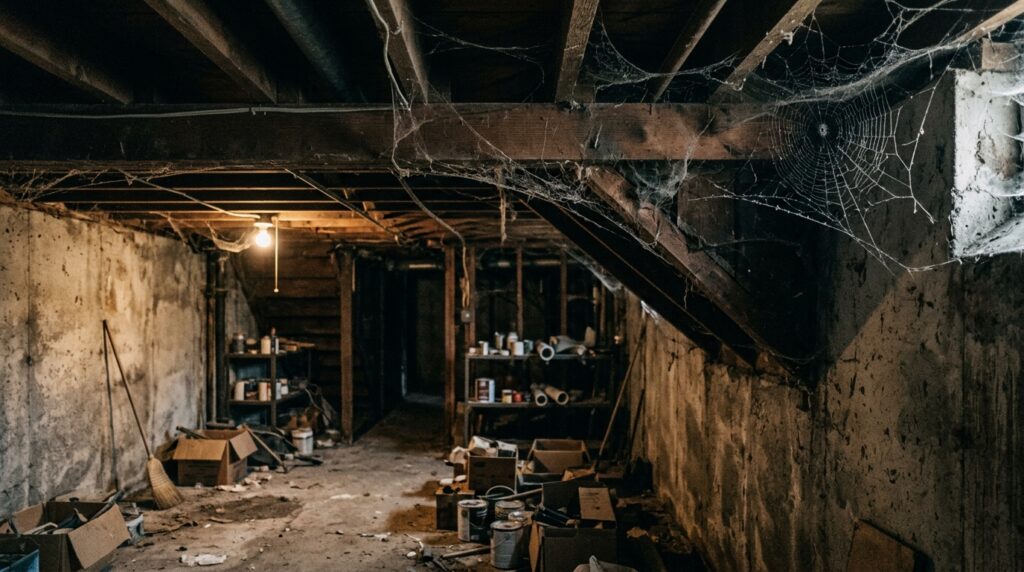
If spiders had an ideal home, it would look exactly like most basements. Dark corners, high humidity, undisturbed clutter, easy access from the outside, and a steady supply of insects. It’s no surprise that basements tend to have more spiders than any other part of the house — often by a wide margin.
The good news: basement spiders respond well to treatment because the space is enclosed. Unlike outdoor populations that continuously replenish, a basement spider population can be dramatically reduced and kept low with the right combination of habitat modification, web removal, and barrier treatment.
Quick answer: Reduce moisture (dehumidifier), remove clutter, vacuum webs and egg sacs consistently, apply a residual spray along baseboards and foundation walls, and seal entry points from outside. This combination eliminates most basement spider populations within 2–4 weeks.
⭐ Our Top Pick:
Web Out Spider Repellent Spray — specifically formulated to repel spiders from building webs on treated surfaces. Apply to walls, corners, and foundation blocks. Keeps spiders from re-establishing after you remove existing webs.
For active infestations: Miss Muffet’s Revenge Spider Killer — contact kill + 12-month residual. Use along basement baseboards, window wells, and foundation walls.
Why Basements Have So Many Spiders
Basements provide everything spiders need in one place:
Moisture: Most basements run 60–80% relative humidity — ideal for cellar spiders and other moisture-tolerant species. High humidity also supports the insects spiders prey on: fungus gnats, drain flies, silverfish, and crickets.
Darkness: Spiders are photophobic — they prefer low light. Basement corners and wall joints rarely see direct light, making them ideal for web construction.
Undisturbed areas: Boxes, stored furniture, and equipment that rarely gets moved provide stable, low-traffic habitat perfect for egg sac development.
Easy entry: Basement walls have more foundation cracks, utility penetrations, and window well gaps than any other part of the house — multiple entry routes for spiders and their prey.
Common Basement Spider Species
Cellar Spiders (Daddy Long-Legs)
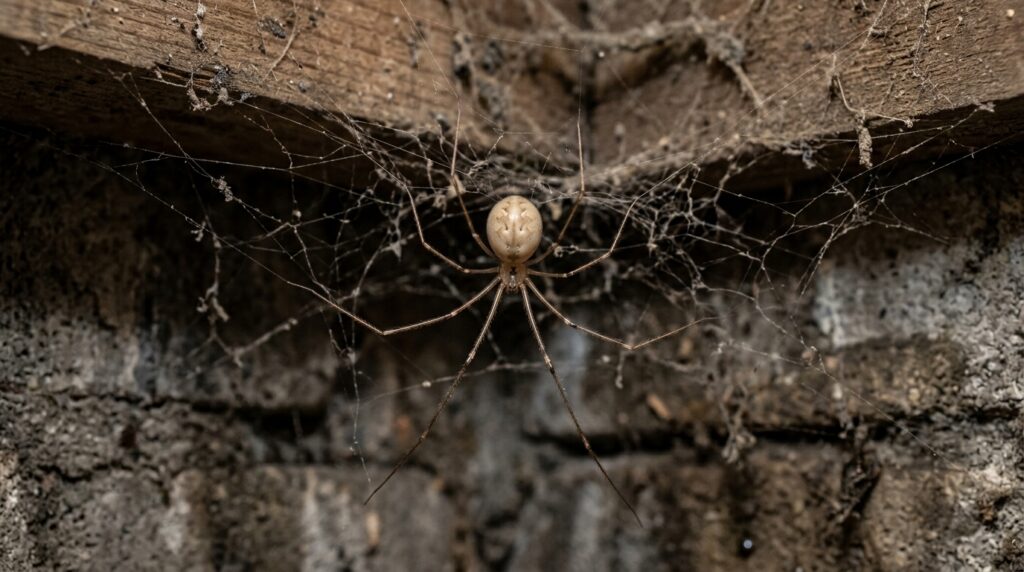
The most common basement spider in North America. Long, thin legs, small body, builds loose irregular webs in corners and ceiling junctions. Completely harmless — fangs too small to pierce human skin. The myth that they’re the most venomous spider in the world is false; their venom is weak.
Identification: Very long legs relative to body size, pale tan to gray body, constantly vibrates in web when disturbed
Cobweb Spiders (Steatoda species)
Round-bodied spiders that build tangled, three-dimensional webs near the floor. Often mistaken for black widows, but Steatoda species have round rather than hourglass markings and are far less medically significant. Common in basements, garages, and crawlspaces.
Wolf Spiders
Large, fast-moving ground hunters that don’t build webs. Brown and patterned, often startling due to size (body up to 1 inch). Common in basements because they follow crickets and other ground insects inside in fall. Harmless to humans — bite only if handled, and bite is no more significant than a bee sting.
Step 1: Reduce Moisture
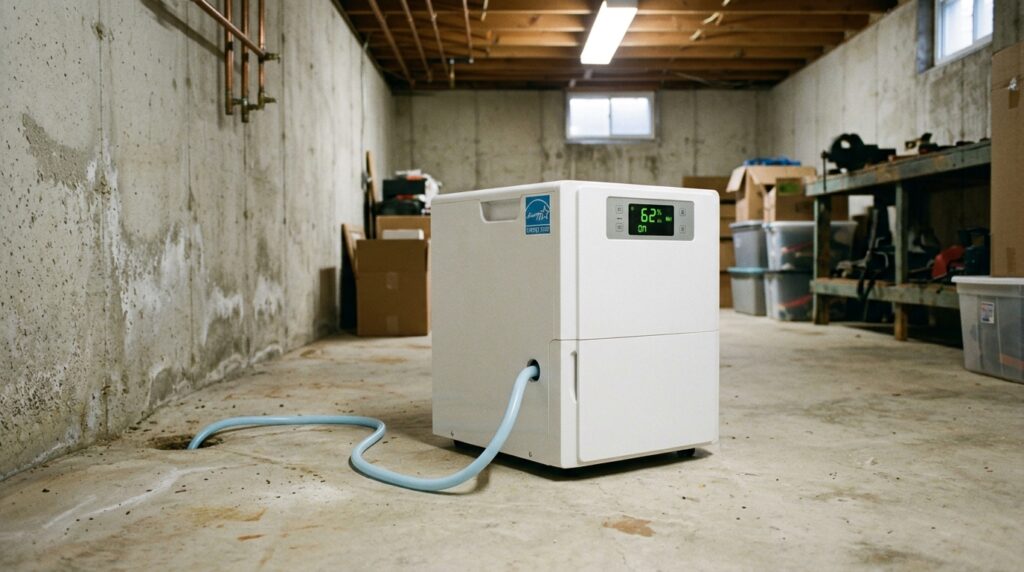
This is the highest-leverage action for long-term basement spider control. Most basement spiders and their prey thrive above 60% relative humidity. Bringing humidity below 50% makes the environment significantly less hospitable — and reduces the fungus gnats, drain flies, and silverfish that spiders eat.
hOmeLabs 4,500 Sq. Ft Energy Star Dehumidifier
The most important tool for basement pest control. Set to maintain 45–50% relative humidity. Models with a continuous drain hose eliminate the need to empty the tank. Run year-round in humid climates.
Additional moisture fixes:
• Ensure downspouts direct water at least 6 feet from the foundation
• Check for plumbing leaks under utility sinks and around water heaters
• Ensure dryer vent exhausts outside, not into the basement
Step 2: Reduce Clutter and Harborage
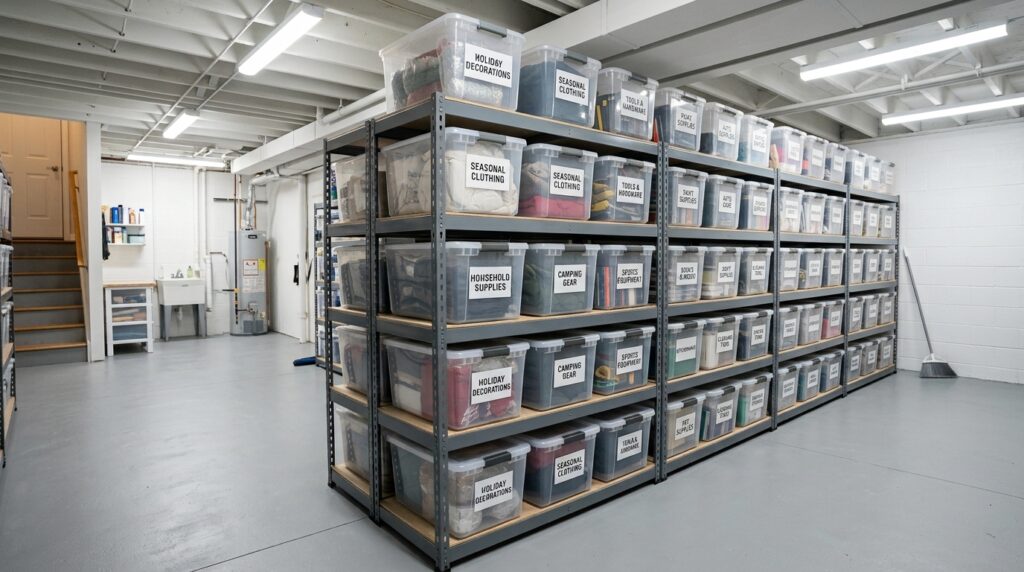
Clutter is spider infrastructure. Cardboard boxes, stacked wood, old furniture, and rarely moved items provide stable habitat for web-building and egg sac development. Reducing clutter is not optional — it’s a core part of the treatment.
• Replace cardboard boxes with sealed plastic storage bins — cardboard absorbs moisture and attracts insects, which attract spiders
• Move storage off the floor onto metal shelving — ground-level storage is prime spider territory
• Remove piles of old newspapers, magazines, and fabric — prime nesting material
• Create clear walking paths through the basement — regular human activity in all areas deters spider settlement
Step 3: Remove Webs Systematically
Vacuum all webs, egg sacs, and spiders using a hose attachment. Work from ceiling to floor — ceiling corners first, then wall joints, then floor perimeter. Pay attention to areas behind and under stored items.
Key areas to target:
• All ceiling corners and wall-ceiling junctions
• Window wells and the frames around basement windows
• Around the water heater, furnace, and utility equipment
• Behind stored items along walls
• Along the sill plate (where the foundation wall meets the floor joists)
Repeat every 2 weeks. Spiders that can’t establish stable webs will relocate.
Step 4: Apply Residual Treatment
After vacuuming all webs, apply a residual spider spray to the surfaces where spiders build and travel. The goal is to create a barrier that kills spiders on contact and discourages re-establishment.
Treatment areas:
• Along the entire perimeter baseboard
• Around all window frames and window wells
• Around utility penetrations (pipes, wires entering the wall)
• Along the sill plate where foundation meets framing
• Inside window wells where spiders enter from outside
Follow-up: Apply Web Out spider repellent to walls and corners after the initial treatment to prevent web rebuilding. Reapply every 4–6 weeks.
Step 5: Seal Entry Points
Basement walls have more entry points than any other part of the house. Sealing them reduces both spider entry and the insect prey they follow inside.
• Foundation cracks: fill with hydraulic cement or polyurethane caulk
• Gaps around pipes and wires entering the foundation wall: pack with steel wool, then caulk over
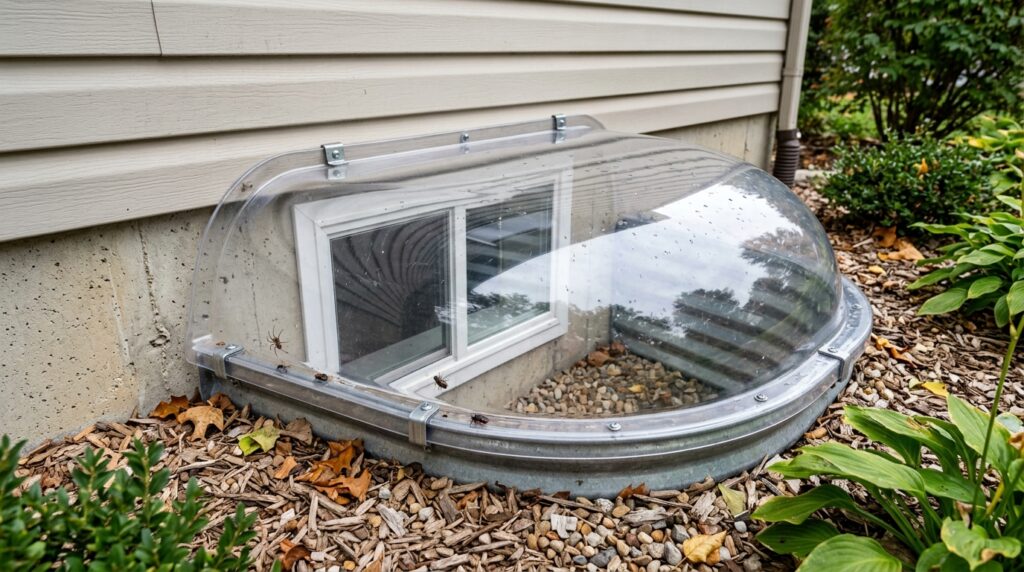
• Window well covers: install covers over basement window wells to block a major entry route for spiders and insects
• Gaps at the sill plate: use foam backer rod and caulk to seal the joint between the foundation wall and the wood framing
Frequently Asked Questions
Are cellar spiders (daddy long-legs) dangerous?
No. Cellar spiders are completely harmless to humans. The widely repeated claim that they’re the most venomous spider but can’t bite through human skin is a myth — their venom is weak and of no medical concern. They’re actually beneficial, as they prey on other spiders including black widows when they share a space.
How do I get rid of wolf spiders in the basement?
Wolf spiders follow crickets and other ground insects into basements in fall. Treat the entry points (foundation gaps, window wells) with residual spray, use sticky traps along the perimeter to monitor and catch ground-running spiders, and reduce the cricket population they’re following. A dehumidifier reduces cricket activity, which reduces wolf spiders.
How long does it take to see results?
With consistent web removal and residual spray, most basement spider populations show significant reduction within 2–4 weeks. The dehumidifier effect takes longer — 4–6 weeks to fully suppress the moisture-dependent insects that spiders feed on. Sealing entry points produces results within 1–2 weeks by stopping new arrivals.
Should I use glue traps for basement spiders?
Glue traps (sticky boards) are useful for monitoring — they tell you where spider activity is highest and confirm that treatment is working. Place them along baseboards and in corners. They catch ground-running spiders like wolf spiders effectively, but web-building spiders (cellar spiders, cobweb spiders) rarely descend to floor level to trigger them.
The Bottom Line
Basement spider control is a habitat problem, not just a pest problem. A dehumidifier, decluttering, consistent web removal, residual spray, and sealed entry points address all the conditions that make basements attractive to spiders. Tackle the habitat and the population drops naturally — tackle only the visible spiders and they’ll be back within weeks.
Concerned about identifying the spiders you’re seeing? See our guide on brown recluse vs. wolf spider identification to confirm what species you’re dealing with.