
This post contains affiliate links. If you buy through our links, we may earn a commission at no extra cost to you.
Not all mosquito repellents are equal — and some popular options barely work at all. Here’s every major repellent ranked by effectiveness, with honest notes on what the research says.
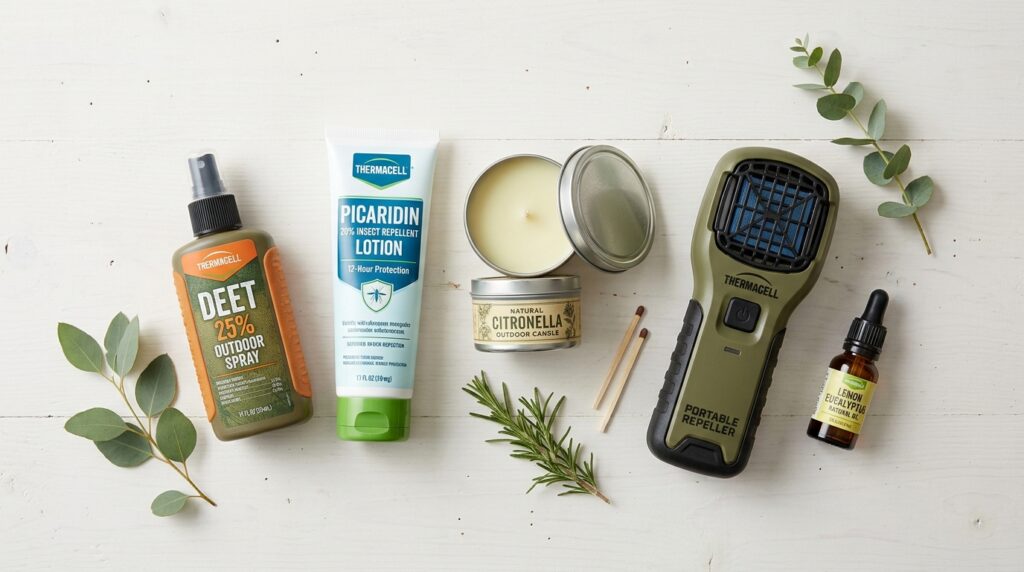
There are more mosquito repellent products on the market than almost any other pest control category — and the effectiveness range is enormous. Some products backed by decades of peer-reviewed research reduce mosquito landing rates by 95%+. Others that are heavily marketed provide less protection than doing nothing, because they attract mosquitoes with their scent before any repellent action kicks in.
This guide ranks every major mosquito repellent category — skin-applied repellents, area devices, candles and coils, wearables, and natural options — by real-world effectiveness data, not marketing claims. Where the research is mixed, we say so.
Quick answer:
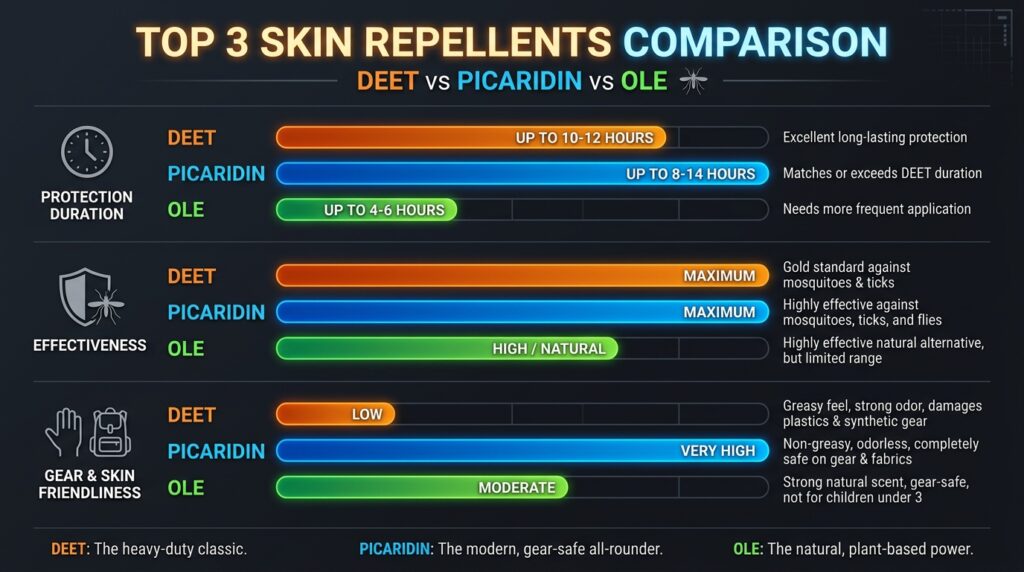
For skin protection, DEET (20–30% concentration) remains the gold standard — the most extensively tested mosquito repellent in existence, with 60+ years of efficacy data. Picaridin (20%) is equally effective, less greasy, and odorless — the best alternative if you dislike DEET’s feel. Oil of Lemon Eucalyptus (OLE, not lemon eucalyptus essential oil) is the most effective plant-based option and CDC-approved. For area protection outdoors, Thermacell devices create a reliable 15-foot zone. Citronella candles, ultrasonic devices, and wristbands provide minimal measurable protection.
1. DEET — The Gold Standard (Still the Best)
DEET (N,N-diethyl-meta-toluamide) has been the benchmark mosquito repellent since 1946 when it was developed by the US Army. More peer-reviewed studies have been conducted on DEET than on any other repellent compound. The conclusion across decades of research is consistent: DEET works, it works well, and it works for longer than alternatives at equivalent concentrations.
How it works:
For decades it was believed DEET simply “smelled bad” to mosquitoes. More recent research (2008 Caltech study) showed DEET directly inhibits olfactory receptors that mosquitoes use to detect the CO2 and lactic acid humans exhale and secrete — essentially making the wearer invisible to mosquito detection. A 2015 follow-up found some mosquitoes can learn to ignore DEET after an initial exposure, but this adaptation is limited and doesn’t significantly affect real-world protection.
Concentration guide:
- 10% DEET: ~2 hours protection
- 20–25% DEET: ~4–5 hours protection — the sweet spot for most outdoor activities
- 30% DEET: ~6 hours protection — maximum recommended for adults
- 40–100% DEET: Not significantly longer protection than 30% — higher concentrations extend duration minimally while increasing skin absorption
Best products:
- OFF! Deep Woods (25% DEET) — the most widely tested consumer product at an effective concentration
- Sawyer Products 20% DEET — long-lasting, widely available
- Repel 100 (98% DEET) — for extreme conditions (hiking in heavily infested areas, military use); not recommended for general residential use
Safety:
DEET is safe for adults and children over 2 months when used as directed (do not apply to hands, around eyes, or under clothing). The American Academy of Pediatrics recommends no more than 30% concentration for children. Decades of use with millions of applications annually have produced no confirmed cases of serious adverse effects from proper use. Avoid on damaged skin or mucous membranes.
Amazon: OFF! Deep Woods (25% DEET)
2. Picaridin — Best Alternative to DEET
Picaridin (also called KBR 3023 or icaridin) was developed in the 1980s and has been available in the US since 2005. At 20% concentration, picaridin matches DEET in protection duration and effectiveness in virtually every head-to-head study. It has three practical advantages over DEET:
- No odor — DEET has a distinctive chemical smell that many users find unpleasant; picaridin is essentially odorless
- Non-greasy — DEET can feel oily and is known to damage plastics, synthetic fabrics, and watch faces; picaridin is not
- More pleasant skin feel — often described as lighter and more comfortable for all-day use
How it works:
Picaridin works by a similar mechanism to DEET — blocking the olfactory receptors mosquitoes use to locate hosts. The protection profile is nearly identical at equivalent concentrations.
Concentration guide:
- 5–10% picaridin: ~2–4 hours protection
- 20% picaridin: ~8–10 hours protection — the highest consumer-available concentration and the recommended level for maximum protection
Best product:
Sawyer Products Premium Insect Repellent with 20% Picaridin (B004O1DHLW) — the most effective and widely available picaridin product in the US market.
Amazon: Sawyer 20% Picaridin Insect Repellent 4-Ounce Twin Pack Lotion and 4-Ounce Premium Pump Spray
3. Oil of Lemon Eucalyptus (OLE) — Best Plant-Based Option
Oil of Lemon Eucalyptus is the only plant-derived active ingredient recommended by the CDC for mosquito repellent. It is important to distinguish OLE from lemon eucalyptus essential oil — these are different products with different effectiveness profiles.
OLE vs. lemon eucalyptus essential oil:
- Oil of Lemon Eucalyptus (OLE): A refined, concentrated extract standardized to contain at least 64% para-menthane-3,8-diol (PMD) — the active repellent compound. CDC-approved. Provides up to 6 hours protection at the right concentration.
- Lemon eucalyptus essential oil: The raw, unrefined essential oil from the lemon eucalyptus tree. Much lower PMD concentration. Not CDC-approved. Significantly less effective.
The marketing on many “natural” repellents obscures this distinction. If a product says “oil of lemon eucalyptus” and lists PMD as the active ingredient, it’s the effective version. If it says “lemon eucalyptus essential oil” in the ingredients with no PMD percentage, it’s not.
Best product:
Repel Plant-Based Lemon Eucalyptus Insect Repellent (B000BGLKL4) — 30% OLE, up to 6 hours protection. CDC-approved. The most effective plant-based option available.
Limitation:
OLE is not recommended for children under 3 years old. At equivalent duration of protection, DEET and picaridin remain more effective — OLE is the best option for those who specifically want a plant-derived repellent, not the top performer overall.
Amazon: Repel Plant-Based Lemon Eucalyptus Insect Repellent (B000BGLKL4)
4. IR3535 — Effective but Less Common
IR3535 (Ethyl butylacetylaminopropionate) is a synthetic amino acid derivative developed by Merck in the 1970s. It’s widely used in Europe and gaining traction in the US. At 20% concentration, it provides approximately 2–4 hours of protection — less than picaridin or DEET at equivalent concentrations, but more than most natural alternatives. It is non-toxic, odorless, and safe for children and pregnant women.
Products: Avon Skin So Soft Bug Guard Plus IR3535 is the most commonly available US product. Effective for light mosquito pressure; less suited to high-exposure environments.
5. Thermacell — Best Area Repellent for Outdoors
Thermacell devices are the most effective area mosquito repellent available for outdoor use. Unlike skin-applied repellents that protect the individual wearing them, Thermacell creates a protected zone — a 15-foot radius of repellent vapor — that works for everyone in the area without requiring application to skin.
How it works:
Thermacell devices use a butane cartridge to heat an allethrin-impregnated mat. Allethrin (a synthetic pyrethroid) vaporizes and creates a repellent zone in the surrounding air. Mosquitoes detect the allethrin and avoid the zone. The device doesn’t kill mosquitoes — it repels them from the protected area.
Effectiveness data:
A 2002 peer-reviewed study in the Journal of the American Mosquito Control Association found Thermacell devices reduced mosquito landing rates by 97% in a field test. Consumer Reports has consistently rated Thermacell as one of the most effective area repellents in their testing. The main limitation is wind — effectiveness drops significantly in wind above ~8 mph.
Models:
- Thermacell Patio Shield (B07QKGK4FM): Designed for stationary outdoor use — patios, decks, outdoor dining. No butane required; plugs into a standard outlet. 15-foot zone.
- Thermacell E55 Rechargeable Mosquito Repeller (B08D73FKFQ): Rechargeable version for portable use — camping, hiking, yard work. No butane, USB charging. 20-foot zone.
- Thermacell MR450 Armored Mosquito Repeller: Butane-powered, ruggedized. The most durable portable option.
Amazon Patio Shield: Thermacell Patio Shield (B07QKGK4FM)
Amazon E55: Thermacell E55 Rechargeable Mosquito Repeller (B08D73FKFQ)
6. Citronella — Limited Effectiveness (Not as Good as Marketed)
Citronella is the most widely marketed “natural” mosquito repellent, and it does have measurable repellent activity — but significantly less than DEET, picaridin, or even OLE at real-world use conditions.
What the research shows:
- Citronella-based skin repellents (5–10% citronella oil): Provide approximately 20 minutes to 2 hours of protection — significantly shorter than any EPA-registered repellent at comparable concentrations
- Citronella candles: A 2002 study in the Journal of the American Mosquito Control Association found that citronella candles reduced mosquito landings by ~42% compared to no candle — less than a plain candle (which reduced landings by ~23% due to heat disruption alone), though the citronella candles performed better in confined spaces
- Citronella torches: Similar to candles — moderate reduction in close proximity, minimal effect beyond 3–4 feet
The honest verdict:
Citronella products provide some protection, particularly when burning directly next to you. But the protection radius is small, the duration is short, and they don’t approach the effectiveness of registered repellents. They’re a pleasant ambiance addition with modest pest control benefit — not a reliable mosquito defense.
7. Essential Oils (Lavender, Lemongrass, Eucalyptus, Peppermint) — Mostly Ineffective
Natural essential oils are heavily marketed as mosquito repellents, and some do have measurable repellent compounds. The problem is concentration and duration:
- Most essential oils evaporate within 20–30 minutes at skin temperature
- The concentration of active repellent compounds in raw essential oils is typically far below what’s needed for meaningful protection
- No essential oil repellent (other than OLE standardized to PMD content) is EPA-registered or CDC-recommended
A 2011 study in Phytotherapy Research tested 38 essential oil combinations against mosquitoes. The most effective (a coconut oil + citronella combination) provided up to 2 hours protection. Lemongrass, eucalyptus, and peppermint oils provided 30–60 minutes in controlled lab conditions — less outdoors where evaporation is faster.
These are not zero — they provide some protection, especially when freshly applied in high concentrations. But for any situation where mosquito exposure matters (disease risk areas, prolonged outdoor time, high mosquito pressure), essential oils are insufficient protection.

What Doesn’t Work (Save Your Money)
Ultrasonic mosquito repellers
Ultrasonic devices claim to repel mosquitoes using high-frequency sound waves. Multiple peer-reviewed studies have found zero measurable effect on mosquito behavior. A 2007 Malaria Journal review of 10 field studies on ultrasonic repellers concluded that none showed any significant mosquito repellent effect. The FTC has taken enforcement action against manufacturers making unsupported claims. Don’t buy these.
Mosquito repellent wristbands
Wristbands impregnated with citronella, DEET, or other compounds provide only localized protection around the wrist — not your face, neck, or the rest of your body, where most mosquito bites occur. A 2017 PLOS ONE study tested 10 commercial wristbands and found “complete absence of significant repellency” for most, and only localized protection for those with DEET or picaridin. Not worth the cost for meaningful protection.
Vitamin B1 (thiamine) supplements
The claim that taking vitamin B1 supplements changes your body odor and repels mosquitoes is a persistent myth with no scientific support. Multiple controlled studies have found no difference in mosquito attraction between B1-supplemented and control subjects.
Garlic (eating or spraying)
Both dietary garlic and spraying diluted garlic extract in the yard have been studied as mosquito repellents. Results: no significant protection effect in any controlled study. The allicin compounds in garlic do have some insecticidal activity at very high concentrations in lab settings — not at the concentrations achievable through diet or typical yard sprays.
Bug zappers
As covered in our yard mosquito guide, bug zappers kill primarily non-target insects (moths, beetles) with minimal mosquito kill. They also use UV light, which can actually attract more mosquitoes to your yard before the zapper kills them. Not recommended for mosquito control.
Permethrin-Treated Clothing — A Separate (and Very Effective) Layer
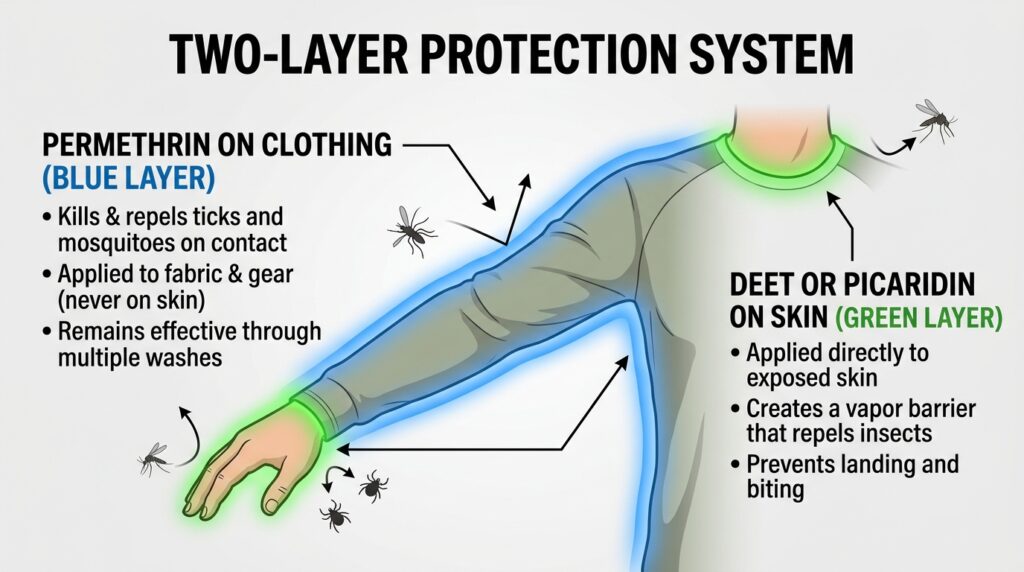
Permethrin applied to clothing — not to skin — is one of the most effective mosquito protection strategies available, and it’s widely underused outside of outdoor enthusiasts and military personnel.
Permethrin on fabric kills mosquitoes on contact (they die when they land on treated clothing) and repels others. A mosquito that lands on a permethrin-treated shirt typically dies within 30 seconds. Combined with a skin repellent (DEET or picaridin) on exposed skin, this creates a two-layer system that approaches 100% protection in most conditions.
- Sawyer Permethrin Clothing Insect Repellent Spray (B001AO2YRO) — spray onto clothing and allow to dry. Bonds to fabric and remains effective through 6 washes.
- Pre-treated clothing: Insect Shield and ExOfficio brand clothing comes factory-treated and retains effectiveness for 70 washes. More expensive upfront, but low maintenance.
Important: Do not apply permethrin to skin — it is for clothing and gear only. It is particularly toxic to cats; keep cats away from treated clothing until it has completely dried.
Amazon: Sawyer Permethrin Clothing Insect Repellent Spray (B001AO2YRO)
How to Choose the Right Repellent for Your Situation
For a backyard barbecue or patio use:
Thermacell device (no skin application needed for stationary outdoor time) + citronella candles if you want ambient light. Apply picaridin or DEET to exposed skin if you’ll be moving around the yard.
For hiking, camping, or extended outdoor time:
DEET 25–30% or picaridin 20% on exposed skin + permethrin-treated clothing. The two-layer system. Reapply skin repellent every 4–6 hours.
For children (2 months – 3 years):
Products with 30% DEET or less, or 20% picaridin. Apply to your hands first, then to child’s skin — avoid hands, around eyes, and cuts or irritated skin. OLE is not recommended under age 3.
For travel to areas with mosquito-borne disease risk (Zika, dengue, malaria):
DEET 30% or picaridin 20% on all exposed skin + permethrin-treated clothing. This is not the situation for essential oils or wristbands. Consult your doctor or travel medicine specialist for destination-specific guidance.
For those who prefer natural options:
Oil of Lemon Eucalyptus (OLE, 30%) is the only plant-based option with CDC endorsement and meaningful protection duration. Reapply every 4–6 hours. Not for children under 3.
Frequently Asked Questions
Is DEET safe to use?
Yes. DEET has been used by hundreds of millions of people since 1946 with an excellent safety record when used as directed. The EPA and CDC have both concluded that DEET, when applied correctly (not to hands or around eyes, not in enclosed spaces, washed off when indoors), poses no significant health risk to adults or children over 2 months. The risk of mosquito-borne disease in many areas significantly outweighs the minimal risk of properly applied DEET.
Is picaridin better than DEET?
At 20% concentration, picaridin matches DEET in protection duration and effectiveness. Picaridin has the practical advantage of being odorless, non-greasy, and safe for use with plastics and fabrics. For most users, these comfort advantages make picaridin the preferred choice. For situations with extreme mosquito pressure (heavy infestation areas, disease risk zones), 30% DEET provides slightly longer protection than any currently available picaridin concentration.
Do natural mosquito repellents work?
Some do, to a limited degree. Oil of Lemon Eucalyptus (OLE, not lemon eucalyptus essential oil) is CDC-approved and provides up to 6 hours protection at 30% concentration — comparable to DEET at similar concentrations. Other essential oils (citronella, lavender, lemongrass) provide 20 minutes to 2 hours at best and are not EPA-registered. Ultrasonic devices and wristbands have no meaningful scientific support.
How long does mosquito repellent last?
Duration depends on concentration and active ingredient: 10% DEET provides ~2 hours; 25–30% DEET, ~4–6 hours; 20% picaridin, ~8–10 hours; 30% OLE, ~6 hours. Sweating, swimming, and rain significantly shorten protection — reapply after water exposure or heavy sweating regardless of the stated duration. Most repellents instruct reapplication every 4–6 hours under normal conditions.
What do mosquitoes hate most?
Mosquitoes detect hosts primarily through CO2 (your breath), body heat, and certain skin volatiles (lactic acid, certain carboxylic acids). DEET and picaridin work by blocking the receptors mosquitoes use to detect these cues. The scents most repellent to mosquitoes in research settings include DEET, picaridin, PMD (from OLE), and certain synthetic compounds not yet commercially available. Contrary to popular belief, there’s no reliable evidence that dietary changes (vitamin B1, garlic, eating bananas or avoiding them) measurably affect mosquito attraction.
The Repellent Stack That Actually Works
For most people in most situations: picaridin 20% (Sawyer) on exposed skin, Thermacell on the patio, and permethrin on outdoor clothing if you spend significant time outside. This combination covers skin protection, area protection, and clothing protection across the three contexts where mosquitoes find you.
Skip the ultrasonic devices, wristbands, and essential oil sprays — the research on these is clear, and the money is better spent on products with a track record.
For controlling the mosquito population in your yard rather than just repelling them, see our full guide on how to get rid of mosquitoes in your yard. And if mosquitoes are getting inside, our post on how to get rid of mosquitoes inside the house covers entry points and indoor treatment.