
This post contains affiliate links. If you buy through our links, we may earn a commission at no extra cost to you.
Mosquitoes breed in your yard before they bite you in it. Here’s how to cut mosquito pressure at the source — breeding sites, yard treatment, and the devices that actually work.
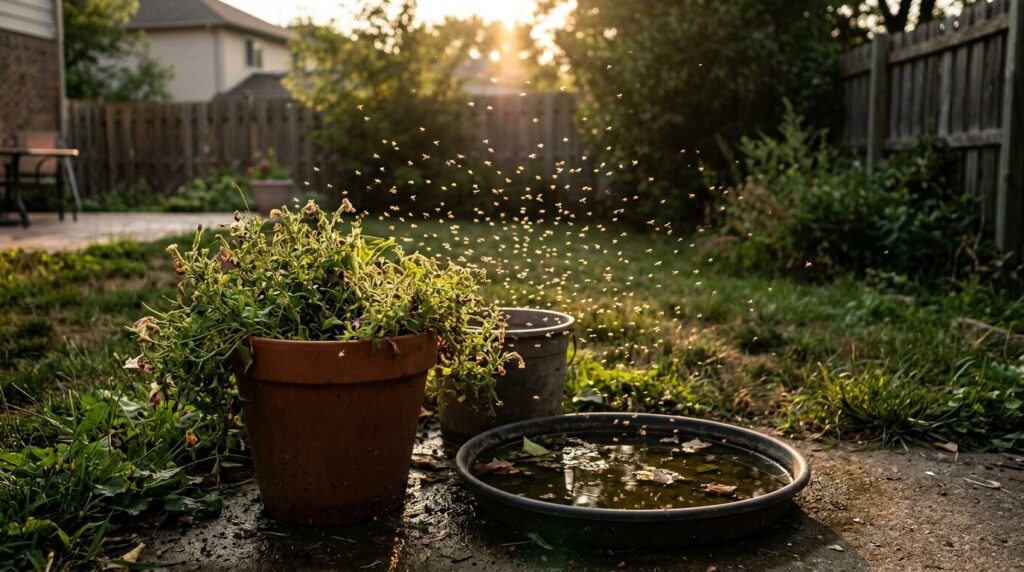
Every mosquito that bites you in your yard was born in your yard — or within a few hundred feet of it. Female mosquitoes rarely travel more than 300 feet from their breeding site to feed. Which means the mosquitoes ruining your backyard barbecue almost certainly hatched in a bottle cap’s worth of standing water somewhere on your property.
That’s the most important thing to understand about yard mosquito control: spraying for adult mosquitoes without eliminating breeding sites is like mopping the floor with the faucet running. You’ll get temporary relief, but the population rebuilds in days.
This guide covers the complete approach — breeding site elimination first, then yard treatment for adult mosquitoes, then the devices and repellents that provide ongoing protection.
Quick answer:
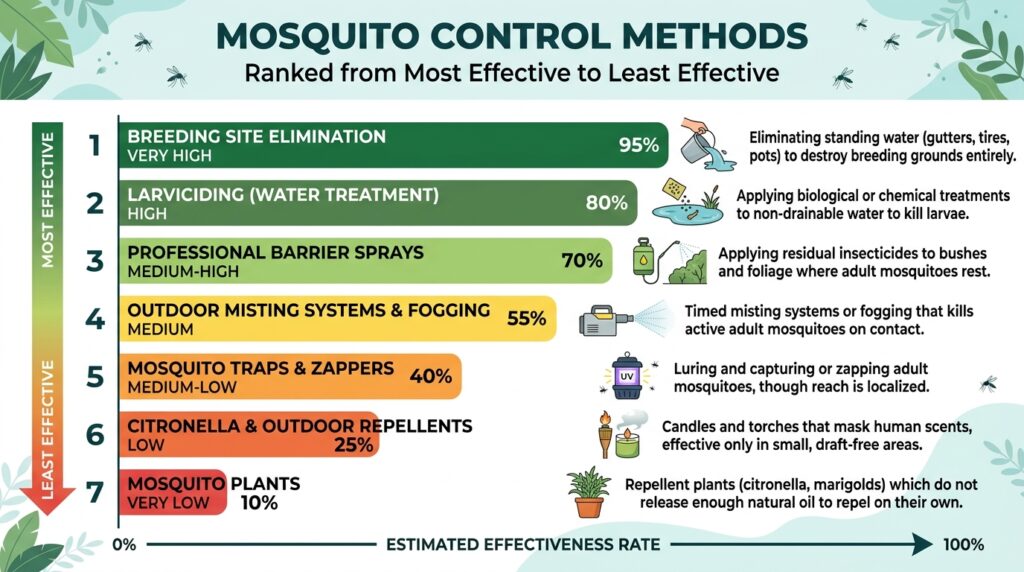
The highest-leverage action for yard mosquito control is eliminating standing water — every container, clogged gutter, and low spot holding water on your property is a breeding site. After eliminating breeding sites, apply a yard spray (permethrin-based, like Thermacell’s Mosquito Barrier or Ortho Home Defense) to shrubbery and ground cover where adult mosquitoes rest during the day. Add a propane or butane heat device (Thermacell) for protected outdoor seating areas. This three-layer approach reduces mosquito presence by 70–90% in most residential yards.
Step 1: Eliminate Every Breeding Site on Your Property
Mosquitoes need as little as half an inch of standing water to lay eggs, and larvae develop to adulthood in 7–10 days. A single female lays 100–200 eggs per batch and can lay multiple batches per season. This means one overlooked breeding site can produce thousands of mosquitoes over a summer.
The mosquito species most responsible for residential yard populations in the US — Aedes albopictus (Asian tiger mosquito) and Aedes aegypti — are container breeders. They prefer small, discrete water containers over large open water sources. This makes them highly dependent on your property for breeding.
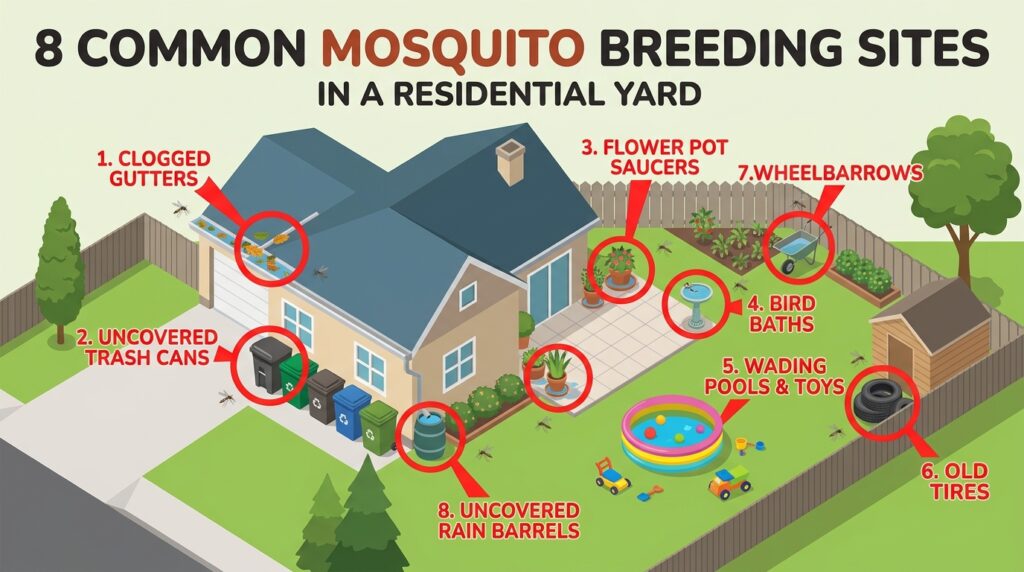
Common breeding sites homeowners miss:
Gutters
Clogged gutters holding leaf debris and water are one of the most productive mosquito breeding sites on most residential properties — and one of the least inspected. Clean gutters in spring before mosquito season and again in fall. Install gutter guards if clogging is a recurring problem.
Saucers under flower pots
The saucer under every outdoor flower pot holds standing water. Empty them weekly, or drill a hole to allow drainage. In peak season (June–September in most of the US), even four days of standing water is enough to start a breeding cycle.
Bird baths
One of the most visible mosquito breeding sites in residential yards. Change the water every 3–4 days, or add a solar-powered agitator to keep the water moving — mosquitoes cannot lay eggs in moving water. Alternatively, treat with Mosquito Dunks (B000BT0ZQS) — a BTi-based biological larvicide that is safe for birds and other wildlife.
Tarps, pool covers, and playground equipment
Any depression in a tarp or pool cover collects water. Adjust or tighten tarps so water runs off. Check the underside of playground slides after rain.
Wheelbarrows, buckets, and yard tools
Any container left outside holds water after rain. Store upside down, or drill drainage holes.
Low spots in the lawn
Areas where the lawn holds water after rain for more than 24 hours are breeding sites. Aerate and top-dress with compost to improve drainage, or fill and regrade low spots.
Tree holes and stumps
Cavities in mature trees collect rainwater. Fill with expansion foam or mortar, or treat with BTi weekly during peak season.
Neglected swimming pools
An unmaintained pool without chlorination can produce tens of thousands of mosquitoes. Maintain chlorination and run the pump daily to keep water circulating.
Children’s toys and sandboxes
Plastic toys left outside, sandbox covers, and any concave toy surface collects water. Store inside or covered when not in use.
Step 2: Treat Water You Can’t Eliminate With Larvicide
Some water sources can’t be drained — decorative ponds, rain barrels, and drainage areas that hold water after heavy rain. For these, a biological larvicide prevents mosquito larvae from developing without harming other wildlife.
Mosquito Dunks (BTi — Bacillus thuringiensis israelensis)
Mosquito Dunks (B000BT0ZQS) contain a naturally occurring soil bacterium (BTi) that produces proteins toxic to mosquito and other fly larvae but harmless to fish, birds, pets, and humans. One dunk treats 100 square feet of water surface for up to 30 days. Place in any standing water you can’t drain — decorative ponds, rain barrels, drainage ditches, and tree holes.
- Active ingredient: Bacillus thuringiensis israelensis (BTi)
- Target: Mosquito larvae only — does not harm aquatic wildlife
- Coverage: 1 dunk per 100 sq ft of water surface
- Duration: Up to 30 days per dunk
- Safe for: Fish ponds, bird baths, rain barrels, pet water dishes
Amazon: Mosquito Dunks (B000BT0ZQS)
Step 3: Apply a Yard Spray for Adult Mosquitoes
After eliminating and treating breeding sites, a yard spray targets the adult mosquito population — the ones currently biting. Adult mosquitoes spend most of the day resting in cool, shaded vegetation: the underside of leaves, dense shrubs, tall grass, and ground cover. This is where yard sprays are most effective.
Important: yard sprays kill adult mosquitoes on contact and leave a residual barrier, but they need to be reapplied every 3–4 weeks during peak season. They are a supplement to breeding site elimination, not a replacement for it.
Permethrin-based yard sprays:
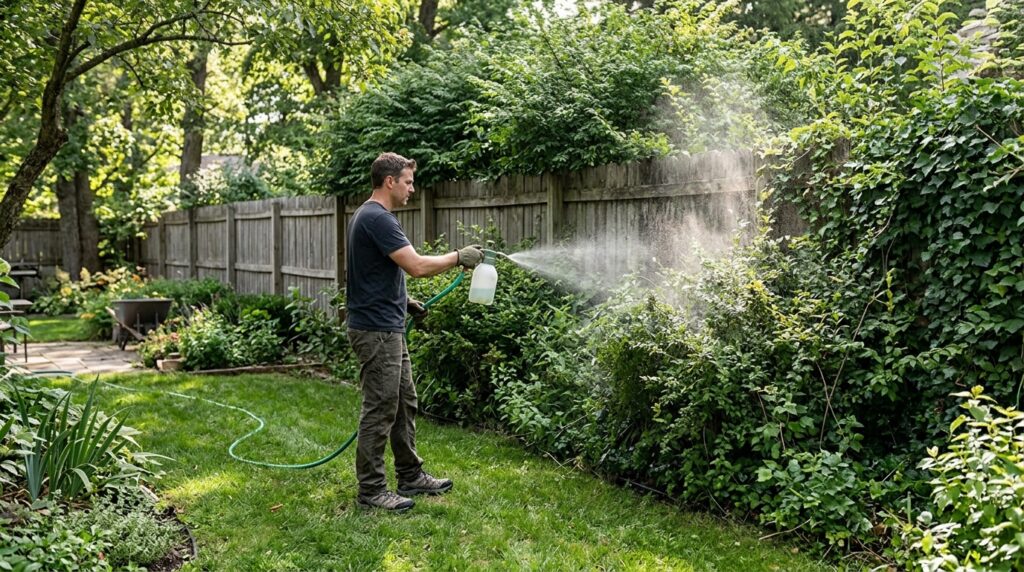
Spectracide Triazicide Insect Killer (hose-end sprayer)
One of the most effective and widely available permethrin-based yard sprays. Attach to a garden hose, spray the underside and exterior of shrubs, the base of the house, and all ground cover. Kills on contact and leaves a 6-week residual. Avoid spraying flowers in bloom (toxic to bees) and don’t spray near water features. Allow to dry completely before allowing children and pets back into the treated area.
Ortho Home Defense Insect Killer for Lawn and Landscape
Broad-spectrum permethrin spray available in a ready-to-spray hose-end attachment. Treats up to 5,300 sq ft per bottle. Apply to dense vegetation, the shaded base of the fence line, and ground cover beds.
When to spray:
- Early morning or evening — avoids peak heat (permethrin degrades faster in direct sunlight) and reduces impact on daytime pollinators
- Avoid spraying when rain is forecast within 24 hours — rain washes the residual away
- Focus on shaded, dense vegetation — this is where mosquitoes rest, not in open sunny areas
- Reapply every 3–4 weeks during peak season (June–September)
Step 4: Use a Mosquito Repellent Device for Outdoor Seating Areas
Yard sprays treat the whole yard but need reapplication. For the specific area where you spend time outdoors — a patio, deck, or seating area — a dedicated mosquito repellent device creates a protected zone without repeated spraying.
Thermacell Patio Shield Mosquito Repeller
Thermacell devices (the patio version, B07QKGK4FM, or the portable E55 model) use a butane-heated mat to vaporize allethrin — a synthetic pyrethroid — into the surrounding air. The repellent creates a 15-foot protected zone in calm to light wind conditions. No spray, no noise, no open flame. Rated by Consumer Reports and independent testing as one of the most effective personal area mosquito repellents available.
- Active ingredient: d-Allethrin (metofluthrin in some models)
- Coverage: 15-foot zone of protection
- Conditions: Most effective in calm air; loses effectiveness in wind above ~8 mph
- Runtime: ~12 hours per butane cartridge + mat set
- Best for: Patios, decks, and outdoor seating areas
Amazon: Thermacell Fuel-ZoneGuard Base Patio Shield Mosquito Repeller
Flowtron Electronic Insect Killer (bug zapper)
Bug zappers attract and electrocute insects using UV light. They are effective at killing large numbers of insects — but most of the insects they kill are moths and beetles, not mosquitoes. Multiple peer-reviewed studies have found that bug zappers kill very few mosquitoes relative to their total kill count. They are not recommended as a primary mosquito control tool. If you already own one, they’re fine as a secondary device; don’t buy one specifically for mosquito control.
CO2 mosquito traps
CO2 traps (like Dynatrap or Mega-Catch) attract mosquitoes by simulating human breath — CO2, heat, and sometimes UV light. They’re more effective than bug zappers at specifically targeting mosquitoes. Effectiveness varies significantly by placement, species mix, and yard size. Best used as a supplement to breeding site elimination and yard spray, not as a standalone solution. Entry price point is $100–$400, making them a significant investment for variable results.
Do Mosquito-Repelling Plants Actually Work?
Citronella, lavender, lemon balm, basil, and catnip are all marketed as mosquito-repelling plants. The honest answer: they have minimal effect as planted specimens. The compounds that repel mosquitoes (citronellal, linalool, etc.) need to be concentrated and applied to skin or released into the air at high density to be effective. A potted citronella plant on your patio provides very little actual protection.
Crushed leaves applied to skin? More effective — but this is essentially a folk version of plant-derived repellents. For real protection, use a DEET-based repellent (OFF! Deep Woods, 25–30% DEET) or picaridin (Sawyer Picaridin, B004O1DHLW) for skin application.
Amazon: DEET-based repellent (OFF! Deep Woods, 25–30% DEET) or picaridin (Sawyer Picaridin, B004O1DHLW)
When to Call a Mosquito Control Service
DIY yard mosquito control is effective for most residential properties when breeding sites are consistently eliminated and yard spray is applied regularly. Consider professional treatment when:
- Your property has a large water feature, pond, or drainage area that can’t be drained and is too large for DIY larvicide
- You’re in a wooded area with high regional mosquito pressure that isn’t driven by your property’s breeding sites
- You’re hosting an outdoor event and need guaranteed protection for a specific date
- You’ve completed 2–3 rounds of DIY treatment with minimal improvement
Professional mosquito services typically apply permethrin-based barrier sprays every 3 weeks during peak season, at $50–$100 per treatment for an average residential yard. The product used is usually the same as what you can buy as a hose-end spray — the difference is professional equipment (backpack sprayer with better coverage) and consistent scheduling.
Timing: When to Start and Stop Mosquito Control
Mosquito season varies significantly by region, but as a general guideline for the continental US:
- Start: When daytime temperatures consistently reach 50°F (10°C) — typically March–April in the South, May–June in the North
- Peak: June through August in most regions; year-round in Florida, coastal Texas, and the Gulf Coast
- Taper: September–October as temperatures drop; mosquito activity slows significantly below 50°F
Begin breeding site inspection in early spring before the first warm spell — this prevents the first generation of the season from establishing. Apply the first yard spray treatment when temperatures are consistently above 60°F and before you’ve seen your first adult mosquito of the season.
Safety Note
Permethrin is highly toxic to cats (they lack the enzyme to metabolize it) — do not apply permethrin sprays to areas your cat frequents, and keep cats indoors until the spray has dried completely (minimum 2 hours). Permethrin is also highly toxic to fish and aquatic invertebrates — do not spray near ponds, streams, or storm drains.
BTi (Mosquito Dunks) is safe for all wildlife including fish, birds, pets, and beneficial insects.
Thermacell allethrin is safe for humans and pets when used as directed outdoors. Do not use in enclosed spaces.
Frequently Asked Questions
What is the most effective mosquito yard treatment?
Eliminating standing water (breeding sites) is the single most effective action — it removes the next generation of mosquitoes before they hatch. Combined with a permethrin yard spray applied to resting vegetation and a Thermacell device for the seating area, this three-layer approach reduces mosquito presence by 70–90% in most residential yards. No single product alone matches this combined approach.
How long does yard mosquito spray last?
Permethrin-based yard sprays last approximately 3–6 weeks, depending on rain, sun exposure, and vegetation density. Reapply every 3–4 weeks during peak season (June–September). Heavy rain within 24 hours of application significantly reduces residual effectiveness.
Does spraying the yard for mosquitoes work?
Yes, when applied correctly to the right areas (shaded, dense vegetation where mosquitoes rest) and reapplied on schedule. Spraying open lawn areas in full sun is largely wasted — mosquitoes don’t rest there. The most common reason yard sprays seem ineffective is incorrect application area and missed breeding sites that continue producing new mosquitoes faster than the spray kills adults.
What kills mosquitoes immediately?
Direct contact with any pyrethroid spray (permethrin, bifenthrin, deltamethrin) kills mosquitoes within minutes. DEET-based or picaridin-based repellents don’t kill mosquitoes — they repel them. BTi kills larvae within 24–72 hours of ingestion. Thermacell repels mosquitoes from the protected zone but doesn’t kill them.
Will mosquitoes come back after yard treatment?
Yes — adult mosquitoes from outside your property can enter, and any unaddressed breeding sites on your property will continue producing new mosquitoes. Yard spray residual lasts 3–6 weeks; after that, new adult mosquitoes that emerge or enter are unaffected. Consistent reapplication every 3–4 weeks, combined with continuous breeding site elimination, is the maintenance approach that keeps pressure low through the season.
The Three-Layer Approach to a Mosquito-Free Yard
The framework that works: eliminate every standing water source on your property (this removes the breeding population), treat unavoidable water with BTi larvicide (this stops larvae from becoming adults), apply a permethrin yard spray to resting vegetation every 3–4 weeks (this reduces the adult population), and use a Thermacell device to protect your outdoor seating area (this creates a personal protection zone for the time you spend outdoors).
None of these steps alone eliminates mosquitoes. Together, they address the problem at every stage of the mosquito lifecycle — and that’s the only approach that produces a meaningful reduction in mosquito pressure through the season.
For mosquitoes inside your home, see our guide on how to get rid of mosquitoes inside the house. And if you’re looking for the best personal repellents, our post on what repels mosquitoes covers every option ranked by effectiveness.