
This post contains affiliate links. If you buy through our links, we may earn a commission at no extra cost to you.
Misidentifying your cockroach species is the #1 reason DIY treatments fail. Here’s how to tell German and American roaches apart — and why it matters for getting rid of them.
You found a cockroach. Now what?
Before you buy anything, open any cabinet, or call an exterminator, you need to answer one question: which species is it? Because German cockroaches and American cockroaches are treated completely differently — and a treatment optimized for one is often wasted on the other.
German cockroaches live inside, breed inside, and die inside. American cockroaches mostly live outside and wander in opportunistically. One is an infestation. The other is usually just a visitor.
Quick answer:
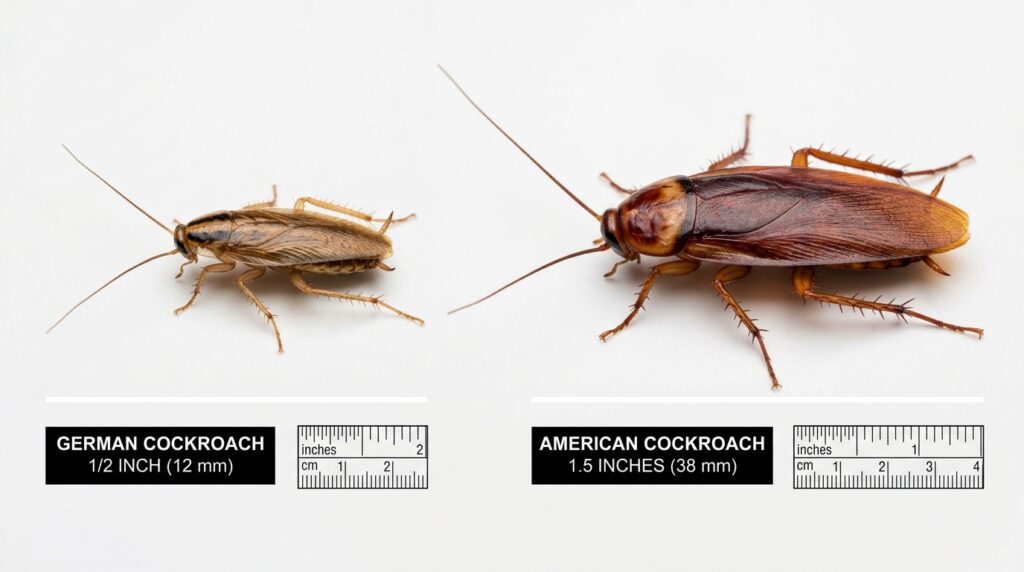
German cockroaches are small (1/2 inch), tan or light brown with two dark stripes on the pronotum (the shield behind the head), and are almost always found indoors — typically in kitchens and bathrooms. American cockroaches are large (1.5–2 inches), reddish-brown with a yellowish figure-8 marking behind the head, and are common in basements, drains, and sewers — usually seen indoors as single wanderers. If it’s small and in your kitchen, it’s almost certainly German. If it’s large and you found it in the basement or near a drain, it’s likely American.
Quick Comparison Table
German Cockroach (Blattella germanica)
- Size: 1/2 to 5/8 inch (13–16 mm)
- Color: Tan to light brown
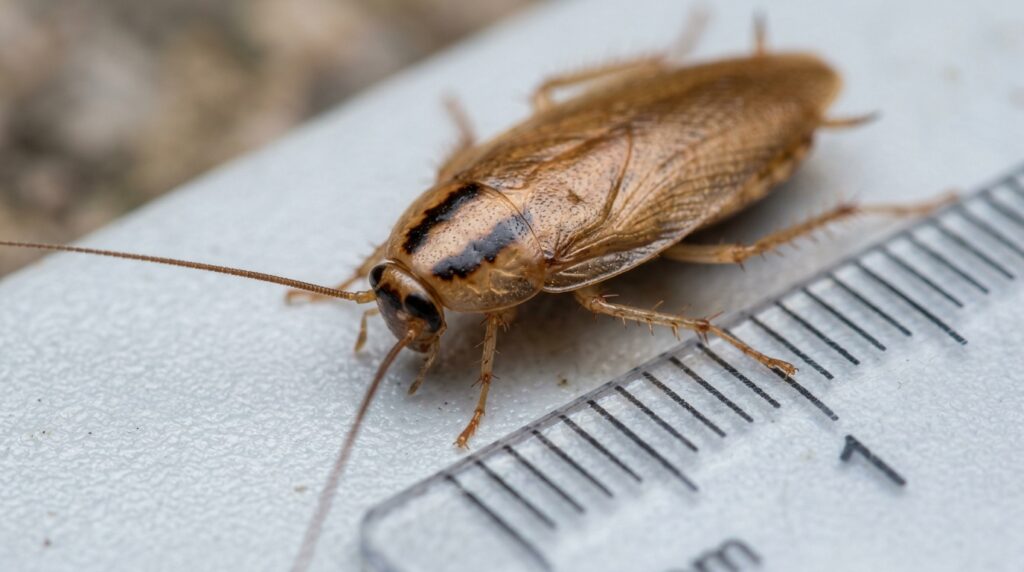
- Marking: Two dark parallel stripes on pronotum
- Wings: Has wings, rarely flies
- Where found: Kitchen, bathroom, indoors only
- Habitat: Warm, humid, near food and water
- Egg case (ootheca): Carries it until hatch — ~30–40 eggs
- Reproductive rate: Very high — can produce 300,000 offspring/year
- Treatment: Gel bait + IGR + boric acid (indoors)
American Cockroach (Periplaneta americana)
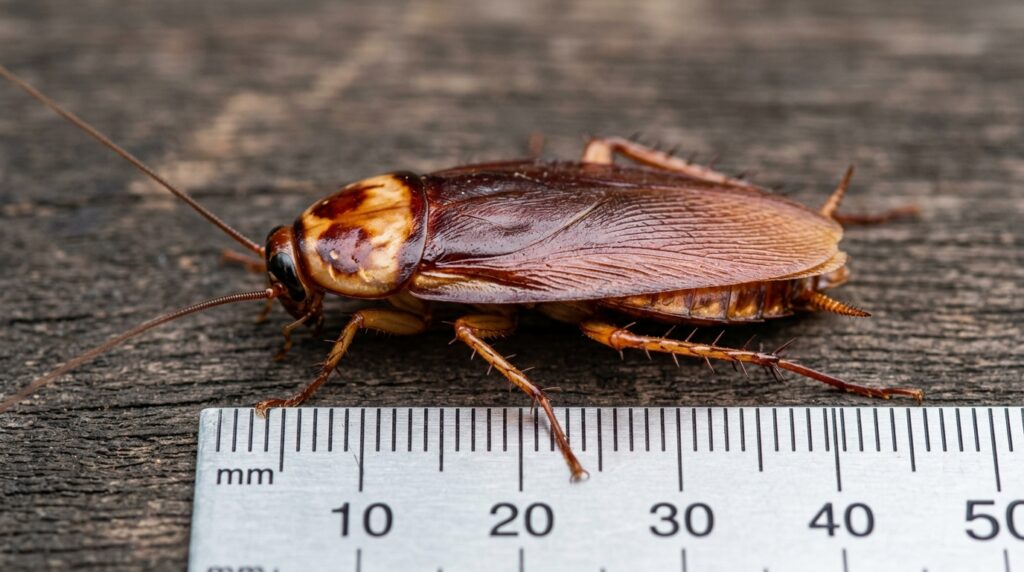
- Size: 1.5 to 2 inches (38–50 mm)
- Color: Reddish-brown
- Marking: Yellowish figure-8 or halo shape on pronotum
- Wings: Has wings, occasionally flies (especially in heat)
- Where found: Basements, drains, sewers, outdoors — wanderers indoors
- Habitat: Moist, dark, near sewers and drains
- Egg case (ootheca): Deposits it in sheltered locations — ~14–16 eggs
- Reproductive rate: Moderate — up to 150 offspring/year
- Treatment: Perimeter spray + drain treatment + exclusion
How to Tell Them Apart at a Glance
The single fastest way to tell the difference: size. If the cockroach you found is smaller than your thumbnail, it is almost certainly a German cockroach. If it is longer than your thumb, it is likely an American cockroach.
The German Cockroach
German cockroaches are the species most people in the US are dealing with when they have an “infestation.” They are:
- Small — adults are 1/2 to 5/8 inch, about the size of a large thumbnail
- Tan to light brown in color — not the dark reddish-brown of the American species
- Distinctively marked — two dark parallel stripes run from just behind the head (on the pronotum) down toward the thorax; this is the clearest single identifier
- Always found indoors — German cockroaches cannot survive outdoors in North American climates; they live exclusively in human structures
- Clustered near food and water — nearly always found in kitchens and bathrooms, often behind the refrigerator, inside cabinet hinges, or under the stove
German cockroaches do have wings, but they almost never fly. They run — fast. If you see one during the day, it usually means the harborage is overcrowded, which means a large population.
The American Cockroach
Despite the name, the American cockroach is not native to North America — it originated in Africa and arrived in the US via ships in the 1600s. It is now the largest cockroach species commonly found in US homes. They are:
- Large — adults are 1.5 to 2 inches, making them the most visually alarming cockroach you are likely to find
- Reddish-brown — darker and more saturated in color than German cockroaches
- Marked with a yellowish figure-8 or halo pattern on the pronotum — distinct from the two parallel stripes of the German species
- Primarily outdoor insects — American cockroaches prefer sewers, storm drains, moist soil, and wooded areas; they enter structures opportunistically through drains, gaps in the foundation, or open doors
- Occasional flyers — in warm weather (above 85°F), American cockroaches will occasionally fly short distances, which can make an encounter particularly alarming
When you find one American cockroach inside, it is usually a wanderer — it came in through a drain or a gap and is looking for food or water. A single sighting rarely indicates an established indoor infestation.
Where You Find Them Is the Second-Best Clue
Location is almost as reliable as visual identification:
German cockroach locations:
- Inside kitchen cabinets, especially hinges and corners
- Behind or under the refrigerator (attracted to the motor heat)
- Under the stove or inside the stove drawer
- Inside the motor compartment of the dishwasher
- Behind bathroom cabinet doors, under the sink
- Inside electrical outlet boxes on shared walls in apartments
American cockroach locations:
- Basements and crawl spaces
- Floor drains and sink drains (they travel through sewer systems)
- Near water heaters and utility rooms
- Garages
- Anywhere near standing water or high moisture
- Outdoors under mulch, in tree holes, under yard debris
If you found a large cockroach in your bathroom at night near the drain, it almost certainly came up from the sewer system — American cockroach. If you found small cockroaches clustered behind your refrigerator or inside a cabinet hinge — German cockroach infestation.
Lifecycle and Reproduction: Why German Roaches Are the Bigger Problem
The most important practical difference between these two species is reproductive rate, and this is why German cockroaches are considered the more serious pest.
German cockroach reproduction:
- Female carries her ootheca (egg case) attached to her body until just before hatching — this means she’s never far from the next generation
- Each ootheca contains 30–40 eggs
- A female can produce 4–8 oothecae in her lifetime
- Eggs hatch in 28 days; nymphs reach adulthood in 40–125 days
- One female and her offspring can theoretically produce 300,000 offspring in a year under ideal conditions
American cockroach reproduction:
- Female deposits the ootheca in a sheltered location and leaves it
- Each ootheca contains 14–16 eggs
- A female produces roughly 10 oothecae in her lifetime
- Population growth is much slower — roughly 150 offspring per female per year
The practical implication: a German cockroach population can explode from a handful of individuals to hundreds in a few weeks. An American cockroach “infestation” is usually just several individual wanderers, not a breeding colony inside the home.

Treatment: Why the Species Changes Everything
This is the most important section. Using the wrong treatment strategy is the primary reason people spend money and see no results.
If you have German cockroaches:
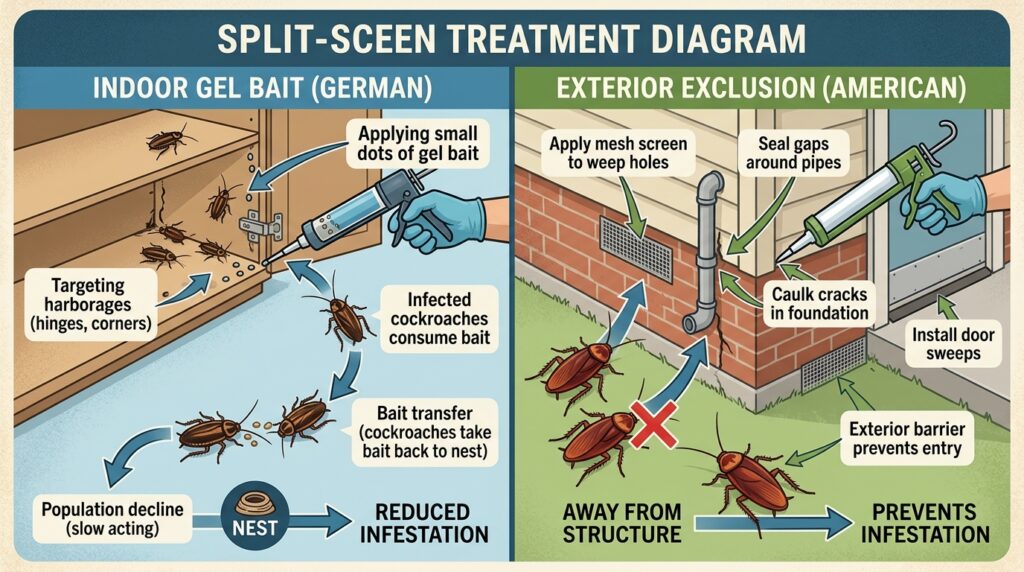
The priority is targeting the indoor harborage colony. Sprays scatter them and make the problem worse. The proven method is:
- Gel bait (Advion Cockroach Gel, B00AA8I29G) — applied in small pea-sized dots inside cabinet hinges, behind appliances, under the sink, and in any gap near the harborage. This is the backbone of treatment.
- Boric acid powder (Harris Boric Acid, B000BWF3GM) — applied as a very thin layer under the refrigerator motor and inside wall voids near plumbing. Kills on contact.
- IGR (Insect Growth Regulator, Gentrol IGR, B00AA8HUEY) — disrupts the reproductive cycle, preventing nymphs from reaching breeding age. Critical for breaking the population growth curve.
- Sealing — once the population is knocked down, seal all entry points with caulk to prevent re-introduction from neighboring units.
Full treatment timeline: 2–4 weeks to see major reduction, 6–8 weeks for complete elimination.
Amazon links:
Advion Gel: Syngenta 383920 Advion Cockroach Gel Bait 4 X 30 Gram Tubes Roach Control
Harris Boric Acid: HARRIS Boric Acid Roach and Silverfish Killer Powder w/Lure for Insects (16oz)
Gentrol IGR: ZOECON 619907 Gentrol IGR Concentrate Insect Growth Regulator, 16 oz
If you have American cockroaches:
The priority is exclusion and perimeter control — keeping them out, not chasing them inside. The approach is:
- Seal floor drains with drain covers or screens — American cockroaches commonly enter through the sewer system
- Caulk foundation gaps and any penetrations at grade level
- Apply a perimeter spray (Ortho Home Defense, available at home improvement stores) around the exterior base of the house, door frames, and garage entry points — this creates a barrier they won’t cross
- Boric acid along the perimeter of basements and utility rooms where they are found
- Address moisture — fix any standing water, high humidity areas, or dripping pipes in basements and crawl spaces
Gel bait indoors is less effective for American cockroaches because they are transient — they are not establishing a colony in your kitchen. The goal is to keep them from entering, not to bait an established population.
Other Cockroach Species You Might Encounter
There are a few other species that appear in US homes, though far less commonly:
Oriental cockroach (Blatta orientalis)
Dark brown to black, about 1 inch long, sluggish. Also called “water bugs.” Found in very damp areas — under sinks, in basements, near floor drains. Treated similarly to American cockroaches (moisture control + exclusion + perimeter barrier).
Brown-banded cockroach (Supella longipalpa)
Similar in size to German cockroach (~5/8 inch) but distinguished by two light tan or yellowish bands across the abdomen (the bands are horizontal, not stripes running lengthwise). Unlike German cockroaches, brown-banded roaches prefer drier areas and are found throughout the home — bedrooms, living rooms, behind picture frames. Treated similarly to German cockroaches (gel bait + IGR) but placed more broadly.
Smokybrown cockroach (Periplaneta fuliginosa)
Similar to American cockroach in size but uniformly dark brown with no markings. Common in the southeastern US. Primarily outdoor species; treatment same as American cockroach.
Frequently Asked Questions
Are German cockroaches worse than American cockroaches?
From a practical standpoint, yes. German cockroaches establish breeding colonies inside your home and reproduce at a rate American cockroaches cannot match. A German cockroach infestation gets worse without treatment. American cockroaches found indoors are usually wanderers from outside — the underlying problem is exclusion, not an established indoor colony.
Can American cockroaches infest a house?
Technically yes, but it’s uncommon in typical residential settings. American cockroaches prefer sewer systems and moist outdoor environments. When they appear inside in large numbers repeatedly, the usual cause is a major structural moisture issue (flooded crawl space, broken sewer line) rather than a standard indoor infestation. Single sightings are almost always individual wanderers.
Do German cockroaches come from outside?
Rarely. German cockroaches are almost exclusively introduced through human activity — groceries, cardboard boxes, used appliances, or movement between infested apartments. They cannot survive North American outdoor winters and have no established outdoor population. If you have them, something brought them in.
Why do I only find one large cockroach at a time?
Large cockroaches found one at a time are almost always American cockroaches (or Oriental cockroaches) that have wandered in from outside. German cockroaches are rarely seen individually — they cluster in harborage areas and venture out to feed, usually at night. Seeing single large cockroaches is a different problem than seeing multiple small cockroaches.
Is it safe to use gel bait if I have pets?
Gel bait products like Advion are low-toxicity when used correctly (small pea-sized dots placed inside cabinets and hinges, not in open areas). The bait attracts cockroaches specifically and is not palatable to most pets in the quantities used. Keep pets away from the application areas while the gel is fresh. For households with dogs that might investigate under appliances, placing bait inside child-resistant bait stations adds a layer of protection.
The Verdict: Identify First, Treat Second
The mistake most people make is buying the first product they find and applying it without knowing which species they have. German cockroaches and American cockroaches require fundamentally different approaches — indoor baiting vs. exterior exclusion — and the wrong approach is both a waste of money and an opportunity cost while the actual problem gets worse.
Take 30 seconds to identify: small + tan + two dark stripes = German cockroach, treat indoors with gel bait. Large + reddish-brown + figure-8 marking = American cockroach, focus on exclusion and perimeter control.
For the complete treatment guide for German cockroaches, see our step-by-step post on how to get rid of cockroaches in your home. And if you found roaches despite keeping a clean home, our guide on why you have roaches in a clean house covers the most overlooked causes.