
This post contains affiliate links. If you buy through our links, we may earn a commission at no extra cost to you.
Got rats? This guide walks you through how to find them, trap them, and seal your home so they don’t come back — no exterminator needed.
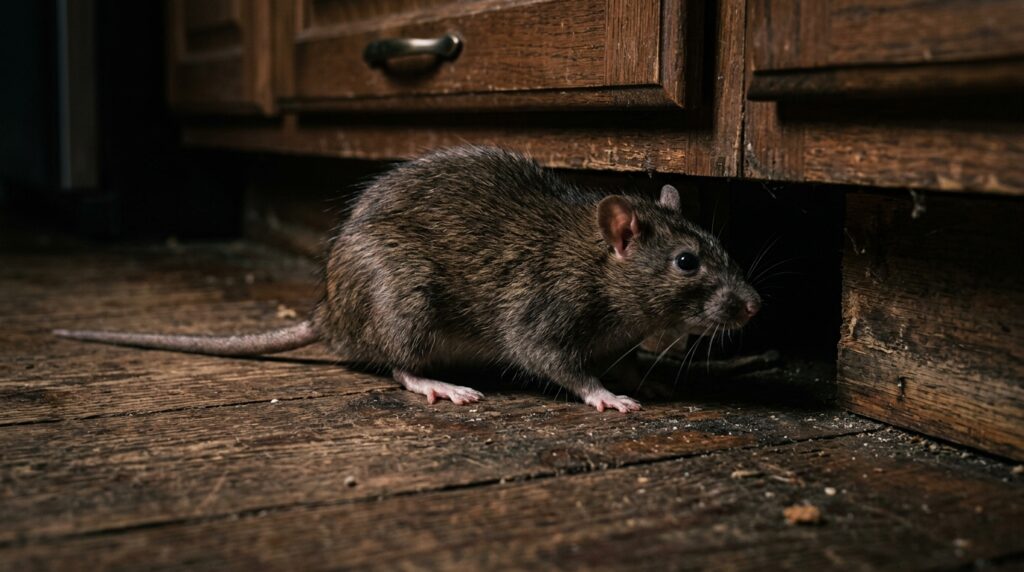
You didn’t see it at first. Maybe it was a noise in the wall late at night, or something knocked off the counter while you slept. Then came the droppings — small, dark, and unmistakable.
Rats are not a minor inconvenience. They gnaw through wiring, contaminate food, and reproduce fast. A pair of rats can produce up to 40 offspring in a year. The sooner you act, the less damage you’re dealing with.
Here’s how to get rid of rats in your house — starting today, without hiring an exterminator.
Quick answer:
The fastest way to get rid of rats is snap traps baited with peanut butter, placed along walls where you’ve seen droppings or activity. Set multiple traps in parallel, check daily, and seal entry points only after the catch rate drops to zero — sealing too early traps rats inside.
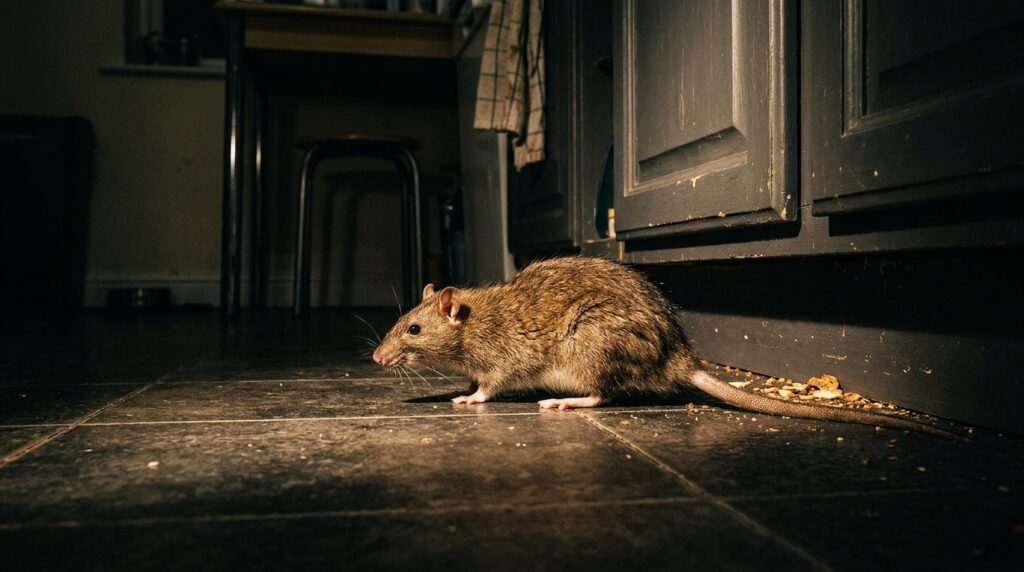
Step 1: Identify the Type of Rat You’re Dealing With
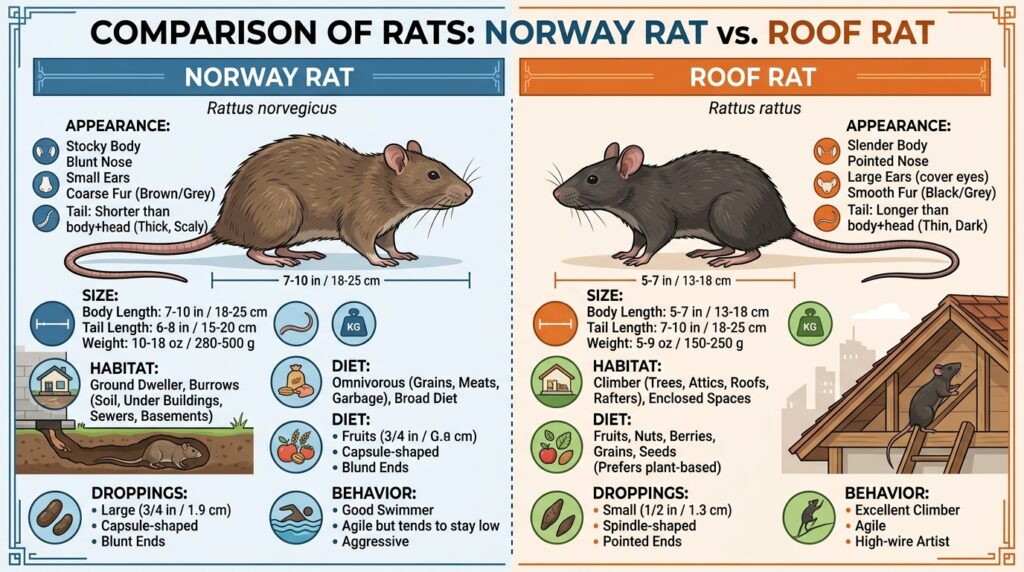
Most homeowners in the US are dealing with one of two species — and they behave very differently.
Norway Rat (Brown Rat)
- Large, heavy body — 7 to 9.5 inches, plus tail
- Blunt snout, small ears, short tail (shorter than body)
- Lives at ground level: burrows under concrete, in crawlspaces, along foundations, in basements
- Most common species in the US
Roof Rat (Black Rat)
- Slender, smaller body — 6 to 8 inches, plus a tail longer than the body
- Pointed snout, large ears, long thin tail
- Climbs: lives in attics, upper walls, trees, and rafters
- More common in Southern states and coastal cities
Why does it matter? Norway rats are found low — under the sink, behind appliances, in the basement. Roof rats are found high — attic, ceiling, upper walls. Trap and seal accordingly.
Step 2: Find Where They’re Active
Don’t guess. Rats follow the same routes every night, and those routes leave evidence. Here’s what to look for:
Droppings
Rat droppings are 1/2 to 3/4 inch long, dark brown, with pointed ends. Fresh droppings are soft and shiny. Old droppings are dry and crumbly. The more droppings, the heavier the activity.
Grease marks (rub marks)
Rats have oily fur. They run along the same paths repeatedly, leaving dark smear marks on walls, baseboards, and pipes. Look especially at corners and where the wall meets the floor.
Gnaw marks
Look for chewed wood, plastic, or even metal. Rats can chew through aluminum and some soft metals. Fresh gnaw marks are light-colored; older marks darken over time.
Burrows
Norway rats dig burrows 2–3 inches in diameter, often along the base of walls, under concrete slabs, or in garden beds near the house.
Tracks
Sprinkle a light layer of flour or baby powder near suspected areas. Come back in 12 hours and look for footprints. Rat tracks show four-toed front feet and five-toed back feet.
Mark every active spot on a simple sketch or photo of your floor plan. This tells you where to place traps — and later, where to seal.
Step 3: Set Traps — The Right Way
Trapping is the fastest and most effective method for indoor rat elimination. Poison bait stations work, but they create a secondary problem: rats often die inside walls, causing a dead-rat odor that can last weeks. Traps give you immediate confirmation and no hidden carcasses.
Which trap to use
Snap traps (best for most situations)
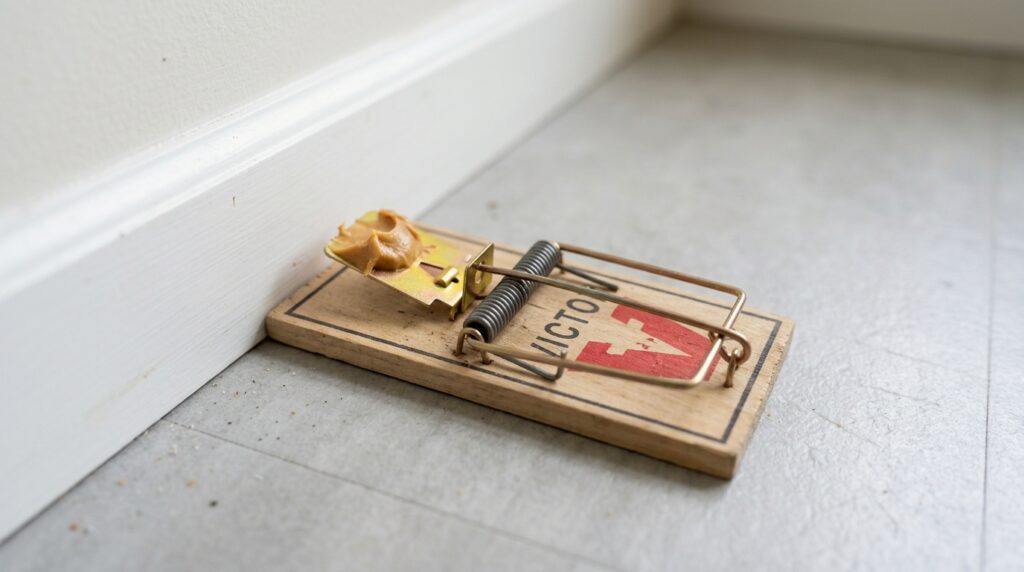
The Victor Rat Snap Trap (B000VWKK5A) is the benchmark. Large, strong, fast kill. Place them perpendicular to the wall, with the trigger end against the baseboard. Rats run along walls, not through the middle of a room.
Amazon link: Victor Wide Pedal Snap Rat Traps, 9-Pack, FSC Certified Wood
Electronic traps (fast, hands-free disposal)
The Victor Electronic Rat Trap (B00007JFIS) kills on contact with a high-voltage shock. No mess, no visible carcass when you open the lid. More expensive per unit, but effective and reusable. Good choice if you’re squeamish about traditional snap traps.
Amazon link: Victor Electronic Rat Trap 1-Pack, Indoor Humane Electric Rodent Killer
Glue boards (last resort)
Catchmaster Heavy Duty Rat Glue Boards (B07PHPNXL8) catch rats but don’t kill them quickly. Use only if snap traps aren’t practical. Not recommended as primary method.
Bait that works
- Peanut butter — best all-around bait. Use a pea-sized amount. Too much and the rat licks it off without triggering the trap.
- Chocolate or hazelnut spread — works well when rats have learned to avoid peanut butter
- Nesting material — a small piece of cotton or dental floss tied to the trigger. Rats are attracted to soft materials for nesting.
- Dry pet food — effective and easy
Do not use cheese. It’s a myth — cheese is not particularly attractive to rats and it spoils quickly.
Trap placement rules
- Place traps perpendicular to walls, trigger end against the baseboard
- Set multiple traps in each active area — rats are neophobic (fearful of new objects) but repeated exposure builds confidence
- Use at least 6–12 traps for an active infestation. More traps = faster resolution.
- For roof rats: place traps on shelves, ledges, pipes, or in the attic on floor joists
- Wear gloves when handling traps — reducing human scent increases catch rates
Check traps every 24 hours. Remove dead rats promptly (double-bag in plastic). Reset and rebait.
Step 4: Should You Use Rat Poison?
Rodenticide bait stations are effective — but they come with significant trade-offs indoors.
The case for rodenticide
- Works passively — no daily checking
- Effective for large infestations or outdoor perimeters
- Tomcat Rat Bait Station (B000VD5MNO) is a tamper-resistant option widely available
Amazon link: Tomcat Rat & Mouse Bait Station, 2 Packages Each with 1 Station & 15 Baits
The case against rodenticide indoors
- Rats die inside walls, under floorboards, or in hard-to-reach spaces — the odor of a decomposing rat can last 1–3 weeks
- Secondary poisoning risk: if a cat, dog, or owl eats a poisoned rat, the animal absorbs the toxin
- No confirmation of success — you don’t know if rats are eliminated or just hiding
Bottom line:
For indoor use, snap traps are the better default. Use rodenticide only for outdoor perimeter control — bait stations placed along the exterior foundation, away from children and pets.
Safety Note: Protecting Pets and Children
If you have pets or small children, place all traps and bait stations inside tamper-resistant bait boxes, inside closed cabinets, or behind appliances where pets and kids can’t reach. Keep this in mind:
- Standard snap traps can injure a dog’s or cat’s paw — use enclosed snap trap stations if pets have access to trap areas
- Rodenticide is toxic to dogs and cats — if you use it outdoors, use only tamper-resistant stations secured to the ground
- If you suspect a pet has ingested rodenticide, call the ASPCA Animal Poison Control Center: (888) 426-4435
Step 5: Seal Every Entry Point (After Trapping)
This is the step most people skip — and why rats keep coming back.
Critical rule: seal entry points AFTER your catch rate drops to zero. If you seal while rats are still active inside, you trap them in — and then deal with decomposing rats in your walls. Trap first. Seal after.
What size gap can rats fit through?
A rat can squeeze through a hole the size of a quarter (about 1/2 inch). If your thumb fits, a rat fits.
Where to seal
- Foundation gaps and cracks — use concrete patch or hydraulic cement
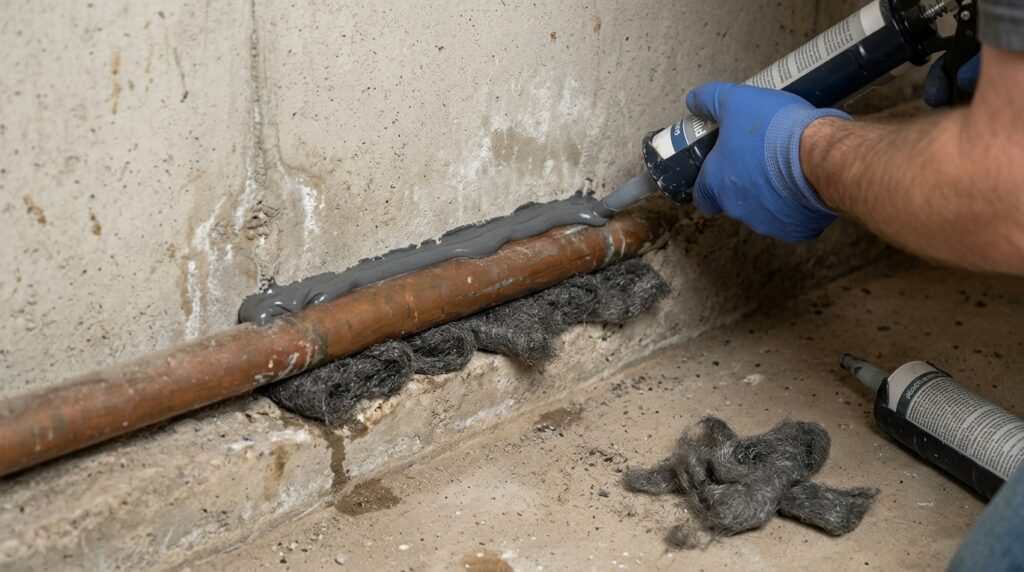
- Utility penetrations (pipes, conduit, cables entering the house) — use steel wool packed tightly, then seal with caulk or foam over the steel wool
- Under doors — install door sweeps on all exterior doors
- Roof line gaps, soffit and fascia — seal with metal flashing or hardware cloth
- Gaps around dryer vents, HVAC, and A/C lines
- Crawlspace vents — cover with 1/4-inch hardware cloth (galvanized)
What to use for sealing
Steel wool / Xcluder copper mesh
Rats cannot chew through tightly packed steel or copper mesh. Use Xcluder Rodent Control Fill Fabric (B001D2IBNQ) for large gaps — stuff it in, then cover with caulk or cement.
Hardware cloth (1/4-inch galvanized)
For vents and larger openings — cut to size and secure with screws or staples.
Hydraulic cement
Best for foundation cracks and gaps around pipes entering through concrete. Expands as it sets, creating a rock-hard seal rats can’t gnaw through.
Do NOT use expanding foam alone. Rats gnaw through foam within hours. It’s useful only as a backing material before applying a physical barrier.
Step 6: Remove What’s Attracting Them
Trapping and sealing handle the immediate problem. Eliminating attractants reduces the chance of reinfestation.
Food and water sources
- Store all food in hard-sided containers — glass, metal, or thick plastic. Rats gnaw through cardboard and thin plastic bags overnight.
- Secure pet food: don’t leave bowls out at night. Store in sealed containers.
- Fix leaky pipes, dripping faucets, and A/C condensation drains — rats need water daily
- Bird feeders attract rats. Move them away from the house, or switch to feeders with baffles.
Harborage
- Firewood stacked against the house is a rat hotel. Move it 20 feet from the foundation, elevated off the ground.
- Dense shrubs, ivy, and ground cover against the foundation provide cover. Keep an 18-inch clear gravel border.
- Clutter in the garage, basement, and attic gives rats nesting spots. Declutter and store items in sealed bins.
Step 7: Know When to Call a Professional
DIY works for most rat situations. Consider calling a licensed pest control company if:
- You’ve set 12+ traps and are catching rats daily for more than 2 weeks — suggests a large population or multiple entry colonies
- You hear rats in the walls but can’t locate entry points — a pro has thermal cameras and inspection scopes
- You have a crawlspace or attic infestation with structural damage — gnawed wiring is a fire hazard that needs professional assessment
- Rats are returning despite sealing — the entry point is in an area you’re not reaching
Average professional rat extermination cost: $200–$600 for a full treatment, depending on infestation size and number of visits.
Frequently Asked Questions
How long does it take to get rid of rats?
Most infestations are resolved in 1–3 weeks with consistent trapping. Larger infestations can take 4–6 weeks. The key variable is how many traps you set and how quickly you seal entry points after catch rates drop.
Can rats come back after I seal the house?
Yes, if there are other entry points you missed, or if new damage opens up over time. Inspect the exterior annually — late summer is ideal, before cold weather drives rats to seek shelter indoors.
Do rats in walls mean I have a big infestation?
Not necessarily. Rats explore, and a single rat can cause scratching sounds that seem like many. Set flour tests near suspected locations to gauge actual activity levels before assuming the worst.
What’s the difference between getting rid of rats vs. mice?
Rats are much larger and stronger than mice — they require larger traps, heavier gauge exclusion materials, and more substantial entry point sealing. The behavior is similar (wall-running, neophobia, nesting), but the scale of intervention is bigger. Check our guide on how to get rid of mice for the mouse-specific approach.
Is rat poison safe to use inside the house?
Not recommended for indoor use. Rats that ingest rodenticide typically die in inaccessible areas — inside walls, under flooring — creating decomposition odor for weeks. Use snap traps indoors and reserve bait stations for outdoor perimeter control.
The Fastest Path to a Rat-Free House
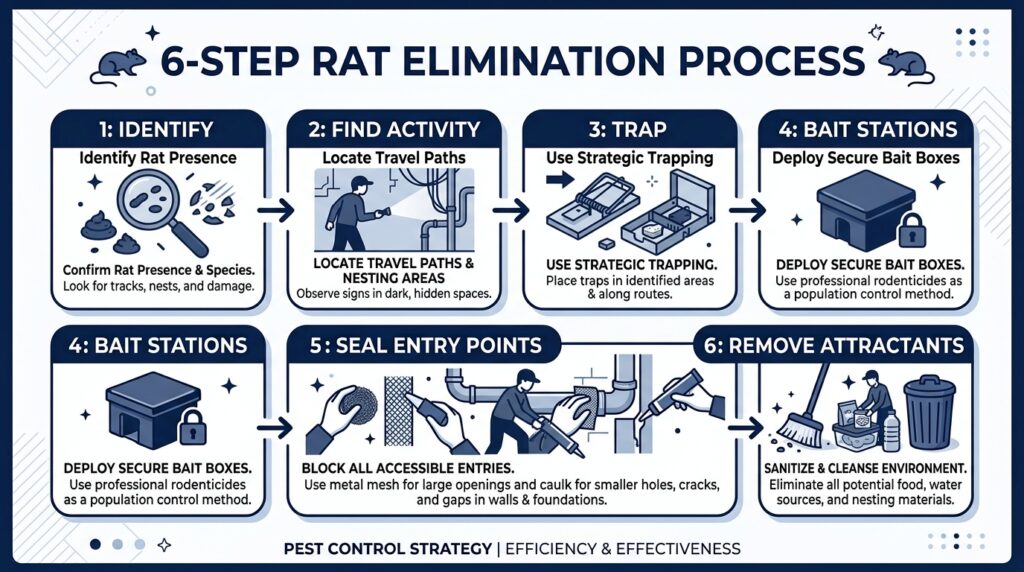
Rats are a serious problem, but they’re a solvable one. The combination that works: multiple snap traps in active areas, checked daily, baited with peanut butter. Then seal every entry point — but only after your traps stop catching.
Skip the poison indoors. Skip the plug-in ultrasonic repellers (they don’t work). Skip peppermint oil. Use proven mechanical methods, stay consistent for two to three weeks, and you’ll resolve most infestations without ever calling an exterminator.
If mice are also an issue at your place, our guide on how to get rid of mice covers the complete mouse elimination process. For keeping rodents out permanently, check out our mouse-proofing checklist — most of the sealing principles apply equally to rats.